

Power to Release (5:17–26)
Jesus has returned from the wilderness “in the power of the Spirit” (4:14). He then stood in the Nazareth synagogue and read Isaiah’s promise of a Spirit-anointed deliverer who proclaims ἄφεσις (aphesis), release, to the captives and the oppressed (4:18). Now, in a crowded house in Capernaum, Luke interrupts his narrative to note something neither Matthew nor Mark records:
“the power of the Lord was with him to heal” (5:17).
The word for “power” is δύναμις (dynamis), the same term Luke used when Jesus returned from the Jordan. What began in the wilderness and was announced in the synagogue has now arrived at this house in Capernaum.
Some men bring a paralyzed friend to see Jesus. Finding the door blocked by the crowd, they climb onto the roof, open it, and lower their friend on his mat to the floor in front of Jesus (5:18–19). Luke says Jesus “saw their faith,” the friends’ as much as the paralyzed man’s own, and answers their unspoken request, saying, “Man, your sins are forgiven you” (5:20).
The verb translated “are forgiven” is ἀφέωνται (apheōntai), a perfect passive meaning “have been released.” It shares its root with aphesis, the word Jesus used twice in the Nazareth reading. Jesus does not repeat his Nazareth announcement in this house. He performs it.
The scribes react immediately to what Jesus has just said.
“Who can forgive sins but God alone?” (5:21).
They are asking the right question, but in the wrong spirit. Jesus does not argue the theology. He asks which is easier to announce: forgiveness of sins or a command to walk (5:23). Then he gives the command. The man stands, picks up the mat that had carried him, and walks home carrying it instead (5:24–25). Forgiveness could not be checked, but his legs could. Luke lets the visible miracle certify the invisible one, and lets both testify to the same dynamis at work since the Jordan. The power to forgive sins and the power to restore creatures and creation are not separate, as if one was more important than the other. They are rather two sides of the same coin, and both are present when the power of the Lord is at work in the world.
Broken and Sent (5:1–11)
Isaiah’s vision of the divine throne room is one of the most arresting scenes in the Hebrew Bible. The Lord is seated, high and lifted up. His train fills the temple. Seraphim cover their faces in his presence. The foundations shake. And Isaiah, confronted with holiness, collapses into confession:
“Woe is me! For I am lost; for I am a man of unclean lips, and I dwell in the midst of a people of unclean lips; for my eyes have seen the King, the LORD of hosts!” (Isa 6:5).
Isaiah’s confession is the precondition for the commission that follows. A seraph touches his lips with a coal from the altar, declares his guilt taken away, and only then does the divine call go out: “Whom shall I send?” Isaiah, undone and reconstituted, answers: “Here I am! Send me” (6:8).
Luke 5:1–11 follows a similar pattern. Jesus borrows Simon’s boat to teach the crowd from the water. When he finishes, he tells Simon to put out into the deep and let down the nets. Simon protests — they have fished all night and caught nothing — but at Jesus’ word, he complies. The catch is so large that the nets begin to tear, and the boats begin to sink. What happens next is the interpretive key to the whole scene.
When Simon Peter saw it, he fell down at Jesus’ knees, saying, “Depart from me, for I am a sinful man, O Lord.” For he and all who were with him were astonished at the catch of fish that they had taken (5:8–9).
The miraculous catch is not, primarily, a demonstration of power. It is a theophany. Simon recognizes — in a moment of overwhelming, inexplicable abundance — that something of divine holiness is standing in the boat with him. “Depart from me” is not polite deference. It is the instinct of a man who has seen enough to know that he should not be this close to what he is looking at.
And as with Isaiah, the commission follows the confession. “Do not be afraid,” Jesus says, “from now on you will be catching men” (5:10). The Greek word Luke uses here, ζωγρῶν (zōgrōn), is striking. It means not merely to catch but to take alive, to capture for life. It appears in the LXX in military contexts, where enemies are taken captive rather than killed. What Simon is being conscripted into is not a fishing expedition with a different quarry. It is the mission of the living God gathering people into life.
Much of this scene does not appear in Mark or Matthew. Their versions of the call are a summons from the shoreline — spare, immediate, no miraculous catch, no kneeling, no confession. Luke has deliberately shaped this scene along the contours of prophetic call narratives with Isaiah 6 as the closest structural parallel. The sequence is the same: the divine breaks in, the witness is undone by the encounter, and confession precedes commission.
It would do us well to let our encounters with God leave us undone. We can become so used to the regular rhythms of the Christian life that even things as incredible as the sacraments can cease to wow us and leave us in awe. But that doesn’t mean they are any less awesome. When we are undone, then we can be made whole. When we are broken, we can be rebuilt—not in our image, but in Christ’s. So many of us want to be sent. We want to be used and commissioned by God for a greater purpose. But that starts with being broken, and most people would rather skip right past that fundamental step.
The Old Is Good? (5:33–39)
The question that the Pharisees and their scribes raise in 5:33 is a valid one. John’s disciples fast and pray; so do theirs. Why don’t Jesus’s disciples do the same? The contrast is not driven by hostility but by real curiosity about a familiar religious practice.
Jesus responds with three comparisons. Wedding guests don’t fast while the bridegroom is with them. New cloth doesn’t patch old garments. New wine doesn’t go into old wineskins. All these illustrate the same core idea: something truly new has arrived, and new things need new containers or practices.
But then Luke includes a saying that Matthew and Mark omit.
“No one after drinking old wine desires new, for he says, ‘The old is good’” (Luke 5:39).
The word translated as “good” is χρηστός (chrēstos), a term with a sensory aspect: pleasant, agreeable, easy to enjoy. The old wine isn’t just acceptable; it is truly satisfying.
A Greek speaker would have perceived a closer similarity in that word. By the Koine period, due to the vowel shift known as iotacism, χρηστός (chrēstos) and Χριστός (Christos) had become nearly indistinguishable in pronunciation. Suetonius, writing about disturbances among Jews in Rome under Claudius, almost certainly garbles the name of Christ as “Chrestus” precisely because the two words sounded alike to outsiders.
Whether or not Luke is intentionally crafting a pun, any Greek-speaking reader would sense the significance: the very word used to praise the old inadvertently describes what is being rejected. The wine of Israel’s long tradition is chrēstos, good and satisfying. But among them stands the Christos, the Anointed, whom they are not yet ready to desire.
Luke is approaching this with pastoral care. The final verse acts as a serious warning: those who have committed to older movements tend to stick with what they know because it genuinely benefits them. The Pharisees in v. 33 are rooted in a tradition of true piety. Fasting, prayer, and Torah observance: these are not empty rituals but practices that have sustained Israel’s relationship with God for generations. The issue isn’t that the old ways were bad. The issue is that the new has come, and those who have deeply embraced the old will need time before the new becomes appealing.
Where in your own life has something genuinely good made it difficult to recognize something better? The one standing before the Pharisees is not just chrēstos but Christos, and what he is asking is whether you are ready to reach for a new cup.
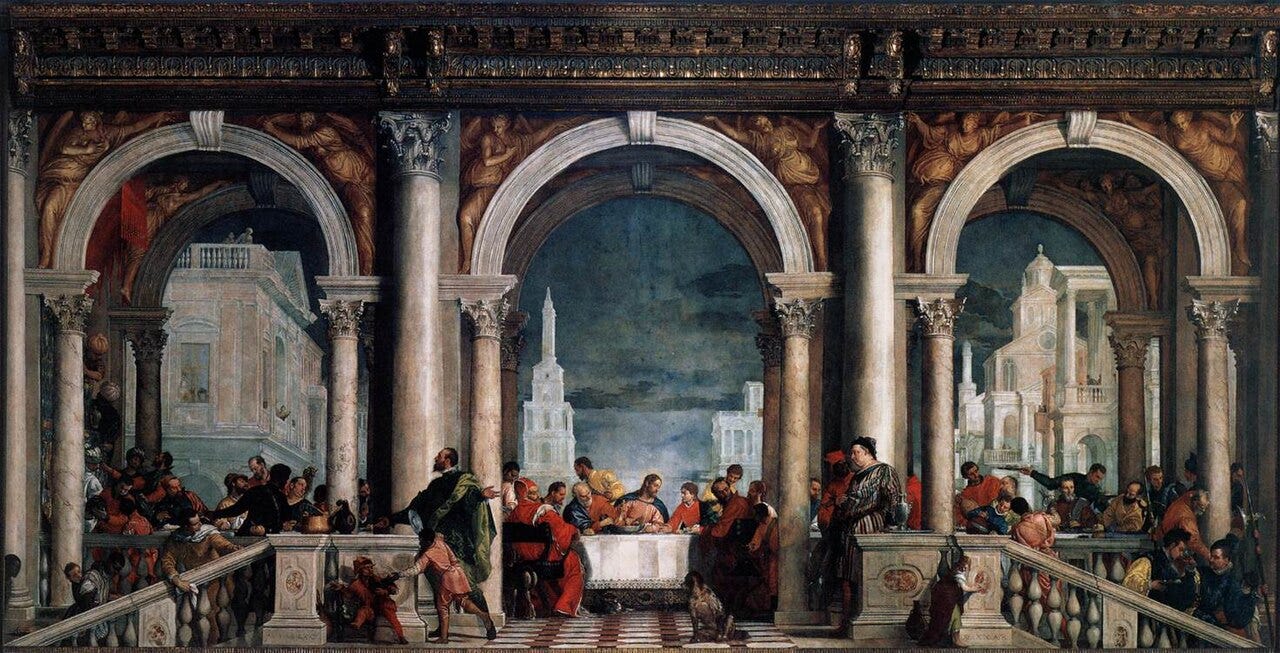
Veronese painted the above image as a Last Supper, was hauled before the Inquisition for filling it with “buffoons, drunken Germans, and dwarfs,” and rather than alter a single figure, changed the title to Feast in the House of Levi. The painting even carries an inscription referencing Luke 5 across the top of the pillars. That backstory is its own small sermon on resistance to authority over what a sacred meal should look like.
I was struck by this part this morning:
“ 4 And when he had finished speaking, he said to Simon, “Put out into the deep and let down your nets for a catch.” 5 And Simon answered, “Master, we toiled all night and took nothing! But at your word I will let down the nets.”
How often have we toiled to overcome some sin or resolve some situation only to have the Lord say to do something that seems fruitless and redundant! May I be like Peter and answer “But at your word!”
I am reminded of the expression “familiarity breeds contempt.” As you mentioned, we can allow the every day rhythms of life make the extraordinary seem ordinary. Yet when brokenness breaks in, we have no where to go but to God!
When my late husband took his own life in 2016, my life felt broken beyond repair. I clung to God in a way I cannot even express. He became more real to me in the every day moments of life — and it’s the time in my life I felt I experienced His guidance, love, and protection the most.