

What a Ghost Cannot Do (24:36–43)
The two on the way to Emmaus had just finished telling the Eleven how they had met Jesus on the road, and suddenly he was standing in the room. The reaction is not relief:
“They were startled and frightened and thought they saw a spirit” (24:37).
Jesus addresses their fear directly.
“Why are you troubled, and why do doubts arise in your hearts? See my hands and my feet, that it is I myself. Touch me, and see. For a spirit does not have flesh and bones as you see that I have” (24:38–39).
“Flesh and bones” is not an odd way to describe a body. It is the oldest way. When Adam first saw the woman, he said, “This at last is bone of my bones and flesh of my flesh” (Gen 2:23).
The disciples still do not move past wonder into ordinary belief.
“And while they still disbelieved for joy and were marveling, he said to them, ‘Have you anything here to eat?’” (24:41).
Luke describes their feelings in an incredibly revealing way. They are not doubting in the usual sense. They are experiencing joy that is too large to trust so easily. And Jesus does not argue with them to move them to certainty. Instead, he asks for dinner.
“They gave him a piece of broiled fish, and he took it and ate before them” (24:42–43).
This is the proof. A spirit cannot be touched, and a spirit does not eat. Jesus does both.
One of the major points of this scene, among others, is to make clear what the Apostles meant when they said that Jesus rose from the dead. They didn’t mean that this spirit was alive and among them. They didn’t mean that he was dwelling in their hearts. They didn’t even mean that he had ascended spiritually. They meant that he was raised from the dead bodily, with a body at least somewhat like ours, in that it can eat and drink. People can deny that Jesus rose from the dead. What should be indisputable is the precise claim the Apostles were making.
Years later, Peter will stand in a Roman household and explain exactly what qualified the apostles to say what they said. Peter tells Cornelius that God raised Jesus on the third day and made him to appear “not to all the people but to us who had been chosen by God as witnesses, who ate and drank with him after he rose from the dead” (Acts 10:40–41). Peter is describing (at least in part) this scene, this fish, and this room. Peter claim is not that they saw a vision of Jesus or felt his presence. He says they ate and drank with him.
The Last Blessing (24:44–53)
Jesus tells the eleven that everything written about him in the Law of Moses, the Prophets, and the Psalms had to be fulfilled (24:44). Then he opens their minds to understand the Scriptures (24:45). Not a new revelation, but a new reading, the same books they had heard numerous times before, now read with Jesus himself as the key.
What was written, he says, is this:
Thus it is written, that the Christ should suffer and on the third day rise from the dead, and that repentance for the forgiveness of sins should be proclaimed in his name to all nations, beginning from Jerusalem (24:46–47).
Israel’s story was never only for Israel. The servant who bears Israel’s guilt is also given as a light to the nations, and that purpose now becomes the shape of the church’s mission. The eleven are witnesses to this (24:48), and before Jesus sends them anywhere, he promises them power from on high (24:49). Wait first. Then go.
Luke narrates the ascension in a single sentence, and the detail he includes is deliberate:
And he led them out as far as Bethany, and lifting up his hands he blessed them. While he blessed them, he parted from them and was carried up into heaven (24:50–51).
Lifting the hands to bless was a priestly act before it was Jesus’ act. When Aaron finished the sacrifices on the day of his ordination, “he lifted up his hands toward the people and blessed them” (Lev 9:22). Centuries later, the high priest Simon would do the same after completing the temple service, coming out before the assembly to raise his hands and bless the people (Sir 50:20). The sacrifice is finished. The priest comes out. He lifts his hands. He blesses.
Jesus does not stop being a priest when he ceases to be bodily present. Aaron finished his service and stepped down from the altar. Jesus finishes his and is carried up, mid-blessing, into heaven. Luke never narrates the blessing’s ending. It simply continues, out of sight.
And they worshiped him and returned to Jerusalem with great joy, and were in the temple continually, blessing God (24:52–53).
Luke’s Gospel opens with a priest struck silent in the temple, unable to speak the blessing the people outside were waiting for (1:21–22). It closes with the disciples in that same temple, freely blessing God, because they have just been blessed by a greater priest whose blessing never stopped.
We are not waiting for the blessing to resume. We are living inside it. Our task is not to stand and stare at the place he left, but to go, in the power he promised, and hand on what we have just received. Hands lifted, not lowered.
Why Do You Seek the Living Among the Dead? (24:1–12)
The question the angels asked at the empty tomb wasn’t just for the women who brought spices. It’s a question for every reader of this Gospel:
“Why do you seek the living among the dead? He is not here, but has risen” (Luke 24:5–6).
Why are we still searching for life in people, places, and pleasures that we know are metaphorical graveyards? Why do we continue to live as if death is the final destination?
The declaration spoken by the angels is the thunderclap at the heart of human history, the sunrise breaking over the dark night of sin and death. If they are true—and they are—nothing can ever be the same again.
The women arrived early in the morning, expecting silence, stillness, and the chill of stone. They were doing what anyone would do: honoring the dead. What they found instead was the stone rolled away, the body gone, and a stunning message from heaven.
The question echoes all the way back to the first garden, where God walked among his people and called out to a man hiding in the shadows: “Where are you?” (Gen 3:9). Now, in another garden near a tomb (John 19:41), God calls again through his angels: why are you looking for the one who is life itself in the place where only death reigns?
The women were terrified, but the angels instructed them to remember what Jesus had said—that he must suffer, die, and rise on the third day (Luke 24:6–7). The grave is not the end. Death has lost its sting. The tomb has been left behind.
God did not abandon his Holy One to the grave. The sacrifice was accepted. The curse is lifted. Peter declared this without hesitation before a Roman household:
“They put him to death by hanging him on a tree, but God raised him on the third day. And he commanded us to preach to the people and to testify that he is the one appointed by God to be judge of the living and the dead. To him all the prophets bear witness that everyone who believes in him receives forgiveness of sins through his name.” (Acts 10:39–43)
The resurrection is not private news. It is not a feeling to be hidden away in the heart. It is public. It is political. It is cosmic. Jesus Christ is Lord, not Caesar, not death, not sin, not the devil. Everyone and everything else is not.
And because he is risen, those who belong to him share in that life now. Paul writes:
“If then you have been raised with Christ, seek the things that are above, where Christ is, seated at the right hand of God. Set your minds on things that are above, not on things that are on earth. For you have died, and your life is hidden with Christ in God.” (Col 3:1–3)
Notice the tense. You have died. You have been raised. That is what happened in your baptism. The resurrection is not only what God did for Jesus. It is what God is already doing in everyone united to him. You are not who you once were. You are not bound by your past. You are not defined by your failures. You are not under the curse of death. So stop living like you’re still in the tomb.
Why do you seek the living among the dead? What grave are you still sitting in? What tomb have you sealed yourself into? What darkness are you hiding in when the light of the world is already shining? Come out. Come out into the light. Come out into the joy. Come out into the freedom of resurrection. Christ is risen, and in him, so are you. Live like it. Rejoice like it. Hope like it. Forgive like it. Love like it. Walk in that newness of life.
Because your Redeemer lives.
Alleluia. Christ is risen. The Lord is risen indeed. Alleluia.
Made Known in the Breaking of the Bread (24:13–35; Easter)
I’m tired. I need to go to bed. I have Easter services in the morning.1
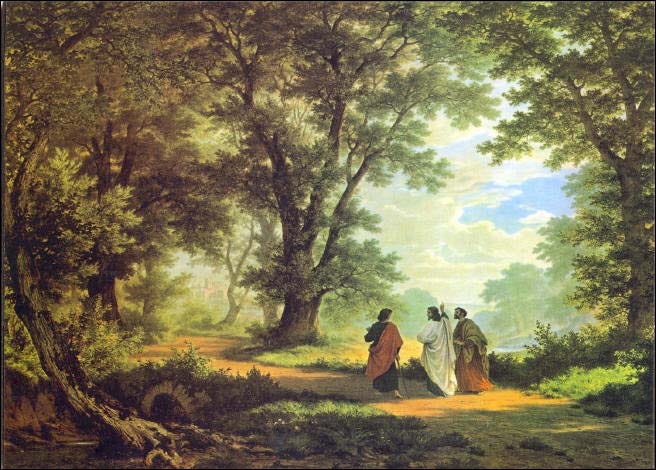
My favorite post-resurrection scene is the Road to Emmaus. Two disciples are walking with Jesus, but they don’t recognize him. When Jesus asks what they are talking about, Cleopas quips that he must be the only person visiting Jerusalem for the Passover who doesn’t know about what happened there. When Jesus asks for more details, Cleopas says hopelessly that he had hoped Jesus was the one to redeem Israel, but apparently that hope came to an end when the Romans crucified him. He adds that there have been reports of angels saying he’s alive and that the tomb is empty, but it doesn’t sound like Cleopas puts much faith in them.
Jesus responds:
“O foolish ones, and slow of heart to believe all that the prophets have spoken! Was it not necessary that the Christ should suffer these things and enter into his glory?” (24:25–26).
Jesus then gives the greatest sermon/Bible study ever. Luke says:
And beginning with Moses and all the Prophets, he interpreted to them in all the Scriptures the things concerning himself (24:27).
The thing is, even after Jesus opens the Scriptures for them, they still don’t recognize him.
The two disciples continue to walk with Jesus. Eventually, they find their way to the table, where Jesus “he took the bread and blessed and broke it and gave it to them” (24:30). This is almost word-for-word what Jesus does at his last Passover with his disciples (cf. Luke 24:31). And in that moment:
“Their eyes were opened, and they recognized him” (24:31).
They didn’t recognize him when he opened up Scripture to them, but as they report later, “he was known to them in the breaking of the bread (24:35).
The Road to Emmaus followed the pattern of early Christian worship. There is the Liturgy of the Word and the Liturgy of the Sacrament. Both are important (and I say this as someone who has spent basically his entire adult life studying Scripture and teaching people), but Christ is made known in the breaking of the bread.
And people try to tell me that it’s not a sacrament, just a meal of remembrance.
Jesus gave the greatest study in Scripture that anyone has ever given (better than I or anyone else reading this will ever give), but they still didn’t recognize him. It was only when he took, blessed, broke, and gave that their eyes were opened, and they recognized their risen Lord.
Happy Easter.
“Be present, be present,
Lord Jesus Christ,
our risen high priest;
make yourself known in the breaking of bread.”
I wrote this at 1:10 am on Easter morning when I was very tired. I’m leaving it here because it reminds me that I am in good company. Ancient scribes copying manuscripts would occasionally leave notes in the margins about their exhaustion, their aching hands, or their longing for rest. For example, one scribe wrote, “Oh my hand.” Another noted that writing “crooks your back, it dims your sight.” The words of Scripture have always come to us through tired human hands.