

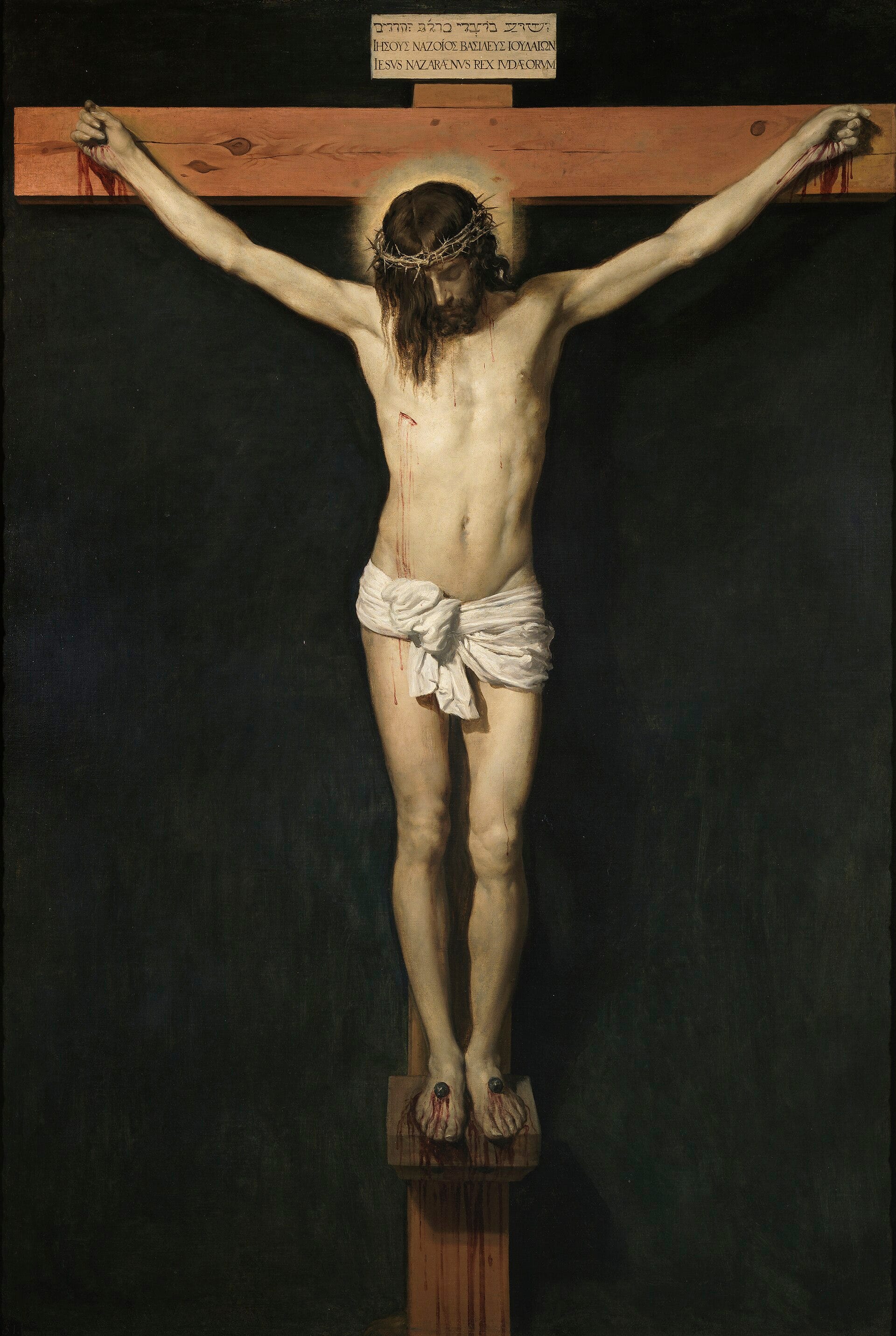
In Paradise (23:39-43)
One of the criminals hanging beside Jesus joins the mockery already coming from the crowd and the rulers below:
“Are you not the Christ? Save yourself and us!” (23:39).
His demand names a savior he does not believe exists, since a real Christ, in his estimation, would never have been nailed to the cross in the first place. The other criminal answers him first, then turns to Jesus.
“Do you not fear God, since you are under the same sentence of condemnation? And we indeed justly, for we are receiving the due reward of our deeds; but this man has done nothing wrong” (23:40–41).
He states his own guilt plainly and Jesus’ innocence just as plainly, something none of the nearby rulers have managed to say. Then he makes a surprising request:
“Jesus, remember me when you come into your kingdom” (23:42).
He asks to be included in a kingdom he cannot see, secured by a king who, by every visible measure, is dying beside him. Jesus answers with more than the man asked for.
“Truly, I say to you, today you will be with me in paradise” (23:43).
The word translated “paradise,” παράδεισος (paradeisos), is the same term the Greek Old Testament uses for the garden God planted in Eden (Gen 2:8; cf. Jos., Ant. 1.37; Iren. 5.5.1). Jesus’ promise echoes the Garden of Eden, the place humanity was driven from and barred from reentering by cherubim and a flaming sword (Gen 3:24).
“Today” belongs with “you will be with me,” not with “I say to you,” although it’s not impossible to read it the other way. Jesus means not merely that he is speaking to the man today, but that the man will be with him before the sun sets on either of their deaths.
The criminal asked for a future kingdom. Jesus offers him present rest. Paradise here denotes the blissful nearness to Christ that precedes the resurrection of the body, not the resurrection itself. It is the same interim state Paul has in view when he says that to depart and be with Christ is far better (Phil 1:23), even as his deepest hope remains the resurrection still to come. What the criminal receives today is real and immediate. The garden is where man was with God. What he still awaits, along with every believer who has died since, is the day when the whole world is remade and he receives back a body that will never die.
Weep for Yourselves (23:26–31)
As the soldiers led Jesus away, they seized Simon of Cyrene, coming in from the countryside, and put the cross on him to carry behind Jesus (23:26). Luke does not tell us what Simon thought, only where he walked: behind, in the position Jesus had already named for anyone who would follow him. “Whoever does not bear his own cross and come after me cannot be my disciple” (14:27). Simon is given no choice in the matter, but the posture is the same one Jesus required of every disciple willing to take it up.
A great crowd follows, with women among them, mourning and wailing for him (23:27). Jesus turns and speaks, redirecting their grief rather than receiving it.
“Daughters of Jerusalem, do not weep for me, but weep for yourselves and for your children” (23:28).
What comes next is warning, not comfort: a coming reversal so severe that barrenness, the ancient curse, will be called blessed, and breasts that never nursed will be envied.
For behold, the days are coming when they will say, ‘Blessed are the barren and the wombs that never bore and the breasts that never nursed!’ Then they will begin to say to the mountains, ‘Fall on us,’ and to the hills, ‘Cover us’ (23:29–30).
This line comes from Hosea, where Israel, under judgment for her idolatry, cries out to the mountains, “Cover us,” and to the hills, “Fall on us” (Hos 10:8). Jesus alludes to the prophet’s words but reverses which cry goes where: mountains fall, hills cover, exactly backward from Hosea’s order. Hosea’s scene will soon replay itself in Jerusalem.
Jesus closes with a proverb:
“If they do these things when the wood is green, what will happen when it is dry?” (23:31).
The proverb implies that the time is not yet right for the Roman destruction of the city, but what will happen when Jerusalem has become dry kindling? The word for wood, ξύλον, is also the same word Luke later uses for the cross in Acts, where the apostles preach that Jesus was killed by hanging him on a tree (Acts 5:30; cf. 10:39; 13:29).
Jesus’ words are unmistakable. Judgment is coming soon upon the city and its people. In some ways, Jerusalem and Jesus will share the same fate: they are both killed/destroyed by the Romans only four decades apart. One of the pair would be resurrected on the third day, and the other would not.
Into Your Hands (Luke 23:44–49)
The psalms of lament provided ancient Israel with a language for moments of crisis — words to express when the body weakens, enemies close in, and God feels far away. Israel’s faithful sufferers kept turning to these prayers, confident that God listened even to the darkest cries. Jesus dies within this tradition, using its language at his final breath.
Which Psalm he draws on, however, depends on which Gospel you read. Mark and Matthew both record a cry of dereliction as Jesus’ last spoken words: “My God, my God, why have you forsaken me?” (Ps 22:1 quoted in Mark 15:34 and Matt 27:46). The weight of abandonment falls hard in those accounts.1 Luke’s account is strikingly different. Luke omits the cry of dereliction entirely. In its place, Jesus speaks three times from the cross (23:34, 43, 46), and every word is either a prayer or an act of grace. His final word is a quotation of Ps 31:5:
“Father, into your hands I commit my spirit” (Luke 23:46).
Not a cry of dereliction; a prayer of trust. The wider context of Ps 31 shows a righteous sufferer surrounded by enemies, mocked and forgotten, yet holding onto God as his refuge. The psalmist does not doubt God’s listening; he trusts in it. Luke’s Jesus dies exactly this way: not in apparent abandonment but in deliberate, filial trust.
The word “spirit” (πνεῦμα) points to the full scope of biblical anthropology. When God formed man in Gen 2:7, he breathed life into dust, and the creature became alive as a combined body and spirit. Neither alone constitutes a complete human being. When Qohelet describes death, he states that the dust returns to the earth and “the spirit returns to God who gave it” (Eccl 12:7). In biblical terms, death signifies the unmaking of that union. Jesus on the cross intentionally and willingly fulfills Eccl 12:7: he entrusts the animating spirit, God’s own breath, given at creation, back into the Father’s hands.
The picture Luke paints is not the Greek view of an immortal soul escaping a disposable body. The spirit Jesus commits to the Father is not destined for eternal disembodied existence. God holds it until the resurrection, when it returns to the body, and Jesus becomes fully alive again in the biblical sense: body and spirit united. The resurrection is not a separate miracle added to the cross. It is the completion of what Jesus began with his final prayer.
Luke’s dying Jesus is the righteous sufferer of Ps 31, trusting, praying, entrusting himself to the Father’s care. And the Father, who holds the spirit of his Son, proves trustworthy when the tomb opens on the third day.
Although if you read the whole Psalm, your perspective shifts.
I took Jesus’ words: ““If they do these things when the wood is green, what will happen when it is dry?” (23:31) to mean if this is how the people are treating HIM when he is green (alive) how would then then treat him when he was dry (dead). We know from history, after Jesus’ death there were many rumors and propaganda from the Romans to discredit the resurrection. There was great persecution against his followers. Could that also be what he meant?
In the last paragraph of the “weep for yourselves” section, did you intend to say four decades rather than four centuries apart?