

Not a Hair Will Perish (21:7–19)
The disciples have just heard that not one stone of the temple will be left upon another, and they want to know what to watch for (21:7). Jesus begins with a warning about deception: many will come claiming his name and announcing that the moment has arrived. The disciples are not to follow them (21:8). Wars and unrest will come, and none of it should be mistaken for the coming judgment. These things must happen first, and Jerusalem’s and the temple’s end will not come at once (21:9). There would be a process.
What follows sounds like a catalog of ordinary catastrophe: nation will rise against nation, and kingdom against kingdom (21:10). Earthquakes, famines, pestilences, terrors and great signs from heaven (21:11). None of it, on its own, tells the disciples anything they could not already have guessed about a violent century.
Jesus then addresses what actually concerns him: before any of this, his disciples will be handed over to synagogues and prisons, brought before kings and governors for his name’s sake (21:12). Family will do the handing over. Parents, brothers, relatives, friends. Some will be put to death (21:16). Everyone will hate them for his name (21:17).
What comes next is the sentence that seems to contradict everything just said. Not a hair of your head will perish (21:18). The imagery is a common metaphor is the Old Testament. When Jonathan had unknowingly broken Saul’s oath and stood condemned to die, the army that intervened for him swore, “As the LORD lives, there shall not one hair of his head fall to the ground” (1 Sam 14:45). Solomon extends the same formula to Adonijah, conditioned on his staying out of trouble: not one of his hairs shall fall to the earth (1 Kgs 1:52). In each case the formula means exactly what it says. The person keeps their life. No one touches them.
Jesus has just said that some of the disciples will be put to death. How then can he say that not one hair on their head will perish? Notice that Jesus changes the verb. The Old Testament metaphor referred to a hair falling. Jesus promises a hair will not perish. The disciple of Jesus may lose their life, but that does not mean that they have perished. Their life may be taken from them, but God can and will give it back to them. So Jesus adds:
“By your endurance you will gain your lives” (21:19).
There is something freeing about believing in a God who raises the dead. It disarms the empire's greatest weapon and relieves us of our deepest fear. Yes, barring the return of Christ in our lifetime, we will all one day die, but we will not perish. Death is not the end for the disciple of Jesus. Disasters, both natural and manmade, may claim our lives. And even if we somehow manage to avoid such things, these mortal bodies will one day take their last breath. But that is not the end. One day God will give life again to our bodies, and we will see that not even a single hair on our head will have perished.
Snared by That Day (21:34–38)
Isaiah’s “little apocalypse” closes with a warning that names no nation in particular:
“Terror and the pit and the snare are upon you, O inhabitant of the earth!” (Isa 24:17).
The three judgments interlock. Whoever flees the terror falls into the pit; whoever escapes the pit is caught in the snare (24:18). Isaiah’s day of the LORD does not discriminate between covenant people and pagan nations; it comes upon “the inhabitant of the earth” as such.
The Greek text of Isaiah renders “snare” as παγίς (pagis). That word is used at the end of Jesus’ discourse on the Mount of Olives. Nineteen verses earlier, Jesus had described the specific, datable fall of Jerusalem: armies surrounding the city, desolation, flight to the mountains (21:20–24). Now the frame widens. “Watch yourselves,” he says, “lest your hearts be weighed down with dissipation and drunkenness and cares of this life, and that day come upon you suddenly like a trap. For it will come upon all who dwell on the face of the whole earth” (21:34–35). Isaiah’s inhabitants of the earth have become, in Jesus’ mouth, all who dwell on the face of the whole earth. Both the vocabulary and the universal scope echo Isaiah’s oracle.
The shift matters. AD 70 was coming for one city within a single generation (21:32). The day described here comes for everyone, indiscriminately, the way Isaiah’s day came for the inhabitants of the earth without exception. That universalizing move is also why the warning turns inward, from watching for armies to watching one’s own heart. The cares of this life (μέριμναι βιωτικαί) are the same cares Jesus already named as thorns choking the seed sown among them (8:14). Jerusalem’s fall would expose a nation’s misplaced trust. This wider day exposes everyone’s.
The remedy Jesus gives is sustained vigilance rather than more information: “stay awake at all times, praying that you may have strength to escape all these things that are going to take place, and to stand before the Son of Man” (21:36). Daniel’s throne room, where the court is seated and the books are opened before the Son of Man receives his kingdom (Dan 7:9–10), stands behind that image. The scene that earlier in the discourse vindicated Jesus becomes the same one in which every person must be ready to stand and face judgment.
When Jerusalem is Named (21:5–6, 20–24)
March 31, 2026
Luke 21 begins with Jesus observing the crowd depositing offerings into the Temple treasury. He notices a widow drop in two small copper coins. Then he tells his disciples that she has given more than all the others because she has donated everything she had to live on (21:4). What’s surprising is that right after, Jesus’ disciples admire the Temple’s beauty, and Jesus then predicts its destruction. In effect, the widow has just given her last coin to an institution that Jesus is about to condemn.
What follows in Luke’s Gospel is the most historically transparent of the three Synoptic versions of this discourse. Where Mark 13:14 speaks cryptically of “the abomination of desolation” and instructs the reader to decode the reference, Luke strips the apocalyptic cipher entirely:
“But when you see Jerusalem surrounded by armies, then know that its desolation has come near. Then let those who are in Judea flee to the mountains, and let those who are inside the city depart” (Luke 21:20–21).
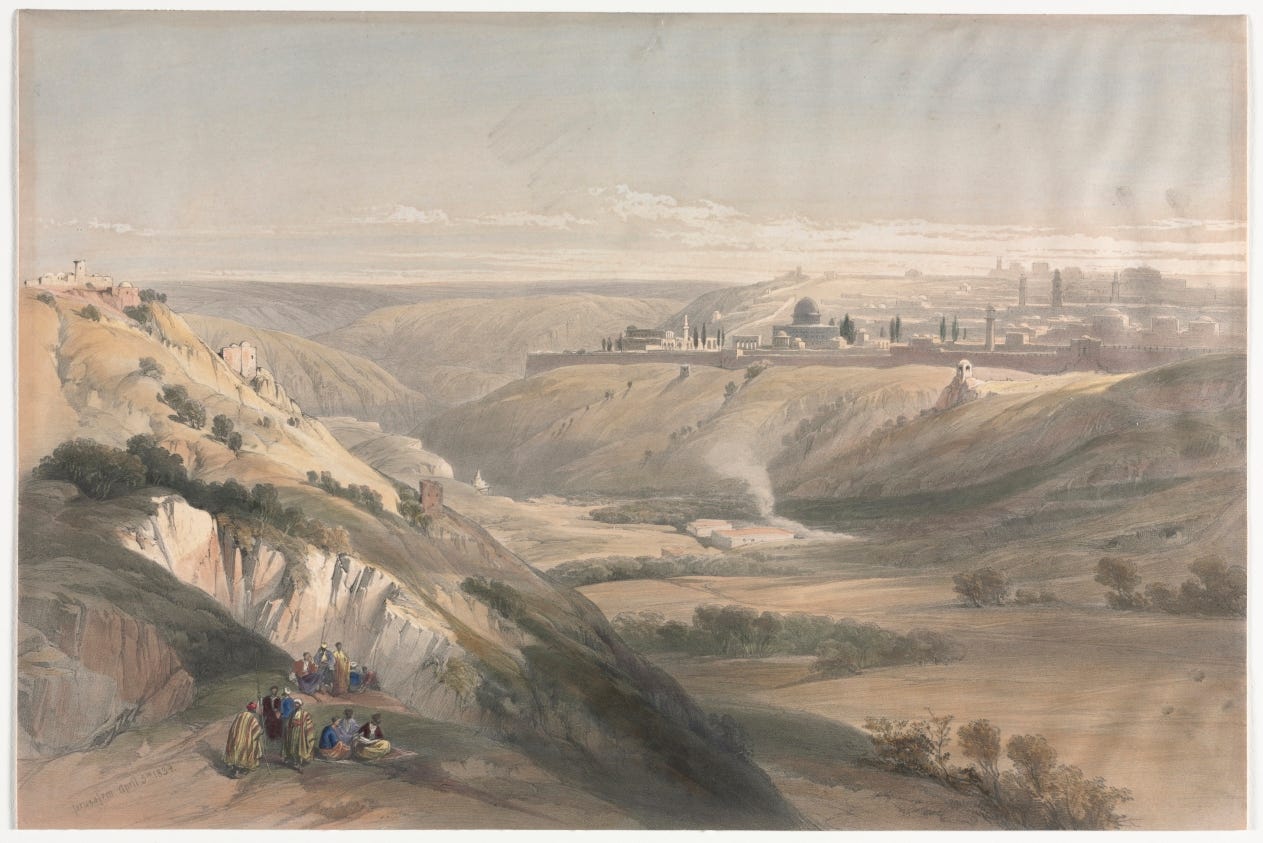
No riddle. No symbol requiring interpretation. Luke names the city and describes a siege. The desolation Jesus predicts is the destruction of Jerusalem and its Temple in AD 70, an event his first readers had either witnessed or heard described in living memory.
This clear identification of the discourse’s subject determines how the rest of the discourse is read. Jesus is not, in this passage, mapping the end of time (as we would understand it). He is speaking as a prophet in the tradition of Jeremiah and Ezekiel, announcing judgment on the city and its temple. His startling claim, the one that contributes to his death, is that Jerusalem will not be spared when God acts to establish his kingdom “on earth, as in heaven.”
Every empire will be knocked down by the stone cut from the mountain without human hands (Dan 2:34–35). That expectation would have been normative to any first-century Judean. What shocks his hearers to learn is that Jerusalem and its temple will fall along with the empires.
Jesus closes with a word his audience could verify: “This generation will not pass away until all has taken place” (21:32). The generation standing before him would live to see it. They did. “This generation” here isn’t “the church age” or some other shoe-horned definition that makes Jesus mean what he obviously does not say. If anything, “this generation” is probably an allusion intended to identify Israel in Jesus’s day with the generation that fell dead in the wilderness (cf Ps. 95:7–11).
The widow’s coins are still there at the beginning, a quiet, devastating detail. Like so many others, she gave everything to a house that would eventually crumble. Jesus offers us more than a building. He offers us a kingdom that shall never be shaken. Jerusalem and its temple shared the same fate as Jesus. They were all destroyed/killed by the Romans. But only one would rise from the dead.