

What Jesus Never Said (20:20–26)
The scribes and chief priests realize that the parable of the wicked tenants was told against them (20:19), but they cannot seize Jesus while the people are listening. So they watch him and send spies “who pretended to be sincere” (20:20). The spies have one task: to catch him in something he said, so that he can be handed over “to the authority and jurisdiction of the governor.”
The spies begin with flattery. They say that Jesus teaches rightly, shows no partiality, and teaches the way of God truly (20:21). Every word of the compliment is accurate, and none of it is meant sincerely. They are buttering him up.
The spies then set the trap. They ask whether it is lawful for them “to give tribute to Caesar, or not” (20:22). A yes would cost Jesus the crowd that protects him; a no would hand the spies a charge of sedition to carry to Pilate.
Jesus sees their craftiness and asks for a denarius. The coin carries Caesar’s likeness and inscription, and Jesus draws his conclusion from the coin itself: render to Caesar the things that are Caesar’s, and to God the things that are God’s (20:25). The answer gives the spies nothing to report. Luke writes that they were not able “in the presence of the people” to catch him, and they fall silent (20:26).
The silence does not last. When the council brings Jesus before Pilate, the accusations include his “forbidding us to give tribute to Caesar” (23:2). The charge repeats the spies’ own phrase from the temple courts. Luke’s readers remember what Jesus said in chapter 20, and so do the men who sent the spies. They failed to catch Jesus in his words, so they reported words he never spoke.
Not only did Jesus’ answer avoid their trap, but it reminded them of a truth they had forgotten and would rather not have rubbed in their face. The rule of a foreign people over the children of Israel was a sign of their sin and need for repentance. However, instead of reckonizing what was wrong and turning to God, they were colluding with the empire against God. “The things that are God’s” are, in short, everything. But Israel was God’s in a unique way. They were God’s people, God’s chosen family among all the nations and families of the world. But they had failed to give to God what was his. They had failed to be faithful tenants of what God had intrusted to them. But faced with this truth, rather than turning from their sinful ways, they double down on their wickedness and seek to kill the Son of God by reporting to the empire what Jesus never said.
The Rejected Stone (20:9–19)
Jesus wasn’t the first to speak to Israel about a vineyard. The prophet Isaiah had sung about one:
Let me sing for my beloved my love song concerning his vineyard: My beloved had a vineyard on a very fertile hill (Isa 5:1).
In that song, Yahweh does everything for the vineyard. He clears the ground, plants the choicest vines, builds a watchtower, hews out a winepress, and waits for grapes. What comes up is worthless. So the owner announces judgment: he will tear down the wall, withhold the rain, and let the vineyard be trampled. Then the prophet names the vineyard plainly: “the vineyard of the LORD of hosts is the house of Israel” (5:7). He looked for justice and found bloodshed, looked for righteousness and heard an outcry.
Jesus takes that song and applies it to his own time. The owner plants the vineyard and leaves it with tenants. At the harvest, he sends servants for his share of the fruit, and the tenants beat them and send them away empty. The servants are the prophets, sent again and again and abused again and again. Finally, the owner reasons that they will respect his son. They do not. They throw him out of the vineyard and kill him, hoping to seize the inheritance for themselves.
The logic of the parable is the logic of the song. A vineyard exists to bear fruit for its owner. God did not plant Israel for Israel’s own sake; he blessed his people so that the blessing would return to him and run out to others. The tenants’ sin is the refusal to give back what was always his. When the owner asks what he will do, the answer is the same verdict Isaiah pronounced: he will destroy those tenants and give the vineyard to others (20:16).
Then the parable turns on a single word. Jesus looks at them and quotes the psalm the pilgrims sang at the great feasts, the last of the Hallel:
The stone that the builders rejected has become the cornerstone (Ps 118:22).
In Hebrew, the stone is אֶבֶן (ʾeben) and the son is בֵּן (ben), one consonant apart. The rejected son of the parable and the rejected stone of the psalm are the same figure. The builders, the very ones charged with raising the house of God, throw away the stone on which the whole structure depends, and God makes it the head of the corner. What the tenants discard, the owner vindicates.
The last line refuses to let the image stay decorative. Whoever falls on the stone is broken; on whomever it falls, it crushes him (20:18). The words gather up the stone of stumbling in Isaiah (Isa 8:14–15) and the stone in Daniel that grinds the kingdoms to powder (Dan 2:34–35). The scribes and chief priests understood. They knew he had told the parable against them, and they wanted to lay hands on him that very hour.
We are the others to whom the vineyard has been given, which is no ground for ease. The same stone stands in the same place. We can receive everything from God and still treat the harvest as ours without remembering that it all belongs to him. The owner will come again to settle accounts, and the son he sent is the stone on which we are either built or broken.
The God of the Living (20:27-40)
The Sadducees arrive at the temple with a trap disguised as a theological question. Levirate marriage law states that a man must marry his brother’s widow (Deut 25:5–10). So: seven brothers, one woman, all dead. Whose wife will she be at the resurrection?
The scenario is not invented from scratch. Second Maccabees 7 describes seven brothers who are martyred sequentially under Antiochus IV, each refusing to renounce their faith, and several explicitly affirm bodily resurrection as they die (2 Macc 7:9, 11, 14, 23, 29).1 That tradition almost certainly influences this exchange. If so, the Sadducees aren’t just asking an abstract philosophical question; they are challenging a type of resurrection hope that is already deeply rooted in Jewish history and imagination.
Jesus dismantles their trap in two moves.
The first is conceptual. The Sadducees construct their reductio ad absurdum scenario on an unstated assumption: that if resurrection were real, it would simply be a resumption of our present earthly life with our present social structures and all. The absurdity that follows is supposed to prove the point that resurrection isn’t real. Jesus pulls the assumption apart. Those who attain the resurrection are ἰσάγγελοι, “like angels,” a word that appears nowhere else in the New Testament. The levirate institution exists because people die; where death no longer holds, the institution is beside the point. The trap collapses before the scriptural argument even begins.
Luke offers another distinctive phrase here: those who reach the resurrection are υἱοὶ τῆς ἀναστάσεως, “sons of the resurrection” (Luke 20:36), a phrase also not found elsewhere in the New Testament. The language of sonship in Luke is important: it symbolizes identity and inheritance. The heirs of the resurrection are not merely its beneficiaries; they are defined by it.
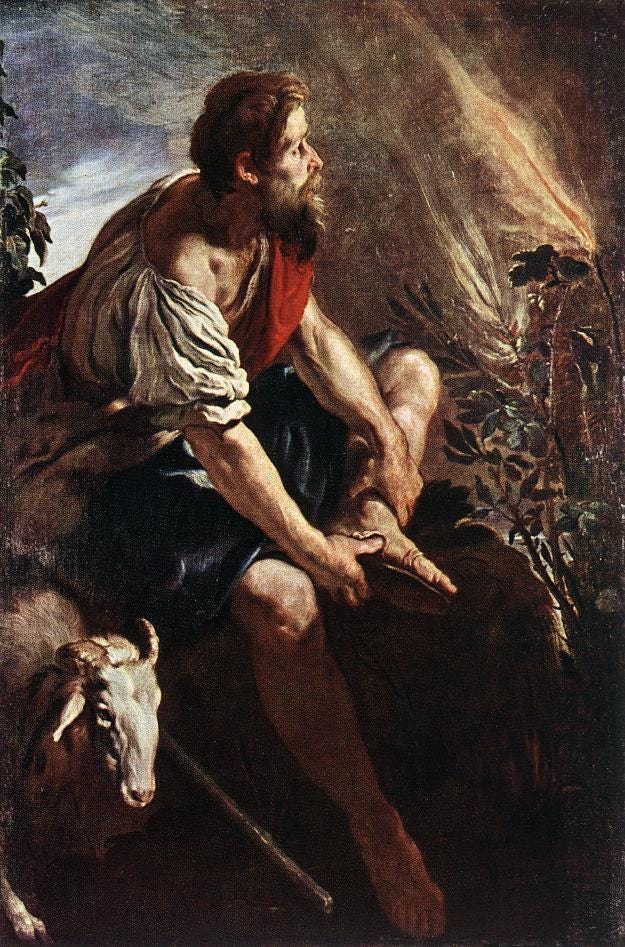
The second move is scriptural and even more surprising than the first. Jesus does not cite a resurrection proof-text but instead quotes Exod 3:6, God’s self-identification at the burning bush: “I am the God of Abraham, and the God of Isaac, and the God of Jacob.” The verb is in the present tense. God does not say he was their God; he is their God. The argument is based on God’s character: the one who enters into covenant does not abandon his covenant partners to non-existence. Jesus presents his case using the terms of the Torah that they accept.
Luke then adds what Matthew and Mark omit: “for all live to him” (Luke 20:38b). Heard against the Maccabean background, the claim is a vindication of the martyrs. Abraham, Isaac, Jacob, and those seven brothers all live to God, held in the presence of the one who made promises and kept them, and they will live again bodily on the last day.
Luke closes the scene with one more detail his Gospel sources do not include: some of the scribes respond, “Teacher, you have spoken well” (Luke 20:39). In a chapter of unrelenting hostility, the approval is small, but Luke notices it. Opposition is not the whole story.
If you haven’t read 2 Maccabees 7 before, you should: A Link to 2 Macc 7.
I read the 2 Maccabees 7 and I’m not sure what significance it has to this reading today. Maybe you can enlighten me.