

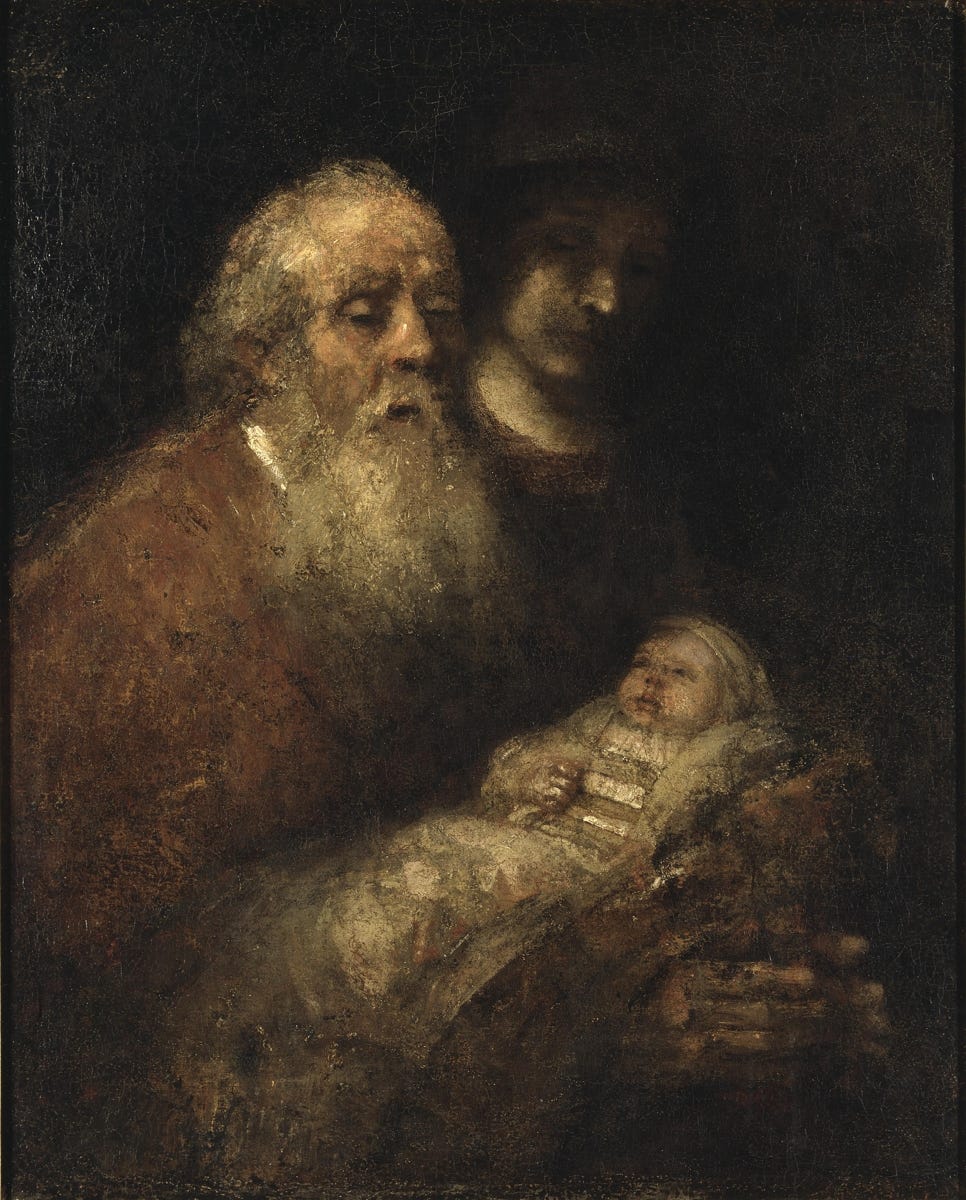
Consecrated but not Redeemed (2:22–24)
When the days required by the law of Moses were complete, Mary and Joseph carried the infant Jesus up to Jerusalem to present him to the Lord. Luke quotes the relevant law directly: “every male who first opens the womb shall be called holy to the Lord” (2:23). The words come from Exod 13:2, 12, and they were spoken on the night the Lord struck down the firstborn of Egypt and passed over Israel’s own firstborn who were sheltered by the blood of the lamb. From that night, every firstborn son belonged to the God who had spared his people. The child was not, however, left in the Lord’s possession outright. Numbers fixes a redemption price, five shekels of silver, paid at a month old, by which every family in Israel bought back their firstborn son (Num 18:16).
Luke quotes the law of consecration and then turns to a different requirement: the offering Leviticus allows a mother too poor to bring a lamb for her own purification, “a pair of turtledoves, or two young pigeons” (2:24). It would be easy to mistake this for the price of the child’s release. It is Mary’s purification offering, not his redemption payment; the five shekels Numbers requires go unmentioned. Luke quotes the very law that demands a price, then declines to record that the price was paid.
Jerusalem had seen a scene like this once before. Isaac was the first to open Sarah’s womb, and his father carried him up a mountain in that same city to offer him as a burnt sacrifice. God stayed Abraham’s hand at the last moment and provided a ram caught in a thicket to die in Isaac’s place, and Abraham named the mountain for what he had seen there: “The LORD will provide,” or as the proverb ran afterward, “on the mount of the LORD it shall be provided” (Gen 22:14). Centuries later Solomon built the Lord’s house on that same mountain (2 Chr 3:1). Every firstborn son ever carried up to it and bought back for silver was reenacting, on a much smaller scale, what Abraham had already lived on its summit.
No substitute appears in this account, and no silver changes hands. Luke quotes the law in full that consecrated this firstborn son to the Lord. He leaves unmentioned the law that would have redeemed him. The sacrifice promised in Gen 22 had come at last. This child was consecrated to the Lord, but not redeemed back to his parents because he would not escape the death that was coming. Rather, he would be the sacrifice that would bring redemption to the whole world.
The Manger of the Lord (2:1–20)
The book of Isaiah begins with an indictment of the nation, and its first concrete charge is a failure to know.
The ox knows its owner, and the donkey its master’s crib, but Israel does not know, my people do not understand (Isa 1:3).
The ox acknowledges its owner; the donkey acknowledges the trough where its master feeds it. Even dull animals know their provider. Israel, however, does not. The catchword that will bind the oracle to Luke comes from the LXX, where the translators called that trough τὴν φάτνην τοῦ κυρίου αὐτοῦ, the manger of its lord.
Luke uses the word φάτνη three times (Luke 2:7, 12, 16) in reference to the birth of Jesus. He passes over other details about the room and Mary’s labor, but he returns to the manger several times, even making it the substance of the angelic sign: “you will find a baby wrapped in swaddling cloths and lying in a manger” (2:12).
The child in the manger is named κύριος, “the Lord” (Luke 2:11), the master whom Israel had not known can now be found in a φάτνη. Israel had not known its God, but “the Lord has made known” to shepherds how he was revealing himself (2:15) and then made it known to others (2:17). Israel must come to the manger and recognize its God.
One word alone settles nothing. The case for this connection rests on the convergence: the threefold emphasis in Luke in which the φάτνη is the sign, the title κύριος, and the vocabulary of knowing. Some of the earliest interpreters saw this connection. Origen already read Isaiah’s ox as Israel and the donkey as the nations, both drawn to the manger of their lord, and the two animals, absent from Luke’s account yet fixed in every nativity scene, were placed there on the strength of that reading.
The God Israel had not known revealed himself to them and to the world in a lowly manger. Without explaining why, Luke continually draws his readers back to that humble place. A manger is a feeding trough, the place where a master provides for the animals that depend on him, and Isaiah charged that Israel knew its God less than an animal knows the one who feeds it. Now the Lord himself lies in the trough. If we would know our God, we must find him where he has revealed himself, in the low place we would have walked past, and be fed there by the God who came down to provide for his people.
The Cost of Consolation (2:25–35)
When Luke introduces Simeon, he describes him as a man waiting for “the consolation of Israel” (Luke 2:25). Search the ESV for that exact phrase, and you’ll find no match, not because there is no Old Testament background for what Simeon says but because the translation cuts the verbal connection to its OT source. The Greek word that the ESV translates as “consolation” is παράκλησις (paraklēsis), the noun form of the verb παρακαλέω (parakaleō), which opens Isaiah 40 in the Greek translation.
Comfort, comfort my people, says your God (Isa 40:1).
The allusion is clear. Simeon awaits the fulfillment of the Isaianic New Exodus, the time when God will finally declare that Jerusalem’s warfare has ended, that her iniquity is pardoned, and that he is returning to his people.
Simeon is waiting for exactly what Mark announces at the start of his Gospel. Mark begins by quoting Isa 40:3, the same passage that comes after the message of comfort to the people. This quotation (along with Mal 3:1) serves as the main framework for everything Jesus is about to do and say in Mark’s Gospel. This same New Exodus theme appears again, this time in the opening chapters of Luke’s Gospel.
Simeon is part of the faithful remnant for whom Isaiah’s announcement was made: the one who has been waiting, recognizes when the moment arrives, and can finally depart in peace because the word has been fulfilled.
Luke wants his readers to keep the entire Isaianic context (chs. 40–55) in mind as this old man takes an infant into his arms. Simeon’s response, the Nunc Dimittis, draws from the Servant Songs at the heart of Isaiah.
“A light for revelation to the Gentiles, and for glory to your people Israel” (Luke 2:32) echoes Isaiah’s portrait of the Servant as “a light for the nations” (Isa 42:6; 49:6)—the one through whom “the LORD has bared his holy arm before the eyes of all the nations” (Isa 52:10). Before Jesus has spoken a single word, Simeon identifies him as Isaiah’s Servant.
But Simeon is not finished. After singing about light and glory, he turns to Mary and says something shocking:
Behold, this child is appointed for the fall and rising of many in Israel, and for a sign that is opposed (and a sword will pierce through your own soul also), so that thoughts from many hearts may be revealed (Luke 2:34–35).
Simeon already understands what the Servant Songs reveal — that the consolation of Israel will not come easily. The comfort described in Isa 40 is only shown through the Servant’s suffering in the following chapters. It entered the world through a cross, and Simeon knew the price to be paid before anyone else dared to say it. So, he returned the consolation of Israel to Mary’s arms and explained what it would cost her to be his mother.
Oh, wow. I never saw the manger that held Jesus this way before, even though great sadness and urgent prayers for my own family, church and nation issue from me when I meditate on the blindness of the people of Israel to recognize their Lord in the time of his appearing to them.
Oh LORD, convict and forgive us when our theological boxes, prejudices, and presumptions keep us from recognizing you. Open our eyes and hearts to welcome you, and acknowledge Jesus as the One who feeds us daily. May we respond quickly to your voice and see and honor you, Lord.
In reading Luke 2:1-20, I can’t help thinking how the animals were fed by these troughs — their food, their very sustenance, was provided by their master was literally consumed in these mangers. To think of Jesus being food — our very sustenance! And he was - and is. He literally poured out his life that we might live! “He took bread and gave thanks to God for it. Then broke it in pieces and gave it to the disciples, saying, “This is my body, which has been given for you” (Luke 22:19).