

Who Was Seeking Whom (19:1–10)
Jesus is passing through Jericho, and a man named Zacchaeus wants to see him. Luke gives us two facts about this man before anything else: he is a chief tax collector, and he is rich. A chief tax collector in Roman Jericho did not stand at a booth collecting his own tolls. He contracted the work to subordinates and took a cut of what they extracted from the toll roads running through the region’s balsam trade, which meant his wealth rested on other men’s extortion as well as his own. Everyone in Jericho had a reason to despise him, and his height gave the crowd an easy way to keep him from Jesus without laying a hand on him. He is too short to see over them, so he runs ahead and climbs a sycamore tree.
Luke says that Zacchaeus “was seeking [ἐζήτει, ezētei] to see who Jesus was” (Luke 19:3). Hold onto that verb.
Jesus reaches the tree, looks up, and tells Zacchaeus to come down, because he intends to stay at his house that day. Zacchaeus comes down joyfully, and the crowd grumbles that Jesus has made himself the guest of a sinner ( 19:5–7). The grumble is not unfair. Zacchaeus is a sinner, and by trade a serial one.
Zacchaeus says:
“Behold, Lord, the half of my goods I give to the poor. And if I have defrauded anyone of anything, I restore it fourfold” (19:8).
His restitution goes well beyond what Israel’s law required of a convicted thief. He offers it as a description of who he now is, not as a plea bargain for what he has done.
But it is Jesus’ answer that matters most because it is where Luke’s verb comes back. Jesus tells Zacchaeus that salvation has come to his house, “for the Son of Man came to seek [ζητῆσαι, zētēsai] and to save the lost [τὸ ἀπολωλός, to apolōlos]” (19:9–10).
That phrase is lifted nearly whole from the LORD’s own promise in Ezekiel’s oracle against Israel’s failed shepherds: “I will seek the lost, and I will bring back the strayed” (Ezek 34:16). Ezekiel’s God takes up the shepherd’s task the appointed shepherds of Israel had abandoned.
Zacchaeus thought he was the one doing the seeking, climbing a tree for a glimpse of a passing teacher. He was the object the whole time. The seeking he assumed he had initiated already belonged to someone else.
God is seeking the lost even before they are seeking him, and he calls his people so seek the lost as well.
The King Comes to Reckon (Luke 19:11–27)
When Herod the Great died in 4 BC, his son Archelaus traveled to Rome to have his kingship confirmed by Caesar. A delegation of Jewish leaders made the same journey to oppose him, pleading that this man not be allowed to reign over them. Caesar confirmed him anyway, and when Archelaus returned, he settled accounts with those who had resisted him. He had built a palace at Jericho, the very city where Jesus now tells a story about a nobleman who goes to a far country to receive a kingdom and then return.
Luke tells us why Jesus speaks this parable:
As they heard these things, he proceeded to tell a parable, because he was near to Jerusalem, and because they supposed that the kingdom of God was to appear immediately (Luke 19:11).
It is tempting to hear that last line as a mistake Jesus is about to correct, as though the crowd expected the kingdom now and the parable answered that it would be a long time off. The crowd is not wrong. The kingdom of God is about to appear, and the parable does not push it into some distant future. As Jesus makes his way to Jerusalem, the kingdom of God is about to appear. What the crowd has wrong is not the timing but the shape. They expect the king’s arrival to mean liberation. The parable tells them it means a reckoning.
A nobleman went into a far country to receive for himself a kingdom and then return. Calling ten of his servants, he gave them ten minas, and said to them, “Engage in business until I come.” But his citizens hated him and sent a delegation after him, saying, “We do not want this man to reign over us” (Luke 19:12–14).
While clearly drawing on the Archelaus frame, alongside that story lies a much older one. Israel’s God had departed from Jerusalem and the temple at the exile, and he had promised to return to his city as king. Now he is returning, in the person of the one walking up the road to Jerusalem, and not everyone is happy about it. For everyone, from the servants to those who oppose his reign, there will be a reckoning.
The reckoning has two edges. The servants are accountable for what they have done with what was entrusted to them. The one who hid his mina and called his master harsh is condemned out of his own mouth, having known the master and done nothing. The citizens who sent the delegation are another matter, and their judgment is the one Jesus will pronounce over Jerusalem within a few verses, when he weeps over the city and foretells that not one stone will be left upon another.
The crowd wanted the kingdom to appear, and it was appearing. They simply assumed its arrival could only mean vindication for them and ruin for their enemies. We make the same assumption when we long for God to set the world right, never imagining that setting it right begins with us. The king’s coming is good news, but it is good news that audits the household before it deals with the rebels, and the most exposed servant is the one who held what he was given, did nothing with it, and assumed the master’s return was no concern of his.
Weeping over the City (Luke 19:28–44)
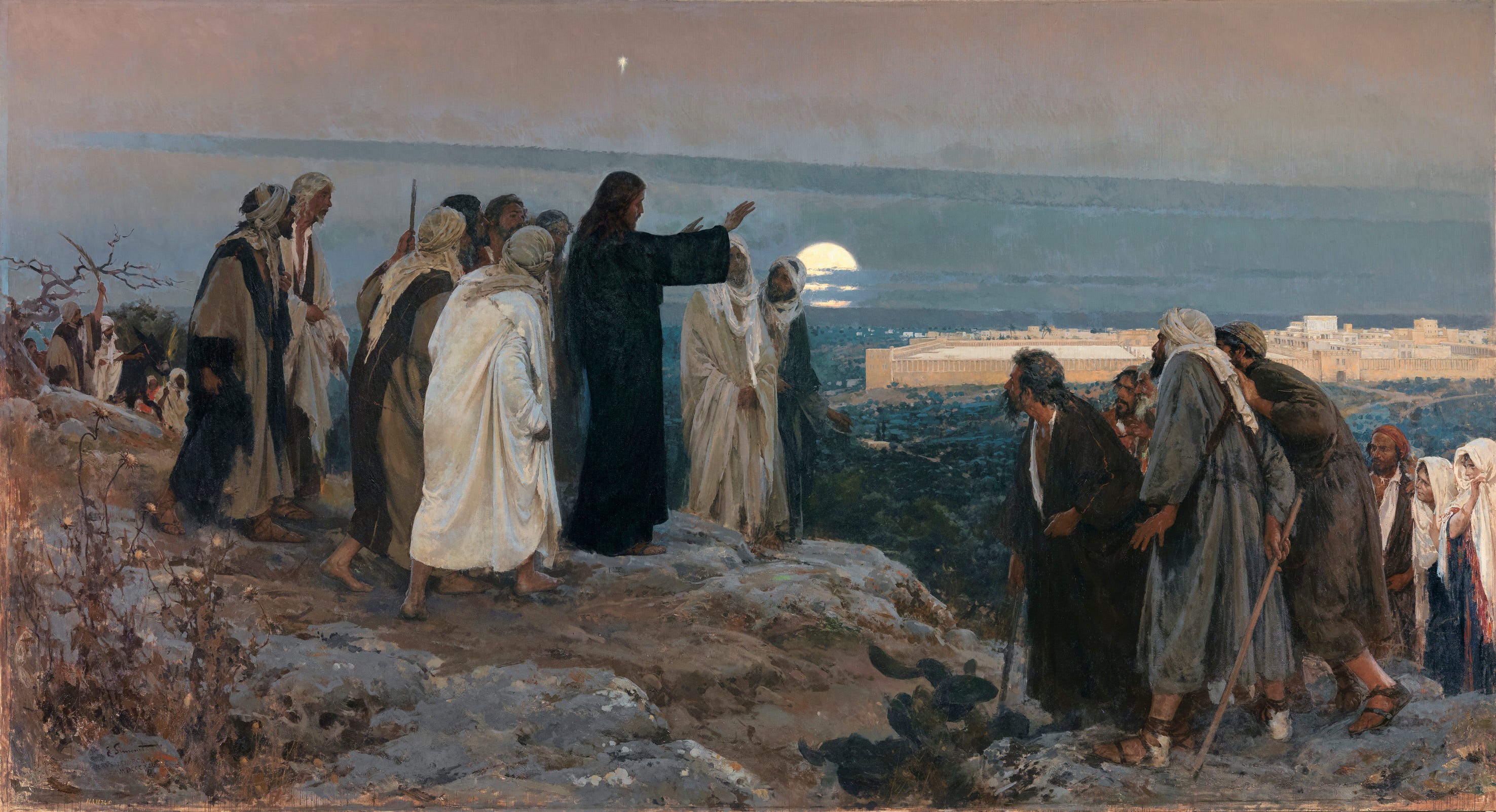
The prophet Ezekiel observed the glory of God leaving Jerusalem before the exile and carefully recorded its course: It moved east, stopping at “the mountain that is on the east side of the city” (Ezek 11:23, referring to the Mount of Olives), and then departed from view.
Centuries later, Zechariah announced the day of the Lord’s return via the same route:
“On that day his feet shall stand on the Mount of Olives that lies before Jerusalem on the east” (Zech 14:4).
The God who departed to the east would come back from the east. That return would mark the long-awaited return of Yahweh to Zion.
Luke seems to assume his readers are already familiar with this theme. When he casually mentions that Jesus was “already on the way down the Mount of Olives” (Luke 19:37), he’s not just giving a geographic detail. He’s making a theological statement. The Lord is finally returning to his city. The day of visitation has arrived. The time has come for God to be king over all the earth (Zech 14:9).
So Jesus makes his way to the city. As he approaches, the crowd quotes Psalm 118:26, but something is off, like a familiar melody that sounds wrong when a single note is out of place.
Blessed is the King who comes in the name of the Lord! Peace in heaven and glory in the highest!” (Luke 19:38).
Two things stand out here. First, they add the word “king” even though the Psalm makes no mention of a king. Second, they unintentionally invert the language of an earlier scene in Luke’s Gospel.
When the angels announced Jesus’ birth, they sang of “peace on earth” (Luke 2:14). The Jerusalem crowd redirects that peace upward, to heaven, away from the world below. Both issues here point to the same conclusion. The people don’t really want “peace on earth.” What they want is a conquering king who will bring peace the way Rome does—by force and at the point of a sword—and they are trying to force Jesus into that role.
Jesus refuses to be that kind of king. He is a king, and he has come to conquer, but not the enemies they think. The people’s true enemies are not the Romans or any human made in God’s image. Their real enemies are sin, death, and the devil, and Jesus will defeat them not by embracing Rome’s way of peace, but by succumbing to it.
And so, when the city comes into view, Jesus weeps.
And when he drew near and saw the city, he wept over it, saying, “Would that you, even you, had known on this day the things that make for peace! But now they are hidden from your eyes. For the days will come upon you, when your enemies will set up a barricade around you and surround you and hem you in on every side and tear you down to the ground, you and your children within you. And they will not leave one stone upon another in you, because you did not know the time of your visitation” (Luke 19:41–44).
Found only in Luke, this lament stands at the convergence of centuries of prophetic promise, Israel’s story, and Jesus’ vocation. Israel had been waiting for its God to return, and now Yahweh is at last coming to his city and his temple to reckon with his people and make things right.
The day has come for the return of Yahweh to Zion, but the city to which he comes does not recognize him. The people see only who they want him to be, not who he truly is.
And so, the one who is the Prince of Peace declares the judgment that comes when God’s people reject his ways. Jerusalem will be torn down until there is not one stone upon another.
Luke does not preserve this lament so that Christians can condemn Jerusalem from a safe distance. The point here is not to stare and wonder how the people of Jesus’ day could have gotten it so wrong. Instead, Luke preserves this lament to make God’s people reckon with an all-important question as we prepare to celebrate Palm Sunday:
Do we know the things that make for peace?
I don’t mean personal inner peace.
I mean peace at the societal, national, and global levels.
If we truly do, then why do the heroes of many Christians today seem so fundamentally different from Jesus? And why do the values they promote seem so unlike the values of the kingdom of God?
And worst of all, why do Christians continue to endorse these unchristlike heroes and anti-kingdom values in Jesus’ name?
Jesus is the Prince of Peace. His self-sacrificial love for others, his embodiment of a love that considers others more important than himself, and his obedient taking up of his cross on the way to Good Friday represent the only true way of peace in this world.
Just outside the city that rejected the Lord’s peace, Jesus would be tortured, murdered, and give his life as a ransom for many, but in doing so, he would accomplish what no earthly king ever could.
We have no right to wonder why there is so little peace in this world when the church continues to advocate for peace the way that Rome brought peace and not the way that Jesus did. Rome brought peace at the end of a sword. Jesus brought peace by being nailed to a Roman cross for the sins of the whole world.
The God who departed Jerusalem by the east and promised to return the same way kept his word. He came back down the Mount of Olives, was rejected by the city he came to save, and won the only victory that could finally bring peace on earth.
And so, as we prepare to celebrate Palm Sunday, I am left wondering whether the Prince of Peace, sitting today on his throne at the right hand of God, looks down upon his church, called to embody his values, his life, and his self-emptying for the good of others, and says:
“Would that you, even you, had known on this day the things that make for peace!” (Luke 19:42).
May God have mercy on us all when our day of visitation comes.
Out of sheer curiosity, I looked up the meaning of Zacchaeus’ name: pure. I’m sure those around him in his community saw him as anything but since he was a chief tax collector and literal thief! Yet Jesus seeks him out, viewing him thru the lens of repentance and grace. How like our God to penetrate the very veneer of our existence to the pure substance of how He created us!!
I have never heard this “minority view” before but it makes a lot more sense to me than trying to squeeze it into some premillennial, rapture-filled second coming tbh. We are reminded in I Peter 4:16-17 that “it is time for judgment to begin the household of God.” A reckoning among those who claim to follow God seems a more apropos rendering of this parable now that you’ve pointed that view out. Thanks