

Recover Your Sight (18:35-43)
Luke ends the third passion prediction with a threefold statement of failure. The Twelve “understood none of these things. This saying was hidden from them, and they did not grasp what was said” (18:34). The very next verse places a blind man by the road outside Jericho, begging (18:35). Luke sets the two scenes side by side with nothing between them. The men who can see have just failed to see, and the man who cannot see is about to regain his sight.
The beggar hears the crowd and asks what is happening. They tell him, “Jesus of Nazareth is passing by” (18:37). The name recalls the beginning of Jesus’ public ministry, when he stood in the Nazareth synagogue and read from Isaiah:
“He has sent me to proclaim liberty to the captives and recovering of sight to the blind” (4:18).
The beggar calls Jesus “Son of David” and asks for mercy. When those at the front of the procession rebuke him, he cries out all the more (18:38–39). Jesus stops, has him brought near, and asks what he wants. Luke then uses the same verb three times in three verses: “Lord, let me recover my sight.” “Recover your sight; your faith has made you well.” “And immediately he recovered his sight” (18:41–43). Luke’s summaries report that Jesus gave sight to many who were blind (7:21–22), but the man outside Jericho is the only blind person whose healing Luke narrates.
Luke closes with two responses. The man “followed him, glorifying God,” and “all the people, when they saw it, gave praise to God” (18:43). Nazareth rejected the promise when it was spoken; Jericho praises God when it is kept. Within a few verses, Jesus will weep over Jerusalem because the things that make for peace “are hidden from your eyes” (19:42), the same language Luke used for the Twelve in 18:34. Proximity to Jesus did not give the Twelve sight, and the temple and its crowds will not give it to Jerusalem.
The Twelve had walked with Jesus from Galilee, heard his teaching, and still could not take in what he said about his death. We face the same danger. We can recite the creed and hear the passion narrative read every Holy Week and still assume that following Jesus leads to honor rather than a cross. Then we are caught off guard when obedience costs us a promotion, a friendship, or the good opinion of people we want to impress. The blind man had no such illusions to protect. He knew what he lacked, asked for it by name, and when he received it, he did what the rich ruler could not bring himself to do earlier in the chapter (18:22–23). He followed Jesus up the road to Jerusalem.
The Widow Who Would Not Stop (18:1–8)
Luke doesn’t leave us guessing about the meaning of this parable. He tells us at the outset that Jesus spoke this parable “to the effect that they ought always to pray and not lose heart” (18:1). The difficulty is not the meaning but the characters in the story: a judge “who neither feared God nor respected man” grants a persistent widow her request. We are evidently meant to learn something about God from him.
The trap is to read the parable as allegory, with the judge standing in for God. The rabbis had a better category for this kind of argument: qal va-homer, “light to heavy.” If even the lesser case holds, the greater holds all the more. If an unjust judge will finally give a widow justice to be rid of her, how much more will the God who loves his people answer those who cry to him? The point turns on the contrast, not the comparison.
The widow is not chosen at random. Throughout Torah and the Prophets, she stands for the one with no standing, the person whose case God himself takes up.
"He executes justice for the fatherless and the widow" (Deut 10:18).
Israel is warned not to mistreat widows (Exod 22:22), and Isaiah measures the nation’s righteousness by whether it will “plead the widow’s cause” (Isa 1:17). When this widow cries out for vindication, she cries with the whole weight of that tradition behind her. The word Luke uses is not the language of acquittal but of vindication: ἐκδίκησις, the setting right of one who has been wronged.
That is why the parable closes where it does.
“When the Son of Man comes, will he find faith on earth?” (18:8).
The question reaches back to the end of chapter 17 and to Daniel 7, where the Son of Man is vindicated and given the kingdom. The widow’s small cry for justice and the cosmic vindication of the Son of Man are the same hope at different scales. To pray “give me justice” is to pray for the world to be set right, for the kingdom to come.
This is where Jacob meets us. At the Jabbok, he seized hold of God and would not let go until he was blessed, and he came away with a new name and a limp (Gen 32:24–31). The name Israel means “wrestles with God.” To be God’s people has always meant to contend with him and refuse to let him go. Prayer that will not stop is not nagging a reluctant God. It is the posture of one who knows how the story ends and who also longs for God’s will to be done on earth as it is in heaven.
We lose heart because the verdict seems delayed. We look at the world and see the case still open. So we come to God again and again in prayer, and that repetitive coming is itself the faith the Son of Man is looking for.
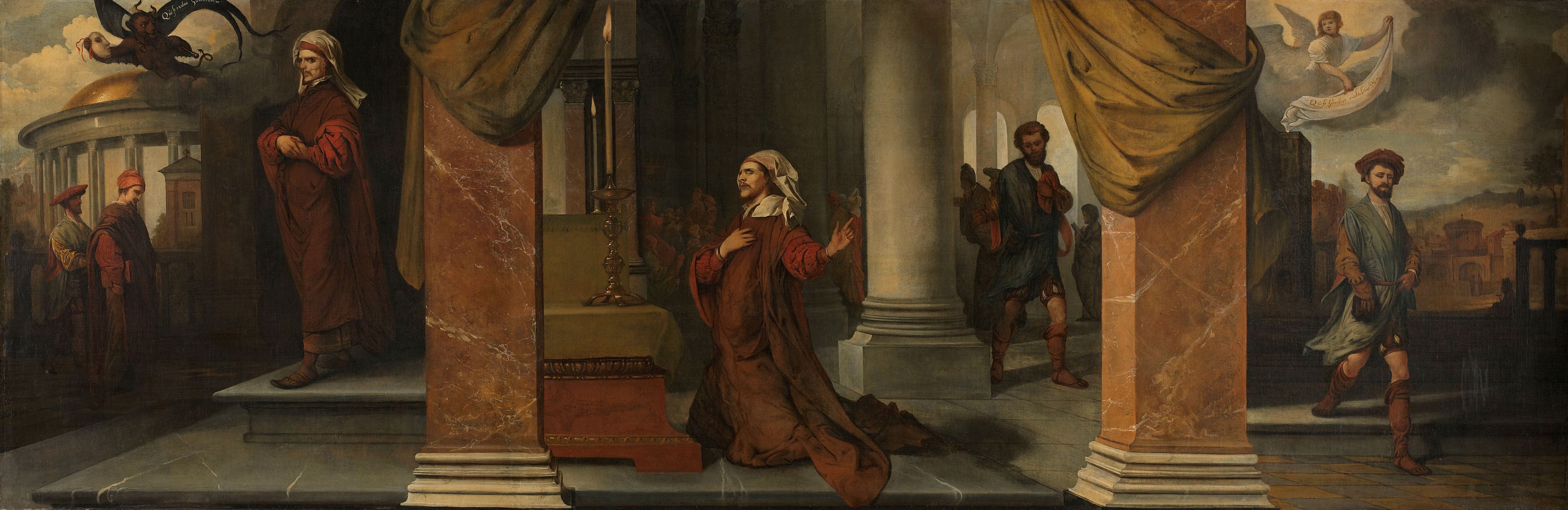
He Went Home Justified (18:9–14)
Throughout Israel’s history, the way sinners approach a holy God has remained consistent. God provides the way; the worshiper only brings their need. The extensive sacrificial system, from the tabernacle to Solomon’s Temple to the Second Temple, was based on this principle. On the Day of Atonement, the high priest entered the inner sanctuary not because of his own worth but bearing the blood of the sacrifice. No one approached the mercy seat on their own terms.
Jesus shares a parable that assumes this entire structure. He addresses it, Luke says, “to some who trusted in themselves that they were righteous, and treated others with contempt” (Luke 18:9). Two men go to the temple to pray. One brings his record with him; the other comes empty-handed.
The Pharisee’s prayer warrants careful consideration:
“God, I thank you that I am not like other men, extortioners, unjust, adulterers, or even like this tax collector. I fast twice a week; I give tithes of all that I get” (Luke 18:11–12).
His words are not shallow pretense. The Pharisee is almost certainly being honest. He fasts more than what Torah requires and tithes part of everything he gets. By every outward standard, he is exactly what Israel should be. But his prayer is directed just as much at himself as at God.
The tax collector adopts a different posture. He stands far away, refuses to lift his eyes to heaven, and beats his chest. His prayer is only six words in Greek: ὁ θεός, ἱλάσθητί μοι τῷ ἁμαρτωλῷ, “God, be merciful to me, a sinner” (Luke 18:13). The word ἱλάσθητί relates to the concepts of propitiation and atonement, the same group of words connected to the mercy seat and the entire Levitical system (cf. Lev 16:2, 13–15). Standing in the temple courts, this man offers the only prayer the temple was ever meant to receive.
The verdict comes in a single sentence:
“I tell you, this man went home justified rather than the other” (Luke 18:14).
The word is δεδικαιωμένος — declared righteous before the judge of heaven and earth. The tax collector received the verdict that the Pharisee assumed was already his.
The sacrificial system existed to say one thing: God provides the mercy; we bring only our need. The tax collector understood what every altar and offering had communicated for centuries. The Pharisee, despite his precision, completely missed it. He approached God with a full résumé and left empty-handed. The tax collector came with nothing and returned home justified.