

I Want To Be Left Behind (17:26-33)
The Pharisees ask when the kingdom of God is coming. Jesus tells them that it will not arrive with the kinds of signs that can be observed (17:20). Then he tells them that “the kingdom of God is in the midst of you” (17:21). The last words there translate the phrase ἐντὸς ὑμῶν, which could mean “within you” (KJV, NKJV), as if Jesus were saying that the kingdom is entirely spiritual, but the ESV’s “in the midst of you” is more accurate. Jesus is saying, “You don’t need to go looking for the kingdom of God because it is already present with you” (cf. Isa 45:16).
He then turns to his disciples and says that a day is coming when they will want to see him (“see one of the days of the Son of Man”, Luke 17:26), but they will not be able to. People might tell them to go looking for him, but they won’t have to guess. When the Son of Man is vindicated, it will be like lightning that lights up the sky. They won’t have to guess what happened or look for signs. It will be plain as day. But before then he must first suffer many things and be rejected by “this generation” (17:25). Jesus is again talking about something happening in his present. This generation, the one in his own day, will reject him and ultimately crucify him.
Jesus explains what those days will be like by assuming his disciples already know two stories. “Just as it was in the days of Noah, so will it be in the days of the Son of Man” (17:26). People “were eating and drinking and marrying and being given in marriage, until the day when Noah entered the ark, and the flood came and destroyed them all” (17:27). He repeats the pattern for Lot: people were “eating and drinking, buying and selling, planting and building,” until the day Lot went out from Sodom and “fire and sulfur rained from heaven and destroyed them all” (17:28–29).
What most people miss, because they want to read texts like these as future predictions of the Second Coming, is the staggering claim Jesus is making. Jesus is predicting judgment on “this generation,” the Jerusalem of his own day, and he is directly comparing it to the judgment that fell on Sodom and Gomorrah. The judgment to fall on Jerusalem will be just like the judgment of Sodom and Gomorrah “when the Son of Man is revealed” (17:30). What Jesus is doing is tying his own vindication (the coming of the Son of Man) to the destruction of Jerusalem. That Jesus truly was who he said he was, that he was the Son of Man rejected by “this generation,” will be revealed with unquestionable certainty when judgment falls on the city.
That Jesus isn’t thinking of future cosmological destruction is made certain by what Jesus says next:
“On that day, let the one who is on the housetop, with his goods in the house, not come down to take them away, and likewise let the one who is in the field not turn back” (17:31)
You can’t run from cosmological destruction by fleeing directly from your rooftop without gathering your belongings or by running away without returning home if you’re working in the field.
Both stories share a second feature as deliberate as the disaster itself. Nobody in Noah’s or Lot’s generation was caught doing anything unusually wicked. They were eating, marrying, buying, building, ordinary activities that fill an ordinary day. Judgment did not interrupt sin in the act. It interrupted life lived as though the day carried no weight at all.
Then Jesus says: “Remember Lot’s wife” (17:32). Genesis says only that she looked back at the city behind her and became a pillar of salt (Gen 19:26). Jesus is telling his disciples, “When the destruction on the city comes, don’t be like Lot’s wife. Don’t look back. Just run.” This leads directly to the “left behind” verses:
“I tell you, in that night there will be two in one bed. One will be taken and the other left. There will be two women grinding together. One will be taken and the other left” (17:34-35).
You probably know the song. “Two men walking up a hill. One disappears, and one’s left standing still. I wish we’d all be ready.” With due apologies to the songwriter, no one here is “disappearing” unless by “disappearing” you mean killed or taken prisoner. In these verses, you want to be left behind because the ones who are taken are taken in judgment. Notice that the disciples want to know “where” they’ll be taken. Jesus essentially says, “You’ll know where they’ve taken their corpses by where the vultures are gathering.”
Among many things, this section of Luke’s Gospel should remind us how important it is to read the New Testament in its historical context first and foremost. There are certainly other appropriate ways to read the Scriptures, and they can be immensely helpful. But they should always be built upon what these words would have meant in their original context. To start otherwise so often leads to confusion and bad theology.
We Have Only Done Our Duty (17:7–10)
The figure in this parable is not a hired laborer who has put in his hours and earned his wage. He is a δοῦλος (doulos), a slave, very likely the only one a small farmer owned, who works the field by day and the kitchen by night. The whole picture turns on a question with an obvious answer. When the servant comes in from plowing, does the master tell him to come and recline at the table (17:7)? No. He tells him to put on an apron and serve supper, and to eat only afterward (17:8). The servant has done what he was bound to do, and by doing his tasks, he puts the master under no obligation.
Jesus presses the comparison onto his disciples. The slave’s labor establishes no claim on the master, and neither does ours on God.
“Does he thank the servant because he did what was commanded?” (17:9).
The expected answer is no. This lands hardest on the assumption that it is built to expose, the assumption that obedience accrues to our account, that the hours we have logged in prayer, service, and study place God in our debt. The parable answers that the account does not exist. We are servants in a household we did not build, doing work we were commanded to do, and the doing earns us nothing.
The word translated “unworthy” sharpens the point. The Greek is ἀχρεῖος (achreios), which carries the sense of useless or worthless, even unprofitable. But, in fact, the servant is not useless; the field was plowed, and supper was made. He is useless in the sense that he has added nothing to his standing. He has produced no surplus, no merit beyond what was owed. He has only done his duty.
We say as much every time we come to the table. Before we receive the body and blood of Christ, we confess that we do not presume to come trusting in our own righteousness, but in God’s manifold and great mercies, that we are not worthy so much as to gather up the crumbs. We say it because it is true at our best and not only at our worst. The church is not a community of sinners alongside the righteous, because there are no righteous persons to stand alongside. There are only servants who, having done all that was commanded, say, “We are unworthy servants; we have only done what was our duty” (17:10), and whose one only hope in life and death is that it is God’s nature always to have mercy.
The One Who Returned (17:11–19)
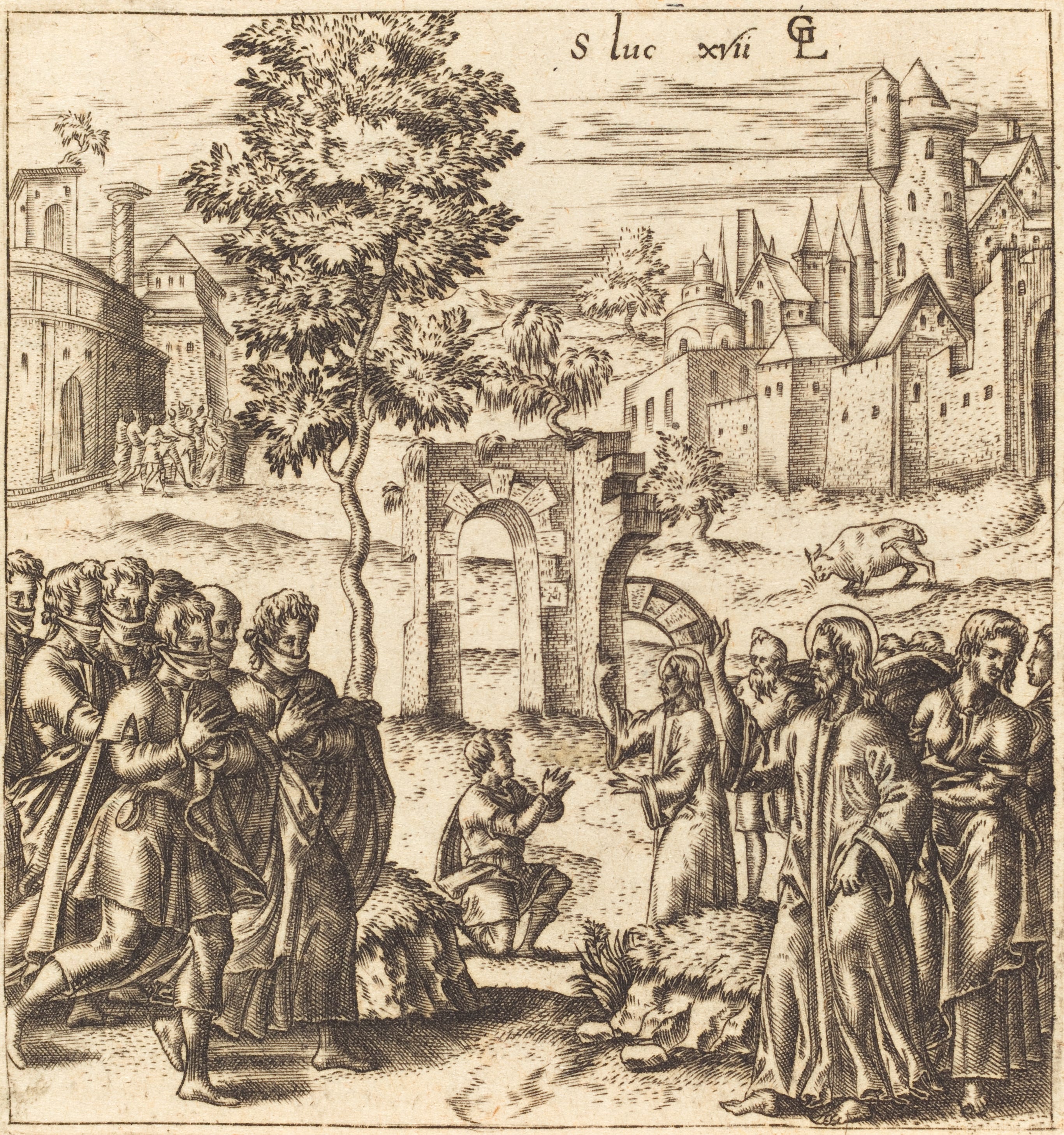
When Jesus healed ten lepers on his way to Jerusalem, he was, as he does elsewhere, doing what other prophets had done before him, but on a larger scale. In 2 Kings 5, the Syrian commander Naaman came to the prophet Elisha covered in leprosy and was healed. Jesus himself referenced that story at the beginning of his ministry, noting specifically that out of all the lepers in Israel, only this foreigner was healed (Luke 4:27). Luke’s reader, prepared by that earlier story, cannot miss what is happening here. A Samaritan leper is healed while the nine Jewish ones walk on. Naaman has returned.
All ten cry out for mercy, and all ten receive it. As they go to show themselves to the priests, Luke writes that “they were cleansed” (17:14). The word is καθαρίζω, the language of ritual purification, the category the priests dealt with. Ten men enter the story as unclean. Ten leave it cleansed. And yet, the story does not end there.
One leper turns back. The Samaritan. Luke’s description of what follows is deliberately blurred:
Then one of them, when he saw that he was healed, turned back, praising God with a loud voice; and he fell on his face at Jesus’ feet, giving him thanks (17:15–16).
He praises God and falls at Jesus’ feet. Luke does not separate these two actions. The worship given to Israel’s God is shown by prostrating oneself before Jesus of Nazareth. This is Luke’s subtle Christological argument, conveyed not through words but through posture.
Then Jesus says something unexpected. The man has already been healed. Every medical fact about him has changed. Yet Jesus says, “Your faith has made you well” (17:19). The word is no longer καθαρίζω. It is σῴζω, the verb for salvation. Jesus is talking about more than just skin being restored.
Ten received cleansing. One received salvation. The difference wasn’t in what Jesus offered but in who came back.
This is why gratitude isn’t just a virtue to develop; it’s a sign of understanding. How easily we praise and give thanks shows how well we recognize what we’ve been given and how truly unwell we once were. The nine went their way, probably happy. They had been physically cleansed. Only the one who knew his deep need understood the significance of the gift. He went home saved.
He was a foreigner. Like Naaman, he was, by every social and religious standard, the last person anyone would expect to be healed. He was also the only one who returned to worship and give thanks, and therefore the only one who was saved.
I have a question regarding righteousness:
In Romans, we read “18 ¶ Therefore, as one trespass led to condemnation for all men, so one act of righteousness leads to justification and life for all men.
19 For as by the one man’s disobedience the many were made sinners, so by the one man’s obedience the many will be made righteous.”
Are we not considered righteous in the eyes of God because of the sacrifice of Jesus on the cross?