

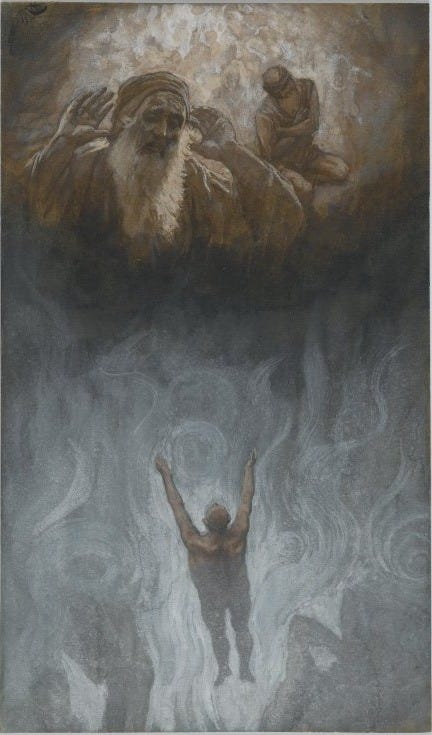
The One God Helps (16:19-31)
Two men appear in this parable. One is dressed in purple and fine linen and feasting sumptuously every day; the other has none of that, but he is named. That second detail is easy to miss, but it’s notable because Jesus rarely names characters in his parables. The sower, the shepherd, the prodigal’s father, and the dishonest manager all go unnamed. Only the poor man at the gate has a name, Lazarus, from the Hebrew Elʿazar (אֶלְעָזָר), “God has helped.” The rich man is described only by his clothing and his table. Before either man speaks a word in the parable, Jesus has already told us whose side God is on.
When both men die, angels carry Lazarus to Abraham’s side. The rich man is buried and finds himself in Hades, in torment, looking across a great chasm at the poor man he had stepped over every day at his own gate. Abraham names the reversal outright:
“You in your lifetime received your good things, and Lazarus in like manner bad things; but now he is comforted here, and you are in anguish” (16:25).
That language is consistent with the song Luke’s readers have already heard once. Mary sang of the same reversal before Jesus was even born. She sang of the proud scattered, the rich sent away empty, and the hungry filled (1:51–53).
The rich man, still thinking in terms of information rather than obedience, asks Abraham to send Lazarus back from the dead to warn his five brothers. Abraham refuses on striking grounds:
“They have Moses and the Prophets; let them hear them” (16:29).
The rich man’s brothers are not missing a revelation. They are refusing the one they already have. When the rich man presses his case, insisting that someone going to them from the dead would move them to repent, Abraham’s answer is almost prophetic:
“If they do not hear Moses and the Prophets, neither will they be convinced if someone should rise from the dead” (16:31).
Luke’s readers know what the brothers do not: that Jesus will be that one who rises from the dead, and his resurrection will not automatically manufacture belief when the Prophets have already failed.
The Scriptures tell us about the great reversal coming up on the world. Mary sang of it. Hannah before her did as well. When then do we live like we don’t think it’s actually coming? We all would say we want to be Lazarus in this parable, but our lives look far more like the unnamed man than the man whom God helps.
An Abomination in the Sight of God (16:14–18)
In Deuteronomy, one word marks the things that cannot stand in God’s presence. The carved idols of the nations are an abomination (Deut 7:25–26). The detestable practices of the surrounding peoples are an abomination (18:9–12). When Israel turns to foreign gods, they provoke the Lord with abominations (32:16). The Greek translators rendered this family of texts with βδέλυγμα (bdelygma), which refers to a detestable thing that defiles. It is the word Daniel LXX uses for the desecration of the temple, the abomination that makes desolate (Dan 9:27). When something is called a βδέλυγμα, it is not merely disliked. It is idolatry, the rival that cannot share the house with God.
That is the word the Lukan Jesus uses here, and he aims it at an audience that would never have expected it.
The Pharisees, who were lovers of money, heard all these things, and they ridiculed him (16:14).
The parable of the dishonest manager has just ended with a verdict: you cannot serve God and money. The Pharisees hear it and sneer. Luke tells us why. They love money, and they have learned to hold that love alongside their devotion to the law without feeling any tension. Jesus exposes the seam.
You are those who justify yourselves before men, but God knows your hearts. For what is exalted among men is an abomination in the sight of God (16:15).
The contrast is the old prophetic one. People look at the surface; the Lord looks at the heart (1 Sam 16:7). What wins approval in the marketplace of human esteem, things like wealth, status, and the appearance of righteousness, is weighed differently in God’s sight. The proverb had already said it: everyone proud of heart is unclean before the Lord (Prov 16:5). Jesus names the love of money for what it is. The thing exalted among men is the βδέλυγμα, the idol set up in the holy place.
The sayings that follow are not a change of subject. The law and the prophets pointed forward, and the kingdom is now being preached; yet not a stroke of the law will fall (16:16–17). The Pharisees have not honored the law they claim to love. So Jesus gives a test case. A man divorces his wife, keeps “the letter” of a legal certificate, and remarries, and Jesus calls it adultery (16:18). The paperwork is impeccable. The covenant is broken. That is the whole indictment in miniature: a righteousness flawless before men and detestable before God.
We are skilled in the same arithmetic. We keep the ledger of our own justification, balancing the books in the only court whose verdict we can manage, the court of human opinion. The Pharisees were not pretending to love God. They believed they did. The question Jesus presses is the one we would rather not hear: not how our lives appear among men, but what God sees when he looks at the heart.
The Chasm and the Crossing (Luke 16:19–31)
March 25, 2026
The parable of the rich man and Lazarus is found only in Luke, and it is worth saying at the outset what Jesus is not doing. He is not giving a detailed map of the afterlife. Parables are not historical accounts, and trying to draw a literal geography of Hades from this story misinterprets the form entirely. Jesus is doing something more specific: he is flipping the world of his listeners upside down.
A wealthy man, dressed in purple and fine linen, feasts every day. A poor man named Lazarus lies at his gate, begging for scraps and covered in sores. The name matters: Lazarus comes from the Hebrew אֶלְעָזָר, meaning “God helps.” He is the only character in any of Jesus’ parables to be given a name, and that name is ironic. God doesn’t seem to have helped him at all. Nor does any human.
In the world his listeners inhabited, wealth symbolized righteousness. Material blessings were regarded as evidence of divine favor. Lazarus, therefore, would have been considered cursed. The rich man would have been perceived as righteous.
Then both men die, and everything is turned upside down. Angels carry Lazarus to Abraham’s side. The rich man descends to Hades, where he is in torment. The one who had everything has nothing; the one who had nothing rests with the father of the covenant people.
When the rich man appeals to Abraham, Abraham identifies what now separates them:
There is a great chasm fixed between us and you, so that those who would pass from here to you cannot, and none may cross from there to us (Luke 16:26).
The wealthy man calls Abraham father, and Abraham recognizes him as a child — the kinship is genuine. However, it changes nothing. The word “fixed” carries significance. The divide is not temporary, and no appeal to Abrahamic lineage alters it. The parable provides no solution, only a boundary that remains intact.
Abraham’s final words add to the impact. When the rich man asks for a messenger to warn his brothers, Abraham replies that they already have Moses and the Prophets. And then:
If they do not hear Moses and the Prophets, neither will they be convinced if someone should rise from the dead (Luke 16:31).
For Luke’s reader, the irony is unmistakable. Someone has risen from the dead, and those who refused Moses and the Prophets did not believe him either.
The parable is not a lesson about the geography of Hades. It is a warning about now, about the moment when the crossing is still possible, when the chasm has not yet been fixed. It’s about listening well while Moses, the Prophets, and the one greater than Moses still speak.
I look forward to when you will cover the first parable in this chapter about the shrewd manager. It appears the manager is commended for being deceitful! I don’t understand Jesus’ urging his followers to be shrewd with wealth in this life nor what that means.
As far as the rich man and Lazarus — I’ve been reading the book “I am Malala.” I’ve been saddened by their teaching that a man who would die for the cause (suicide bombing in particular) will receive 72 virgins. What about female suicide bomber?! What is her incentive? It seems a demonic teaching created by men (for whom unlimited sex is the motivation?). It saddens me to think of the many young persons who have been taken in by such an awful teaching