

The Finger of God (11:14–23)
A mute man begins to speak because Jesus exorcises a demon from him. Some accuse Jesus of casting out demons by Beelzebul, the prince of demons; others press him for a sign from heaven (11:15–16).
Jesus first answers the accusation on its own terms. A kingdom at war with itself does not stand, and a divided household falls (11:17). If Satan is casting out Satan, his kingdom is already collapsing from within. But this raises an awkward question: if Jesus casts out demons by Beelzebul, by what power do the accusers’ own sons cast them out? Let those exorcists be the judges (11:18–19).
Then comes the line that reframes the exchange:
“But if it is by the finger of God that I cast out demons, then the kingdom of God has come upon you” (11:20).
The phrase originates from Pharaoh’s court. When Egypt’s magicians could not reproduce the plague of gnats, they told Pharaoh: “This is the finger of God” (Exod 8:19). The admission comes from men whose whole craft depended on replicable tricks. They had reached the edge of what imitation could do.
This is the language Jesus uses to explain what is happening in his ministry. His accusers cannot deny that a mute man now speaks any more than Pharaoh’s magicians could deny the gnats. At least the magicians in Pharaoh’s court understood what was happening. Jesus accusers are completely blind to the truth.
Matthew’s version of this saying has Jesus casting out demons “by the Spirit of God” (Matt 12:28). Luke’s choice to keep “finger” instead suggests he is preserving, not softening, a saying built to recall Exodus on purpose.
By referring to the finger of God here, Jesus is indicating that God’s reign was already arriving in his ministry. The New Exodus was underway. God's people were about to be delivered by a new Passover. To look at what Jesus was doing with such blindness as to call it an act of the devil is to be totally and completely blind.
One of our basic prayers as Christians should be that God would give us eyes to see. When he is at work in the world, we may not call it the work of Beelzebul, but we also don't want to miss what God is doing because of our own spiritual blindness. The finger of God continues to work in this world, displaying his mighty power and setting his people free. May God give us the sight to recognize when he is at work in the world.
Something Greater Is Here (11:29–32)
Nineveh was the capital of the empire that had devoured the northern kingdom of Israel. When Jonah, son of Amittai, a prophet of that northern kingdom, was sent there, he ran in the opposite direction (Jonah 1:3). His reluctance was not cowardice. He feared that the God who had shown ḥesed (steadfast covenant love) to Israel would extend that same mercy to her enemies, and he was right. When Jonah finally preached a single sentence of judgment, the whole city repented, and God relented (Jonah 3:4–10). A pagan city heard a foreign prophet and turned, while Israel had heard prophet after prophet and would not.
The same pattern runs through the story of Solomon. The queen of Sheba came from the far south, from the edge of the known world, drawn by a report of the wisdom God had given Israel’s king. She arrived with hard questions, heard his answers, saw the order of his house, and blessed the Lord who had set him on the throne (1 Kings 10:1–9). A Gentile woman traveled to the ends of the earth to receive what Israel had been given freely.
Both stories sit underneath what Jesus says to the crowds pressing in around him.
This generation is an evil generation. It seeks for a sign, but no sign will be given to it except the sign of Jonah. For as Jonah became a sign to the people of Nineveh, so will the Son of Man be to this generation (11:29–30).
The crowd wants a spectacle. They want proof on their own terms. Jesus refuses, and instead issues a warning. He does not point them to the great fish. In Luke, the sign of Jonah is Jonah himself, sent to a city and preaching a word that demanded repentance. The Son of Man is that same kind of sign. The sign is the preacher standing in front of them.
Then the witnesses are summoned.
The queen of the South will rise up at the judgment with the men of this generation and condemn them, for she came from the ends of the earth to hear the wisdom of Solomon, and behold, something greater than Solomon is here (11:31).
The men of Nineveh repented at a reluctant prophet. The queen crossed the world for borrowed wisdom. At the judgment, they will stand as witnesses against everyone who had the greater prophet and the greater king standing in their midst and asked for something more impressive.
We, too, sometimes want a sign. We want confirmation or proof. But God has already acted in Jesus Christ, raised him from the dead, and given us his Word. We don’t need another sign. What we need is to repent, set our eyes on Jesus, and follow him wherever he leads.
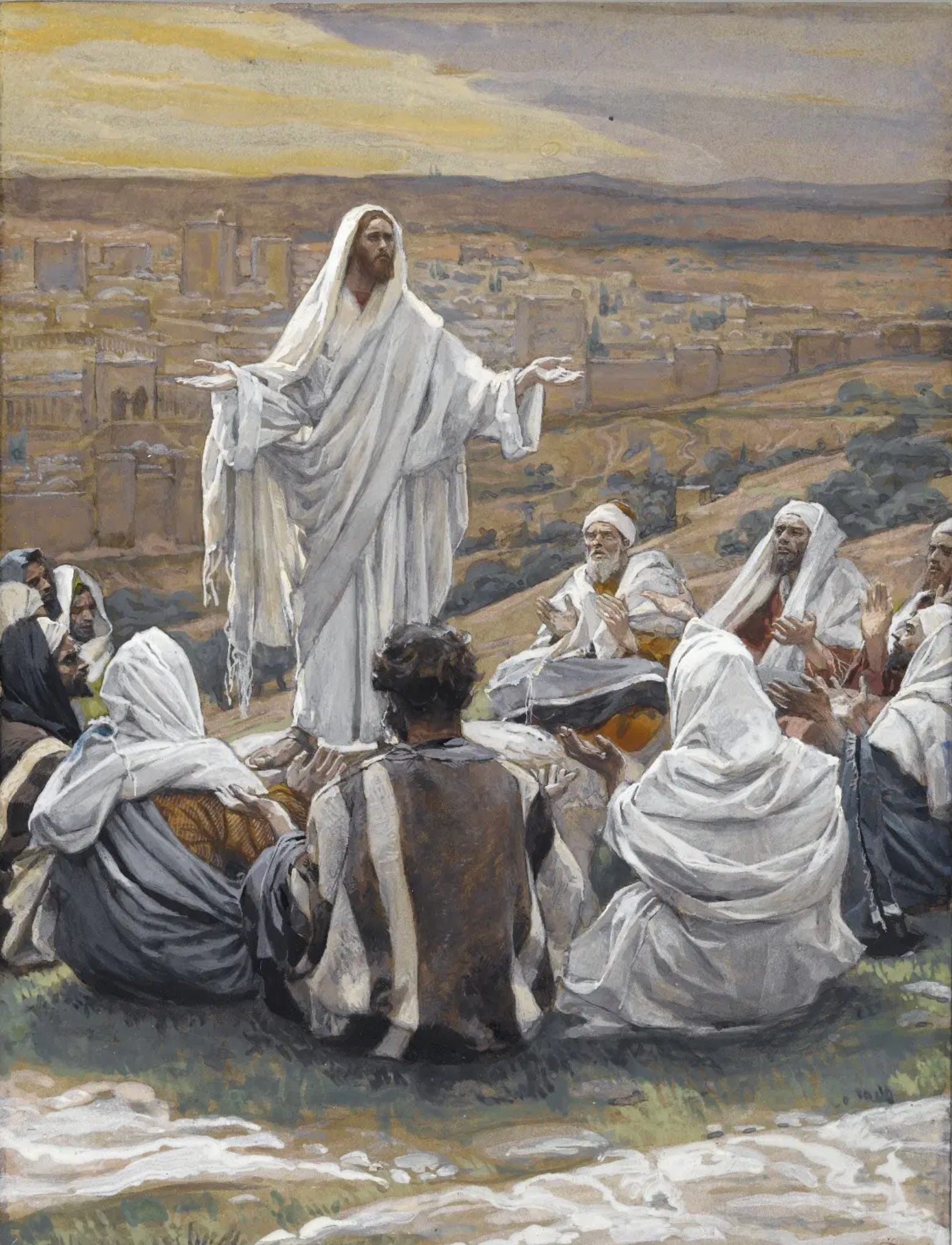
The Lord’s Prayer Is Stranger Than You Think (11:1–4)
The Lord’s Prayer is one of the most frequently recited texts in human history. Many of us have prayed it so often that the words have become almost invisible, like a familiar song we no longer truly listen to. This familiarity is worth challenging, because what Jesus actually put into these few lines is stranger, richer, and more demanding than most of us have been taught.
The disciples had observed Jesus praying before. Luke emphasizes this more than any other evangelist: at his baptism, before choosing the Twelve, and during the transfiguration. So when one of them finally asked, “Lord, teach us to pray, as John taught his disciples” (Luke 11:1), the request carried significance. John the Baptist had given his followers a unique prayer that symbolized community identity. The disciples were asking Jesus to do the same—to provide a way of praying that would identify them as his followers.
What Jesus provided was not just a personal practice but a community charter.
Father, hallowed be your name. Your kingdom come. Give us each day our daily bread, and forgive us our sins, for we ourselves forgive everyone who is indebted to us. And lead us not into temptation (Luke 11:2–4).
The core of the prayer is the petition “your kingdom come” (ἐλθέτω ἡ βασιλεία σου). The other petitions gain significance through it: the hallowed name, the bread, the forgiveness, and the deliverance each make sense as aspects of what it looks like when the kingdom arrives on earth. To pray this prayer is to align yourself with the coming of God’s reign.
The petition for bread centers on a single word, ἐπιούσιος, which appears in almost no other ancient Greek texts. Origen, in the third century, suspected Matthew coined it, highlighting its rarity. The word combines the preposition ἐπί (“upon, over, or beyond”) and a form related to οὐσία (“being, substance, or existence”), and the ambiguity of both parts allows for a variety of possible meanings.
If ἐπί carries the sense of “beyond” and οὐσία means “being” or “existence,” the word translates to “supersubstantial bread,” which refers to bread that goes beyond ordinary existence. This is how Jerome translated it in the Vulgate’s Matthew, and it has a clear eucharistic resonance.
If ἐπί conveys the sense of “for” or “toward” and the second element comes from the Greek idiom ἡ ἐπιοῦσα (the coming day), then ἐπιούσιος means “for the coming day,” representing tomorrow’s bread asked for today—an eschatological plea for a preview of the messianic banquet.
If ἐπί and οὐσία are read together in the common sense of “subsistence” or “what sustains life,” the word means “daily bread,” bread for survival, echoing the manna given one day at a time in the wilderness (Exod 16:4).
The petition is not only practical but also eschatological and sacramental, and the word may intentionally be broad enough to encompass all three.
Unlike ἐπιούσιος, the prayer’s treatment of forgiveness is precise and encourages attention. We bring ἁμαρτίας (“sins”) to God, a word that signifies moral failure and a fractured relationship with him. Conversely, others bring ὀφείλοντι (“debts”) to us, a term rooted in tangible obligation. The vertical dimension refers to sin; the horizontal dimension pertains to debt. Jesus links them, but not in a transactional manner: forgiven individuals become forgiving individuals, and a refusal to extend mercy to others shows that God’s mercy has not yet taken root in us.
The final petition is perhaps the most surprising. “Lead us not into temptation” seems like a request related to everyday moral struggles, and the Greek word πειρασμός can imply that meaning. However, in this context, it probably goes beyond ordinary temptation to refer to trial, ordeal, or eschatological crisis, with the NRSV translating it as “time of trial.” Jesus uses the same word in Gethsemane when he tells the disciples to pray lest they enter into πειρασμός (Luke 22:40, 46). The petition is a plea to avoid that intense test, the moment when everything falls apart, and faith is pushed to its limit. Honest prayer of this kind is an acknowledgment that we can’t keep ourselves together under such pressure, and we recognize that.
Prayed slowly and attentively, this is not the gentle, familiar prayer most of us inherited. It is a prayer for people who know what time it is: that the kingdom is coming, that the bread they need is more than just daily sustenance, that they owe more than they can repay, and that they cannot face the coming ordeal alone. What is remarkable is that a prayer carrying such weight begins with a single word: Father.