

Falling from Heaven (10:17–20)
The seventy-two have returned from the mission Jesus sent them on, and they are giddy.
“Lord, even the demons are subject to us in your name!” (10:17).
Jesus’ initial reply seems strange.
“I saw Satan fall like lightning from heaven” (10:18).
The verb behind “saw” is θεωρέω (theōreō), and here it is used in the imperfect tense, meaning “I was watching,” an ongoing sight rather than a single instance. Rather than an event from before the creation of the world, the fall Jesus describes began in the wilderness, where Satan tried to turn him from his mission and failed (4:1–13). Jesus has watched that fall continue ever since, most recently in Galilee, where the seventy-two watched demons give way in his name.
Two verses earlier he told Capernaum it would be “brought down to Hades” for refusing him, language drawn from Isaiah’s taunt against the king of Babylon, who boasted he would be “exalted to heaven” and instead was “brought down to Sheol” (Isa 14:13–15). Read on its own terms, Isaiah’s oracle mocks a tyrant’s delusion of grandeur, not a prophecy of Satan’s future.
Then comes the specific gift:
“Behold, I have given you authority to tread on serpents and scorpions, and over all the power of the enemy, and nothing shall hurt you” (10:19).
The wording recalls Psalm 91’s promise:
“You will tread on the lion and the adder ... the young lion and the serpent you will trample underfoot” (Ps 91:13).
Luke’s readers had already heard this psalm once. Satan quoted it to Jesus in the wilderness:
“He will command his angels concerning you, to guard you ... lest you strike your foot against a stone” (Luke 4:10–11, citing Ps 91:11–12).
There Satan recites the promise about a foot kept from stumbling and stopping exactly one verse short of the promise that the same foot would crush the serpent. Whatever Satan hoped to gain by quoting scripture selectively in the wilderness, Jesus now grants his followers precisely what that selective quotation left out.
Then Jesus corrects the celebration:
“Do not rejoice in this, that the spirits are subject to you, but rejoice that your names are written in heaven” (10:20).
Jesus was waging war, but not like the Romans did, nor like his fellow Jews wanted. Luke has already shown him refusing exactly that contest in the wilderness, when the devil offered him the kingdoms of the earth outright (4:5–8). The battle he won there, and is still winning through his disciples, was never a fight for that kind of power, and it is not yet finished. The seventy-two have only seen its first casualties.
The contrast here is between the fall of Satan from heaven and the command to rejoice because their names were written in heaven. Satan is falling and will be ultimately defeated. In contrast, those who follow Christ can rest secure that because of his victory, their names are secure in heaven, and there’s no greater cause for rejoicing.
One Thing Is Necessary (10:38–42)
When Mary sat at Jesus’ feet and listened to his teaching, she was doing something that required explanation in first-century Jewish culture. The posture of sitting at a teacher’s feet was not devotion in a generic spiritual sense. It was the posture of a disciple. Luke uses the verb παρακαθεσθεῖσα (parakathestheisa), which describes someone who has taken up a position alongside a teacher for instruction. This is the same idea as when he says he was trained “at the feet of Gamaliel” (Acts 22:3). The image is technical: a student and a rabbi in a formal relationship of learning.
But Mary was a woman.
Women in first-century Jewish society were not typically received as disciples in this sense. What Martha was doing — serving — was the expected role. What Mary was doing was not.
Jesus and his disciples enter the village, and Martha welcomes them into her house. Luke writes that Martha was “distracted with much serving” (10:40), and the word translated “distracted” carries the sense of being pulled in multiple directions at once. She is not doing something wrong; she is doing what a good host does. But she is increasingly agitated, and finally she breaks:
“Lord, do you not care that my sister has left me to serve alone? Tell her then to help me” (10:40).
Jesus’ reply is sometimes misread.
“Martha, Martha, you are anxious and troubled about many things, but one thing is necessary. Mary has chosen the good portion, which will not be taken away from her” (10:41–42).
The repetition of her name is not harsh. It is tender. Jesus is not dismissing what Martha has done. He is naming what is happening inside her, and the word he uses for “anxious” is the same root that appears in the parable of the sower for the worries that choke the word (8:14). The problem is not her service. The problem is what the service has become: a source of anxiety and trouble.
Mary, by contrast, has chosen the “good portion.” This word can carry the sense of a share in an inheritance, what belongs to someone by right. She has chosen what will last, and Jesus refuses to take it from her.
That refusal is the point. In first-century terms, someone could reasonably have argued that Mary was out of place, that she was neglecting a proper role to occupy an improper one. Jesus does not agree. He receives her as a disciple. He lets her sit at his feet. He defends that seat when it is challenged.
The one thing necessary is not passivity or the absence of work. It is the kind of presence that keeps everything else in its right order. Martha’s service was not the problem; her anxiety was. She had allowed the many things to crowd out the one thing, and she had become troubled in the very house where the Lord was sitting.
We do the same. We fill our days with genuinely good things and wonder why we feel distant from Jesus. The “many things” we fill our lives with can be taken away. Mary’s portion cannot.
The One Who Showed Mercy
Every Christian who worships regularly has heard the Summary of the Law more times than they can count. In my church, the priest recites it near the beginning of the service, and the congregation knows it before the words are finished.
Love the Lord your God with all your heart, soul, strength, and mind.
Love your neighbor as yourself.
The lawyer in Luke 10 could do the same. When Jesus asked what the law required, the man answered without hesitation, and Jesus commended him.
“You have answered correctly; do this, and you will live” (Luke 10:28).
The lawyer’s answer was not a guess. The Shema (Deut 6:4–5) was recited morning and evening by observant Jews, and combining it with Lev 19:18 as a summary of the entire law was a recognized practice in first-century Jewish discussion. Notably, in Matthew and Mark, it is Jesus who provides the double commandment; in Luke, the lawyer states it himself (cf. Matt 22:34–40; Mark 12:28–34). The lawyer is not being corrected. He is being held accountable for what he already knows.
The issue wasn’t that the lawyer didn’t know the commandments, but that he believed knowing them was sufficient.
He pressed further, and Luke explains why:
But he, desiring to justify himself, said to Jesus, “And who is my neighbor?” (Luke 10:29).
He is not really seeking understanding; he wants to know where the line is. He knows who God is and has some idea of what it means to love God with all his heart, soul, strength, and mind, but he seeks clarification about exactly whom he must love to fulfill the second great commandment. If “neighbor” can be defined narrowly enough, the commandment becomes manageable. If “neighbor” means only those within our own circle, or only those who share our social world, or only those who have been kind in return, then love of neighbor is a duty bounded by a fence. The lawyer did not ask the question to learn; he asked it to limit.
Jesus refused to answer the direct question. Instead, he told the parable of the man who fell among robbers on the road from Jerusalem to Jericho (10:30–35). At the end, he posed a different question altogether:
“Which of these three do you think proved to be a neighbor to the man who fell into the robbers’ hands?” (10:36).
Here is the real point. The lawyer wanted to know who he was required to love, but Jesus shifted the focus: who proved to be a neighbor? The question was no longer about the limits of obligation but about the condition of the heart.
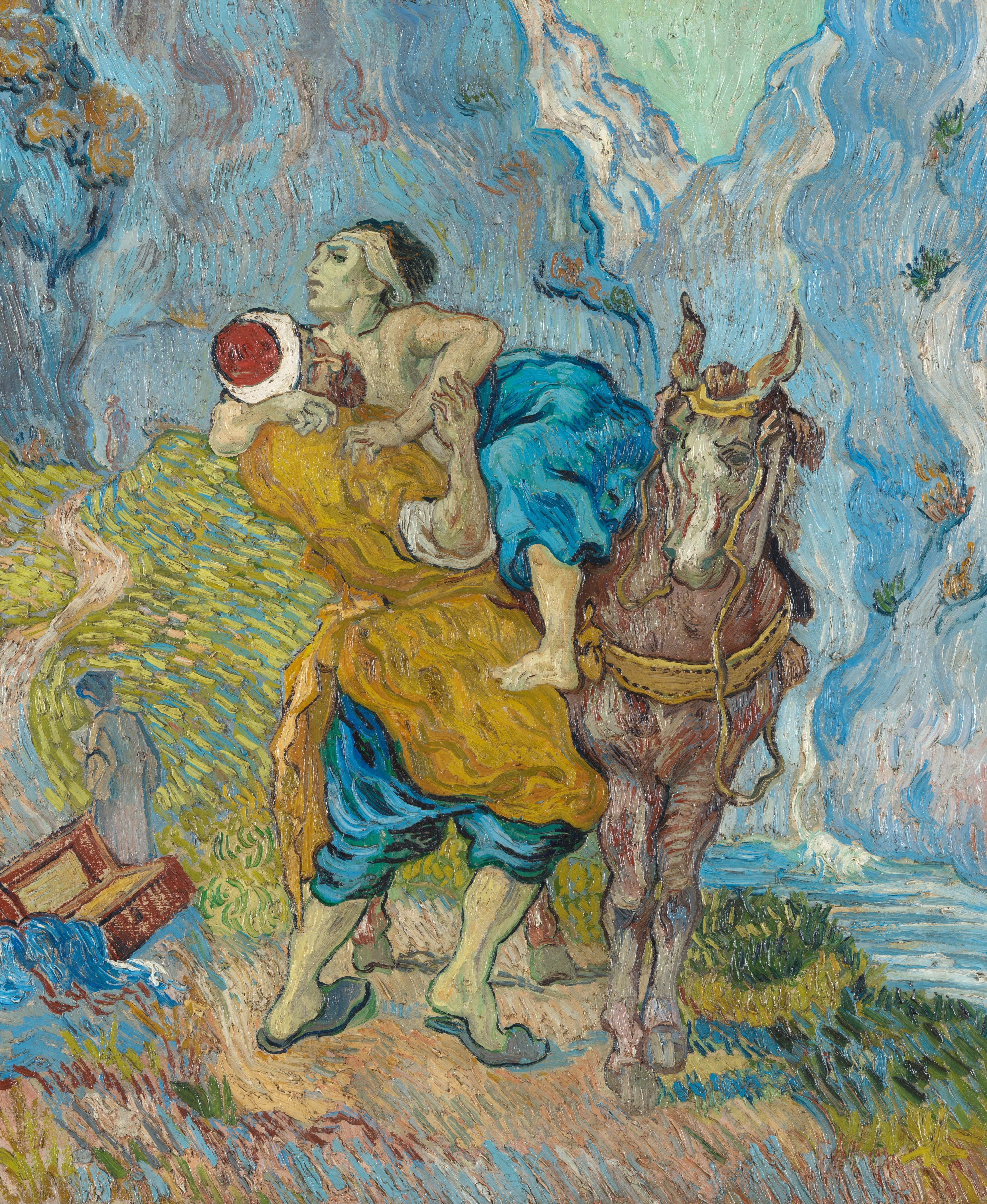
The fact that the hero of the parable is a Samaritan would have been offensive. But there is more happening beneath the surface. The details of the parable—the oil and wine, the donkey, the binding of wounds, the destination of Jericho—echo a nearly forgotten episode in 2 Chr 28, where Samaritans clothed the naked, anointed the wounded, set the frail on donkeys, and brought them to Jericho (28:15). Luke’s Samaritan is doing what a previous generation of Samaritans once did, embodying a covenant faithfulness that Israel had forsaken. The parable does more than introduce an unlikely hero; it reaches back into Israel’s own scriptures to bring conviction.
When Jesus finished the story, the lawyer gave the answer himself:
“The one who showed him mercy” (Luke 10:37).
That word “mercy” is the key. Mercy belongs to the very character of God, and he expects the same from his people. Mercy is not just a feeling; it is what motivates a person to cross the street toward someone in need rather than walk past them. The parable ends not with the boundary the lawyer was looking for, but with a definition that implicates him: a neighbor is the one who shows mercy. Jesus then says:
“You go, and do likewise” (10:37).
The Summary of the Law is heard near the beginning of the service, before the readings, before the sermon, before the table. It is placed there as a mirror held up before the congregation enters more deeply into worship. Luke 10 suggests that the mirror is effective only when we have been disturbed enough by what we see to go and do likewise.