

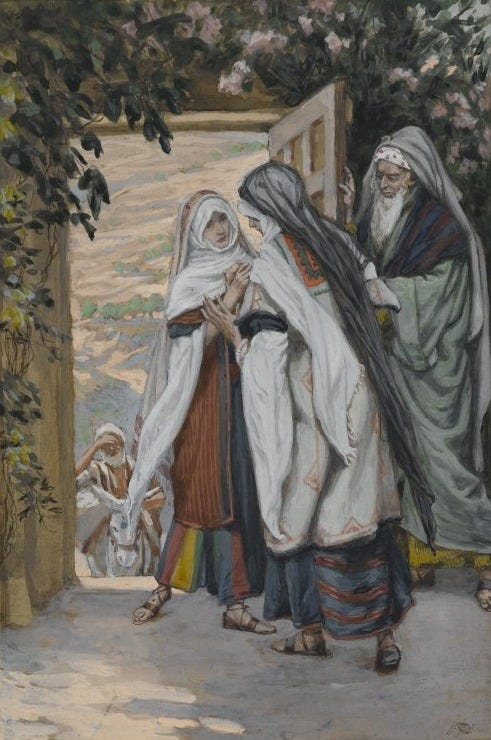
How Can the Ark Come to Me?
When the angel Gabriel tells Mary that she will conceive the Son of God, he offers two parallel clauses by way of explanation: “The Holy Spirit will come upon you, and the power of the Most High will overshadow you” (Luke 1:35). The two lines say the same thing in different words — a Hebraic poetic parallelism — and the second is where Luke’s theological precision is sharpest. The word translated “overshadow” is ἐπισκιάζω (episkiazō), and in the Septuagint it is used in a strikingly important context: the cloud of God’s glory descending on the newly completed tabernacle.
Then the cloud covered the tent of meeting, and the glory of the LORD filled the tabernacle. And Moses was not able to enter the tent of meeting because the cloud [overshadowed] (ἐπεσκίαζεν, LXX) it, and the glory of the LORD filled the tabernacle (Exod 40:34–35).
Luke compares Mary to the tabernacle. The divine presence that once descended on the wilderness tent now descends on her.
Luke then presses the image further. When Mary arrives at Elizabeth’s house, Elizabeth cries out:
“Why is this granted to me, that the mother of my Lord should come to me?” (Luke 1:43).
The question echoes what David asked when the ark of the covenant was brought to Jerusalem:
“How can the ark of the Lord come to me?” (2 Sam 6:9).
Luke emphasizes the comparison throughout the narrative. David leapt and danced before the ark (2 Sam 6:14); John leaped in Elizabeth’s womb (Luke 1:41). The ark stayed in Obed-edom’s house for three months (2 Sam 6:11); Mary remained with Elizabeth for three months (Luke 1:56). Luke is not making a casual analogy; he is presenting Mary in terms that deliberately recall the ark, the vessel of God’s presence.
The tabernacle and the ark converge in Mary.
Both images point to the same conclusion, which Elizabeth herself states: Mary is “the mother of my Lord” (Luke 1:43).
This divine designation for Mary’s child is the earliest Christological confession in Luke’s Gospel, and it resonates with the title the Church would later give to Mary: Theotokos, God-bearer. Luke has been leading up to this designation through the imagery of the tabernacle and ark. Mary carries in her body the one to whom the tabernacle and ark pointed all along. She bears their true meaning in her body.
That is why the Magnificat rings with such confidence. Mary sings as though the world has already changed (she sings in the past tense about future events), because in one sense it already has. The mighty will fall. The humble will be lifted up. God has remembered his promise to Abraham. Why? Because the Lord has come.
The ark is moving again. And when the presence of God comes near, nothing stays the same.
I agree with Barbara. I’ve never heard or seen these connections before. This is excellent- eye opening and thought provoking. Thank you so much for this devotional.
I have never read about those OT connections. Just amazing!! Love this!