

Turning the Hearts (1:5–25)
Zechariah is chosen by lot to enter the sanctuary and burn incense, a duty that fell to a priest of his division only once in a lifetime, given how many priests were on rotation (1:8-10). While the assembly prays outside, an angel stands on the right side of the altar inside. Gabriel tells Zechariah that he will have a son, one who will go before the Lord “in the spirit and power of Elijah, to turn the hearts of the fathers to the children, and the disobedient to the wisdom of the just, to make ready for the Lord a people prepared” (1:17).
Gabriel’s words draw upon the closing promise of the book of Malachi, that Elijah would come and “turn the hearts of fathers to their children and the hearts of children to their fathers” before the great and terrible day of the Lord (Mal 4:6). Luke’s angel keeps the first half of that promise nearly intact but drops the second. Malachi’s Elijah reconciles two generations to each other, fathers to children and children back to fathers. Gabriel’s Elijah does something narrower. He turns fathers toward children and turns “the disobedient” toward “the wisdom of the just,” a description of repentance, not of a mended family.
Luke isn’t narrowing the promise on his own. Ben Sira had already done so a century and a half earlier. Writing around 180 BC, he praised Elijah as the one appointed “to turn the heart of the father to the son, and to restore the tribes of Jacob” (Sir 48:10). Malachi’s balanced pair has become one direction only, father to son, and the return of children to their fathers has become the restoration of Israel’s scattered tribes. Gabriel’s word to Zechariah stands closer to Ben Sira’s Elijah than to Malachi’s own. By the time the angel speaks in the temple, turning the hearts had stopped meaning a mended relationship between two living generations and had come to mean the return of a disobedient people to God.
The promise is strange for a childless couple past childbearing age. Zechariah is handed a task centuries in the making. His own child will be the prophet promised by the prophet Malachi. Luke is telling the same story we’ve seen in the other Gospels. The exile is coming to an end. The Elijah who would precede the Lord has come, which can mean only one thing. The Lord is on his way back to Zion. This story shapes all of the Synoptic Gospels. It is the story the Evangelists all believed that the death and resurrection of Jesus Christ had brought to its ultimate conclusion. Learning how to read the Gospels starts with learning this story and keeping it in mind as we read every word of the Gospels.
The Branch and the Dawn (1:68–79)
When the prophets wanted a word for the king God had promised to David, they reached for an image from the earth. The Hebrew word is ṣemaḥ, a shoot, sprout, or branch, a new growth breaking out of an old root. Jeremiah wrote: “I will raise up for David a righteous Branch” (Jer 23:5). The prophet Zechariah used it twice, naming a coming figure simply the Branch, the one who would build the temple of the Lord (Zech 3:8; 6:12). When these prophecies were put into Greek, the translators chose a word that kept the upward motion, ἀνατολή (anatolē), a rising.
That word had a second meaning. ἀνατολή is also the ordinary Greek word for the rising of the sun, the dawn, and the east. One prophet had already welded the royal hope to the morning: “for you who fear my name, the sun of righteousness shall rise with healing in its wings” (Mal 4:2). The promised one would come up like a shoot from David’s line and break over the world like daybreak.
Both streams run together in a single word, and the word falls from the mouth of a priest, also named Zechariah, who has been unable to speak since an angel met him in the temple. His first sentence after the silence is a song, and the song ends here:
because of the tender mercy of our God, whereby the sunrise shall visit us from on high to give light to those who sit in darkness and in the shadow of death, to guide our feet into the way of peace (1:78–79).
Luke’s word carries the prophets’ old ambiguity. Is the ἀνατολή the Branch out of David’s house, or the dawn breaking over the earth? Zechariah has already sung of “a horn of salvation for us in the house of his servant David” (1:69), which points toward the shoot. The next line pulls toward the sun. Zechariah likely means both. The Branch and the dawn are one person, and both meanings are summed up in ἀνατολή.
He is the Branch of David. He is dawn breaking upon the world. He is the promise to David fulfilled. He is God’s light shining into the darkness of our lives.
How Can the Ark Come to Me?
When the angel Gabriel tells Mary that she will conceive the Son of God, he offers two parallel clauses by way of explanation: “The Holy Spirit will come upon you, and the power of the Most High will overshadow you” (Luke 1:35). The two lines say the same thing in different words — a Hebraic poetic parallelism — and the second is where Luke’s theological precision is sharpest. The word translated “overshadow” is ἐπισκιάζω (episkiazō), and in the Septuagint it is used in a strikingly important context: the cloud of God’s glory descending on the newly completed tabernacle.
Then the cloud covered the tent of meeting, and the glory of the LORD filled the tabernacle. And Moses was not able to enter the tent of meeting because the cloud [overshadowed] (ἐπεσκίαζεν, LXX) it, and the glory of the LORD filled the tabernacle (Exod 40:34–35).
Luke compares Mary to the tabernacle. The divine presence that once descended on the wilderness tent now descends on her.
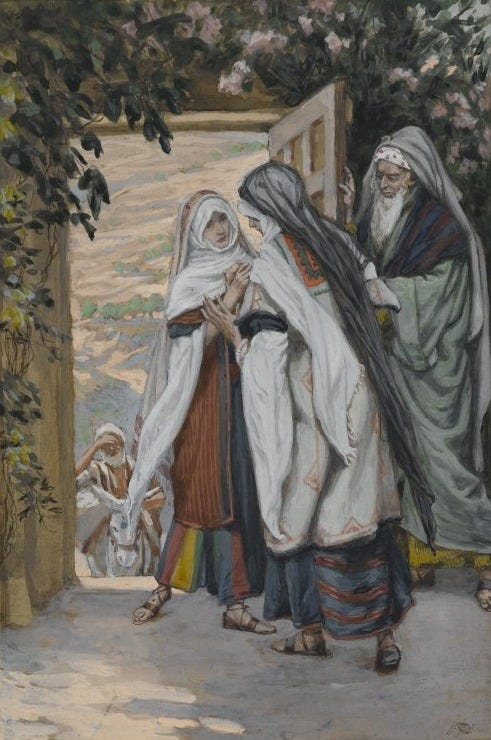
Luke then presses the image further. When Mary arrives at Elizabeth’s house, Elizabeth cries out:
“Why is this granted to me, that the mother of my Lord should come to me?” (Luke 1:43).
The question echoes what David asked when the ark of the covenant was brought to Jerusalem:
“How can the ark of the Lord come to me?” (2 Sam 6:9).
Luke emphasizes the comparison throughout the narrative. David leapt and danced before the ark (2 Sam 6:14); John leaped in Elizabeth’s womb (Luke 1:41). The ark stayed in Obed-edom’s house for three months (2 Sam 6:11); Mary remained with Elizabeth for three months (Luke 1:56). Luke is not making a casual analogy; he is presenting Mary in terms that deliberately recall the ark, the vessel of God’s presence.
The tabernacle and the ark converge in Mary.
Both images point to the same conclusion, which Elizabeth herself states: Mary is “the mother of my Lord” (Luke 1:43).
This divine designation for Mary’s child is the earliest Christological confession in Luke’s Gospel, and it resonates with the title the Church would later give to Mary: Theotokos, God-bearer. Luke has been leading up to this designation through the imagery of the tabernacle and ark. Mary carries in her body the one to whom the tabernacle and ark pointed all along. She bears their true meaning in her body.
That is why the Magnificat rings with such confidence. Mary sings as though the world has already changed (she sings in the past tense about future events), because in one sense it already has. The mighty will fall. The humble will be lifted up. God has remembered his promise to Abraham. Why? Because the Lord has come.
The ark is moving again. And when the presence of God comes near, nothing stays the same.
Wow! I agree with the other 2 comments. I have never seen or heard these comparisons before. It’s so beautiful!
I agree with Barbara. I’ve never heard or seen these connections before. This is excellent- eye opening and thought provoking. Thank you so much for this devotional.