

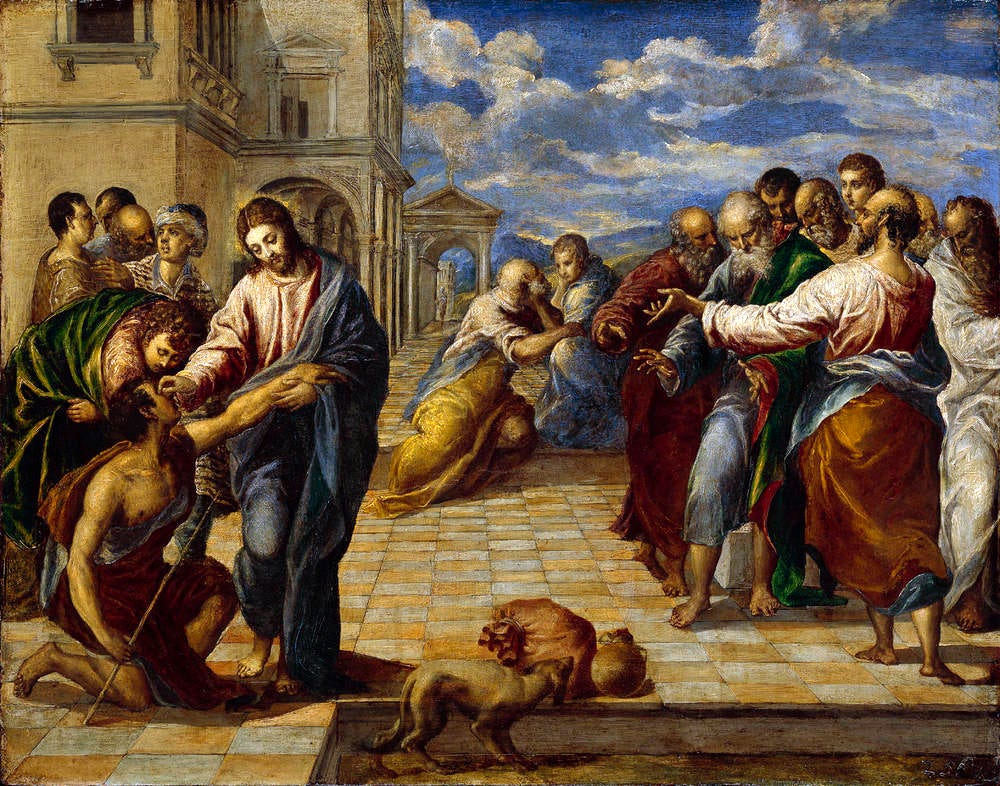
Your Guilt Remains (9:35–41)
Jesus hears that the man he healed has been thrown out of the synagogue, so he goes to look for him. The man has just lost his place in the community for telling the truth about what happened to him, and Jesus asks him directly, “Do you believe in the Son of Man?” The man does not know who that is until Jesus tells him, and then he worships him on the spot (9:35–38).
Jesus then explains why he came: “For judgment I came into this world, that those who do not see may see, and those who see may become blind” (9:39). On its own, the statement sounds paradoxical unless we remember what just happened in the chapter. A man born blind now sees. The Pharisees who interrogated him, men who could see perfectly well and who prided themselves on knowing the law of Moses, have just told him, “You were born in utter sin, and would you teach us?” (9:34). The reversal Jesus names is not theoretical.
Some of the Pharisees overhear him and ask, “Are we also blind?” Jesus answers, “If you were blind, you would have no guilt; but now that you say, ‘We see,’ your guilt remains” (9:40–41). The line does something Jesus rarely does this plainly. He names the exact mechanism of judgment. The guilt lies in the claim to sight, not in blindness itself.
Three chapters later, when the crowds refuse to believe despite the many signs Jesus performed in front of them, John explains the unbelief by quoting Isaiah: “He has blinded their eyes and hardened their heart” (12:40), the same prophet who was told at his commission to go and preach to a people who would keep seeing but never perceive (Isa 6:9–10). John signals this in chapter 9 and names it outright in chapter 12: Isaiah’s commission describes exactly what is happening to the people standing before Jesus.
Jesus’s warning falls hardest on people whose vocation is to see clearly. We study, we learn the Scriptures, we form settled convictions about God and what he requires, and all of that is good. None of it protects us from the sin the Pharisees commit in this scene. The danger does not come from lacking knowledge. It comes from the certainty that we already have what we need and no longer need to be shown anything. The man born blind was in no position to defend what he thought he knew. That turned out to be exactly the position from which he could see Jesus for who he is.
The Closed System (9:8–34)
The man who left the pool of Siloam, now able to see, walks straight into a hearing he never asked for. His neighbors, the people who watched him beg for years, can't reconcile what they knew with what they see.
“Is not this the man who used to sit and beg?” (John 9:8).
He plainly explains what happened. They take him to the Pharisees, and the serious questioning starts.
The first round hinges on a technicality. Jesus made mud and healed on the Sabbath, and for some of the Pharisees, that single fact settles the case before the evidence is heard.
“This man is not from God, for he does not keep the Sabbath” (9:16).
Others emphasize the more obvious point that sinners do not perform this kind of sign, and the group splits. Unable to settle the matter among themselves, they summon the man’s parents, who only confirm the basic facts of his birth and blindness. They refuse to say more.
“His parents answered, ... but how he now sees we do not know, ... for they feared the Jews” (9:20–22).
The healed man is called back a second time. What he says to them is not evasive. It becomes bolder with each exchange.
“Whether he is a sinner I do not know. One thing I do know, that though I was blind, now I see” (9:25).
When they press him again, he turns the interrogation back on his questioners, then he reasons past them entirely: no one has ever opened the eyes of a man born blind, so a man who can do this cannot be what they claim he is. Their answer to that argument is not an argument at all. It is a verdict.
“You were born in utter sin, and would you teach us?” And they cast him out (9:34).
What is remarkable throughout this scene is how each side responds. The man’s testimony does not weaken under pressure; it becomes sharper. Every round of questioning provides him with another point to stand on, until he's debating theology with men who have spent their entire lives arguing about it. The Pharisees, on the other hand, go in the opposite direction. Every new piece of evidence—whether it's the healing itself, the man’s reasoning, or his parents’ fear—only confirms what they had already decided before the hearing even began. Their conclusion was set at verse sixteen, and everything afterward was just a search for a way to support that conclusion.
We understand this pattern because we've experienced both sides. We've held beliefs that couldn't be changed by any evidence, and called that faithfulness. We've also had someone else’s fixed mindset judge who we were before we ever spoke. The Pharisees weren’t wrong to care about the Sabbath. They were wrong to let one fixed idea guide all their perceptions, so that a man they should have celebrated became a man they felt they had to reject.
No Longer (9:1–7)
For centuries, Israel had lived with a painful proverb:
The fathers have eaten sour grapes, and the children’s teeth are set on edge (Jer 31:29; Ezek 18:2).
The idea ran deep. God himself had warned in the Torah:
I the Lord your God am a jealous God, visiting the iniquity of the fathers on the children to the third and the fourth generation of those who hate me (Exod 20:5).
Suffering, in this framework, was traceable to sin, whether your own or your ancestors’.
Both Ezekiel and Jeremiah pushed back. Ezekiel declared that the soul who sins shall die, each person accountable before God alone (Ezek 18:4). Jeremiah, writing in what is the new covenant chapter of the Old Testament, announced that the day was coming when the proverb would be retired:
In those days they shall no longer say: “The fathers have eaten sour grapes, and the children’s teeth are set on edge.” But everyone shall die for his own iniquity (Jer 31:29–30).
The very next verses announce the new covenant (Jer 31:31–34). The question of who pays the penalty for sin and the promise of a new covenant stand side by side in Jeremiah’s vision.
That is the world the disciples inhabit when they encounter the man born blind. Their question is not foolish. It is the only question their theology allows:
“Rabbi, who sinned, this man or his parents, that he was born blind?” (John 9:2).
They want to know why.
Jesus refuses the premise entirely:
“It was not that this man sinned, or his parents, but that the works of God might be displayed in him” (John 9:3).
He is not merely redirecting the conversation. He is enacting what Jeremiah promised. The age in which suffering is always read as divine retribution is giving way to something new. Jesus doesn’t look back to assign blame. He looks forward to what God is about to do.
He makes mud, anoints the man’s eyes, and sends him to wash in the pool of Siloam (John 9:6–7). The man goes, washes, and comes back seeing.
When the Pharisees press the healed man to renounce Jesus, he won’t be moved:
“Whether he is a sinner I do not know. One thing I do know, that though I was blind, now I see” (John 9:25).
He makes no theological argument. He doesn’t appeal to Scripture to explain who Jesus is. He just gives the testimony of a changed life, and it is more convincing than anything the Pharisees can muster. Changed lives change hearts.
Jesus never answered the disciples’ question. He replaced it with a better one. Not “why is this man suffering?” but “what will God do here?” And then he showed them.
As Christ’s disciples, we need to start seeing the world the way Jesus did rather than through our theological systems. Everywhere there is pain, there is potential for the works of God to be displayed. When God’s people work to bring God’s healing, justice, and mercy into the world, that witness to Jesus is more persuasive than any theological or rational argument we could ever construct.
For Judgment (9:35–41)
John 9 focuses on the healing of a man born blind and the consequences of that miracle. In the Gospels, while these are literal miracles, the acts of restoring sight to the blind are almost always also metaphors and signs. Verse 39 highlights this when Jesus says, “For judgment I came into this world, that those who do not see may see, and those who see may become blind.”
Jesus clearly isn’t speaking about literal blindness here. Instead, he uses the language of blindness and sight metaphorically to describe the great reversal that his ministry will bring to the world. Those who believe they see the truth will become blind, while those considered blind by the world to God’s truth will see.
When questioned by the Pharisees (who claimed to see), the man born blind said, “One thing I do know, that though I was blind, now I see” (9:25). He didn’t understand everything about who Jesus was and is. Neither do I, and neither do you. But what he did know was how Jesus had changed his life, and that was enough for him. Focus today on how Jesus changed your life, and then, like the man born blind, worship him.