

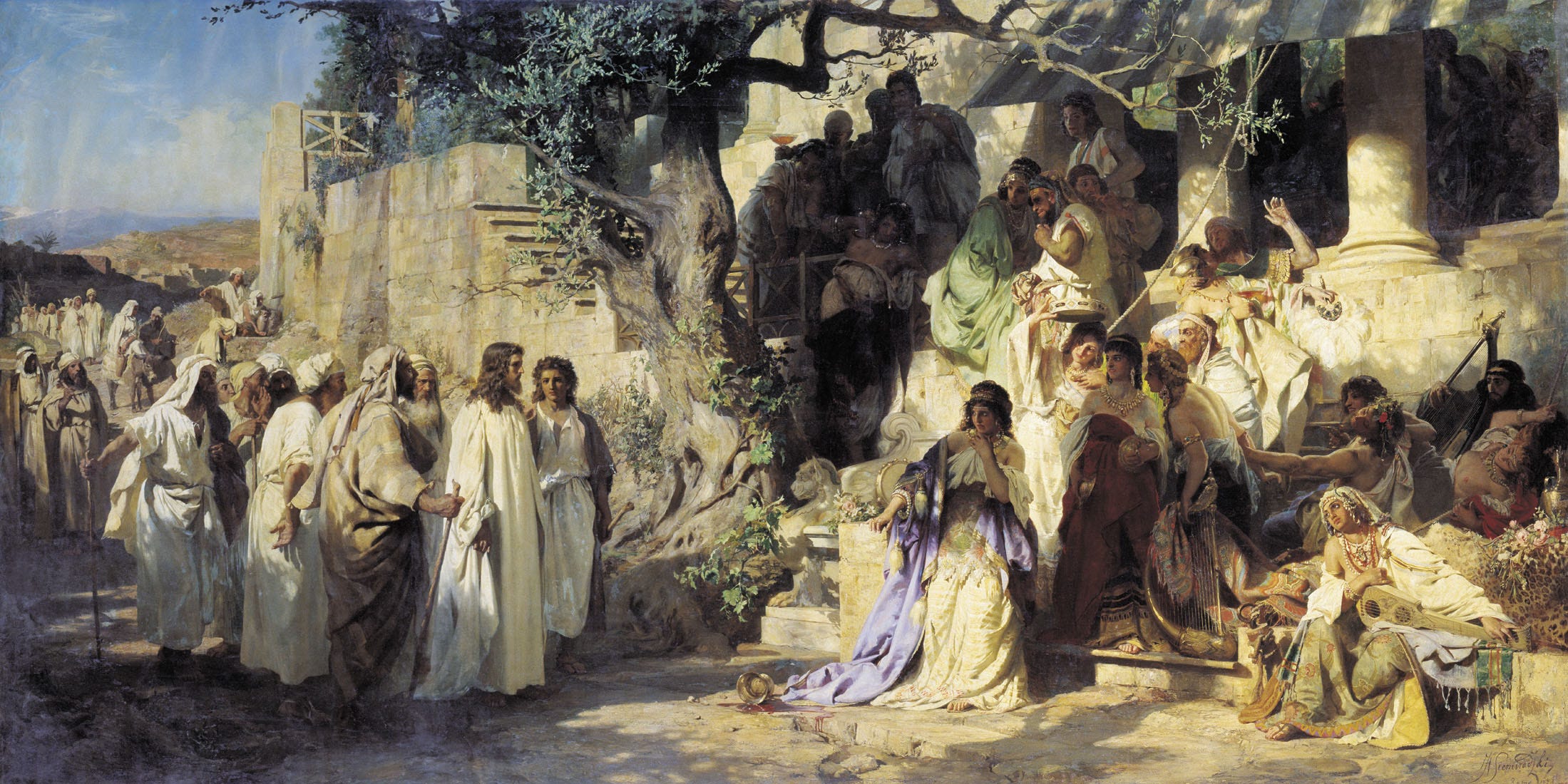
A Murderer from the Beginning (8:31–47)
Jesus says to the crowd, “If you abide in my word, you are truly my disciples, and you will know the truth, and the truth will set you free” (8:31–32). Their reply comes quickly: “We are offspring of Abraham and have never been enslaved to anyone” (8:33). Set against Israel’s experience in Egypt and Babylon, the claim is startling. This requires a bit of mirror reading, but I suspect they considered themselves privileged to have been born in the land of Judah at a time when the nation wasn’t independent, but the people weren’t slaves either. They were the descendants of those who had returned from exile, and unlike their ancestors, they had never been enslaved.
Jesus disputes their claim by redefining slavery. “Everyone who practices sin is a slave to sin” (8:34), and a slave has no permanent place in the house; only a son does (8:35). Freedom, when it comes, comes from the son: “if the Son sets you free, you will be free indeed” (8:36).
The argument moves from slavery to sonship. “If you were Abraham’s children, you would be doing the works Abraham did” (8:39), Jesus says, but his hearers are doing something else: “you seek to kill me” (8:37, repeated at 8:40). Jesus names the conclusion already enacted: “you are doing the works your father did” (8:41). They answer with Scripture’s own language, going past Abraham to divine ancestry: “We have one Father, even God” (8:41). It is probably worth remembering here that Israel is first called God’s son at the exodus.
Jesus disputes this claim too. He says, “If God were your Father, you would love me” (8:42), since he comes from God. Instead, “my word finds no place in you” (8:37) and “you are not able to bear to hear my word” (8:43). They claim to be God’s children, the children of the exodus, or more probably, the second exodus, who had come back to the land just as God promised. But Jesus says, “You are of your father the devil, and your will is to do your father’s desires. He was a murderer from the beginning, and has nothing to do with the truth, because there is no truth in him” (8:44).
John supplies his own commentary on that verse later, in a letter to his own churches. “Whoever makes a practice of sinning is of the devil, for the devil has been sinning from the beginning” (1 John 3:8), he writes, using the identical phrase, ἀπ’ ἀρχῆς, “from the beginning.” He then goes all the way back to the first murder: “We should not be like Cain, who was of the evil one and murdered his brother. And why did he murder him? Because his own deeds were evil and his brother’s righteous” (1 John 3:12). Cain murdered Abel not because Abel accused him of anything, but because his brother’s righteousness was itself the rebuke he could not bear. The men seeking to kill Jesus are not inventing a new sin. They are repeating the story of Cain and Abel.
The Light of the World (8:12–20)
“I am the light of the world. Whoever follows me will not walk in darkness, but will have the light of life” (John 8:12).
Jesus says this during the Feast of Tabernacles, the same festival that has filled the previous chapter with debate about his identity. Each night of the feast, four golden lampstands stood in the temple’s Court of the Women, and their light was said to reach every courtyard in Jerusalem. The Mishnah remembers pious men dancing before them with torches while the Levites sang. The feast itself commemorated Israel’s wilderness years, when a pillar of fire went before the people by night (Exod 13:21). Jesus speaks these words in that same court and claims for himself what the pillar once was for Israel: light that does not merely show a path but leads a people through the dark toward life.
Jesus’ claim also picks up a promise Isaiah made to a nation that had lost its way. Yahweh’s servant would be “a light for the nations,” opening blind eyes and bringing prisoners out of darkness (Isa 42:6–7; 49:6). What the festival lamps could only represent for a single week, Jesus claims to be without interruption. Whoever follows him receives not a memory of guidance but its substance.
The Pharisees do not dispute the imagery. They dispute the witness. “You are bearing witness about yourself; your testimony is not true” (John 8:13). Behind their objection stands the law’s own requirement that testimony be established by two witnesses, not one (Deut 19:15). Jesus does not deny the principle. He supplies the second witness. His testimony and the Father’s testimony agree, because the Father sent him and knows exactly what is being testified to (8:16–18).
Their reply exposes the actual problem. “Where is your Father?” (8:19). They are standing in front of the light and asking where it comes from. Jesus tells them plainly that knowing him and knowing the Father are not two separate achievements. To see one is to see the other. Their question is not a failure of information. It is a failure of sight.
John notes, almost as an aside, that no one arrested Jesus because his hour had not yet come (8:20). The light that exposes the darkness will eventually be extinguished, and when it is, the world will discover that the darkness could not hold it.
Before Abraham Was (8:48–59)
When Moses asks the name of the God who speaks from the burning bush, the answer comes back in the first person: “I AM WHO I AM” (Exod 3:14). The Greek translation renders this ἐγώ εἰμί ὁ ὤν, the self-existent one whose being depends on nothing outside himself. Centuries later, Isaiah records Yahweh returning to that same name in a courtroom scene in which the nations are summoned to produce witnesses for their gods. Yahweh’s own testimony is decisive:
“You are my witnesses,” declares the Lord, “and my servant whom I have chosen, that you may know and believe me and understand that I am he. Before me no god was formed, nor shall there be any after me" (Isa 43:10).
The Hebrew אֲנִי הוּא, rendered in the Septuagint as ἐγώ εἰμι, marks Yahweh’s absolute uniqueness across Deutero-Isaiah (41:4; 43:25; 46:4; 48:12). From Sinai to the exile, the name belongs to Yahweh alone. No creature shares it.
Then Jesus claims that name.
The exchange leading to v. 58 has the character of a hostile interrogation. Jesus’s opponents open with a double insult:
“Are we not right in saying that you are a Samaritan and have a demon?” (8:48).
Jesus does not defend his honor. He defers it entirely to the Father (8:50) and advances a claim his opponents find more dangerous than any slur: that keeping his word delivers a person from death (8:51). When they protest that Abraham himself died, Jesus does not yield. He names Abraham as a witness: “Your father Abraham rejoiced that he would see my day. He saw it and was glad” (8:56). John does not specify where Abraham saw it. However, Second Temple traditions associated the patriarch with prophetic sight of future redemption. What matters is that Abraham saw and rejoiced, while Jesus’s opponents see and rage.
The crowd hears a man not yet fifty claiming acquaintance with a patriarch dead for centuries, and they press him: “You have seen Abraham?” (8:57). The answer is the climax of the chapter and of the entire interrogation:
“Truly, truly, I say to you, before Abraham was, ἐγώ εἰμι” (8:58).
The words ἐγώ εἰμι are not a grammatical accident. They are the name from the burning bush and the name from the Isaianic courtroom, spoken now by Jesus without qualification or apology. He does not claim merely to predate Abraham. He claims the mode of existence that belongs to Yahweh alone, the uncreated, self-existent being before whom no other god stands.
The crowd understands perfectly. They pick up stones (8:59). In moving to execute him for blasphemy, they become the most honest witnesses in the chapter. The name that Yahweh spoke from Sinai and that Isaiah said belonged to no creature has been claimed by the carpenter from Nazareth.
January 9, 2026
You might notice (or have noticed yesterday) the double brackets around John 7:53–8:11, along with a note indicating that the earliest manuscripts do not include this well-known passage. This is true, and it has led some to argue that the story of the woman caught in adultery should be removed from our Bibles and not preached on because it was likely not part of the original composition of John.
But consider this: many of the early church fathers were aware of this story and cited it authoritatively, and someone in the early church was so convinced that it was an authentic account from the life of Jesus that they felt compelled to include it in John’s Gospel (as well as Luke’s, actually; some even argue it fits more appropriately in Luke).
The question here concerns authority. Are the sayings and actions of Jesus authoritative because they are in the Bible (meaning the original writings of the books), or because Jesus said and did them?
The story of the woman caught in adultery is likely not original to John but is nevertheless still an authentic Jesus tradition. Should we cut this remarkable story of forgiveness from our Bibles, or give thanks for the mercy that Jesus showed the woman and model that same mercy in the world?