

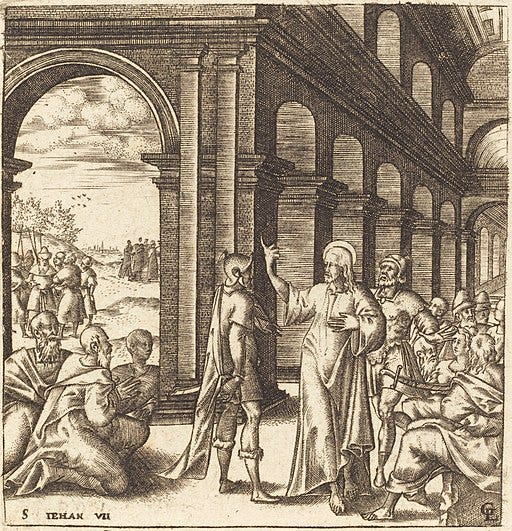
Making Whole on the Sabbath (7:14–24)
Halfway through the Feast of Booths, Jesus goes up to the temple and begins to teach. The crowd is caught off guard. “How is it that this man has learning, when he has never studied?” (John 7:15). Jesus answers by relocating the source of his teaching: “My teaching is not mine, but his who sent me” (7:16). Whether anyone can tell the difference, he says, depends on obedience rather than education. “If anyone’s will is to do God’s will, he will know whether the teaching is from God or whether I am speaking on my own authority” (7:17). The test is not academic credentials. It is a willingness to do what God asks.
Jesus then presses the crowd on a specific case. “Did not Moses give you the law? Yet none of you keeps the law. Why do you seek to kill me?” (7:19). The crowd answers with an accusation of its own: “You have a demon! Who is seeking to kill you?” (7:20). But Jesus is referring to the healing of the paralytic at Bethesda two chapters earlier (5:1–9), which had provoked exactly this murderous response (5:16, 18).
Jesus doesn’t answer them directly but turns instead to a problem within the Mosaic Law. “Moses gave you circumcision (not that it is from Moses, but from the fathers), and you circumcise a man on the Sabbath” (7:22). Leviticus requires that a male child be circumcised on the eighth day without exception (Lev 12:3), and when the eighth day fell on a Sabbath, the ritual law of circumcision was understood to override the Sabbath rather than wait. If the law permits altering one part of a man’s body on the Sabbath to keep a single commandment, Jesus argues, how much more should the Sabbath permit making a man’s whole body well.
“If on the Sabbath a man receives circumcision, so that the law of Moses may not be broken, are you angry with me because on the Sabbath I made a man’s whole body well?” (7:23).
The argument is a recognized form of rabbinic reasoning, moving from the lesser case to the greater, later associated with Hillel’s exegetical rules. Jesus is not evading the law. He is reasoning from inside it, more carefully than his accusers.
The exchange ends with a command that reframes the whole dispute. “Do not judge by appearances, but judge with right judgment” (7:24). The language echoes the standard the law itself gives Israel’s judges, who are told to judge righteously and without partiality (Deut 1:16; Lev 19:15). The crowd has applied the Sabbath law correctly on the surface and missed what the law was for. A rule that makes room for a cut on the skin has no coherent reason to forbid a cure for the whole body.
It’s very easy for us to fall into this same kind of rule-keeping. (Or should it be rule-reading?) Jesus didn’t fulfill the Law and the Prophets a new set of rules for us to keep instead. And even within the Law, there’s an inner-dialogue happening that requires wisdom to sort through. This is why I’m always leery of anyone who wants to quote a single verse of the Bible at me for just about any reason. I’m just as leery when someone quotes a single verse and says that they’re position or interpretation is Biblical, implying that anyone who disagrees with them is really disagreeing with the Bible. Christian ethics and theology simply don’t work like. Don’t start (and end) your ethical debates with a verse from anywhere in the Bible usually quoted without context. Start those coversation by looking at and following Jesus, and then work out from there. He is the center of the concentric circles that make up Christian ethics and theology.
From the Father (7:40–44)
Jesus’s words at the feast split the crowd into three basic groups. Some said, “This really is the Prophet” (John 7:40), reaching for the promise that God would raise up “a prophet like [Moses]” (Deut 18:15, 18). Others said simply, “This is the Messiah” (7:41). But a third group objected to the claims of the second:
“Has not the Scripture said that the Christ comes from the offspring of David, and comes from Bethlehem, the village where David was?” (John 7:41–42).
The objection is not without merit. Micah had named the town where the coming Davidic king would be born centuries earlier:
“But you, O Bethlehem Ephrathah... from you shall come forth for me one who is to be ruler in Israel” (Mic 5:2).
Samuel had anointed David there as a shepherd boy (1 Sam 16:1, 4, 13), and the Lord had promised David an heir whose kingdom would never end (2 Sam 7:12–13). By the first century, the Davidic-Bethlehem link was common among those waiting for a coming king. The crowd cites Scripture correctly, but their conclusion goes wrong at a single, ordinary point: they do not know that Jesus was born in Bethlehem (cf. Matt 2:1; Luke 2:4–7).
John could have ended the debate in a sentence. He does not. He lets the objection stand and moves straight to the temple guards returning empty-handed (John 7:45). His silence is interesting.
Fifteen verses earlier, the same crowd argued that the Messiah’s origin must stay hidden, then ruled Jesus out because they assumed they already knew where he came from. Jesus answered that his real origin was not Galilee but the Father who sent him (7:27–29). Now the crowd argues that the Messiah’s origin must be Bethlehem, and gets tangled in geography again. John will not correct their facts, because facts were never the real question. Whether the crowd traces Jesus origin to Nazareth or to Bethlehem, they are still asking the wrong question. The answer Jesus has already given stands: he comes from the Father, and to the Father he goes (7:29; 13:3).
We do something similar when we treat faith as a matter of getting the right facts straight. We call this wisdom, discernment, and even spiritual maturity, and sometimes it is. But it can also be a more sophisticated version of the crowd’s mistake, reciting Scripture correctly while missing the one it was written to identify. Bethlehem matters, and Micah was not wrong. But knowing where Jesus was born does not answer the question the crowd actually needed answered. Only knowing the Son who has come from the Father can do that.
The Origin They Missed (7:25–31)
Israel’s hope for a Messiah took on a particular form. By the Second Temple period, many Jews believed that when the Messiah finally arrived, his origins would be concealed, and his true identity would remain hidden until the moment he suddenly appeared and was revealed. It was this hiddenness that would define him—no one would see him coming.
This expectation appears in several texts from that period: the figure rising from the sea in 4 Ezra is hidden and unknown until his revelation (4 Ezra 13:51–52), the Son of Man in 1 Enoch is described as chosen and concealed from God before creation (1 En. 48:6), and Justin Martyr’s second-century dialogue with Trypho preserves the tradition that the Messiah remains unknown even to himself until Elijah comes to reveal him (Justin Martyr, Dial. 8.4).
The Jerusalem crowd in John 7 is aware of this tradition, and they use it to settle the question of Jesus once and for all.
“But we know where this man comes from, and when the Christ appears, no one will know where he comes from” (John 7:27).
The logic appears sound. They believe Jesus is from Galilee, yet the Messiah’s origins are meant to be unknown. So, Jesus cannot be the Messiah. Case closed.
John, however, is doing something precise here. The crowd is correct that the Messiah’s origins would be concealed from them. They are simply mistaken about which origins are important. Jesus responds with sharp irony:
“You know me, and you know where I am from. But I have not come of my own accord. He who sent me is true, and him you do not know. I know him, for I come from him, and he sent me” (John 7:28–29).
The geographic location, Galilee, isn’t the main point. The important origin is the Father, who is completely hidden from them. They dismiss Jesus based on a tradition that, applied correctly, would have identified him. The crowd reaches for the right criterion and misses the right answer.
This pattern runs throughout John’s Gospel. Characters often speak more truth than they realize. Caiaphas later states it is more convenient for one man to die for the people, meaning something much smaller than what John records (John 11:49–52). Pilate asks, “What is truth?” while standing in front of it (John 18:38). The Jerusalem crowd references the hidden Messiah and describes him perfectly without actually recognizing him.
Jesus’s true origin is not a village in Galilee. It is the Father who sent him. And because they do not know the Father, they cannot recognize the Son. The hiddenness they expected was always theological, not geographical. The Messiah came from exactly where no one was looking.
The Water that Waits (7:37–39)
Israel had not forgotten the rock. In the wilderness, when the people were dying of thirst, God told Moses to strike it, and water poured out to sustain the whole congregation (Exod 17:6). The memory of that moment shaped the Feast of Booths, which commemorated God’s provision during the wilderness years. Each morning of the feast, priests drew water and carried it in procession to the temple, enacting Israel’s hope that God would provide once again.
But the prophets had promised something greater than water from a rock. Zechariah had envisioned a day when living waters would flow from Jerusalem itself (Zech 14:8). Isaiah had made an explicit connection between water poured on the land and the Spirit poured on God’s people: “I will pour water on the thirsty land, and streams on the dry ground; I will pour my Spirit upon your offspring” (Isa 44:3). The wilderness provision pointed forward to a final, eschatological outpouring.
On the final and most important day of the Feast of Booths, Jesus stands and proclaims boldly, using language unique to John’s Gospel:
“If anyone thirsts, let him come to me and drink. Whoever believes in me, as the Scripture has said, ‘Out of his heart will flow rivers of living water’” (John 7:37–38).
Jesus appears to quote the Old Testament, although his exact words aren’t found in any single passage. He is summarizing a broad stream of prophetic hope, from the water at the rock to Zechariah’s vision of living water flowing from the eschatological Jerusalem. He has already described himself as the bread of life (John 6); now he portrays himself as the source of living water. He is both the typological fulfillment of what God did in the wilderness and the direct fulfillment of what the prophets envisioned.
John then provides the interpretive key: “Now this he said about the Spirit, whom those who believed in him were to receive, for as yet the Spirit had not been given, because Jesus was not yet glorified” (John 7:39). Glorification here means resurrection and ascension. The living water cannot flow until Jesus has passed through death, been raised, and seated at the Father’s right hand. When that moment arrives, the Spirit falls on Jerusalem, the followers of Jesus are filled, and the eschatological outpouring the prophets foretold finally occurs (Acts 2).
Jesus embodies Israel’s entire story and brings it to its climax. The water from the rock always pointed here. Give thanks today for the Holy Spirit. His presence in you is living water, cleansing, refreshing, and renewing.