

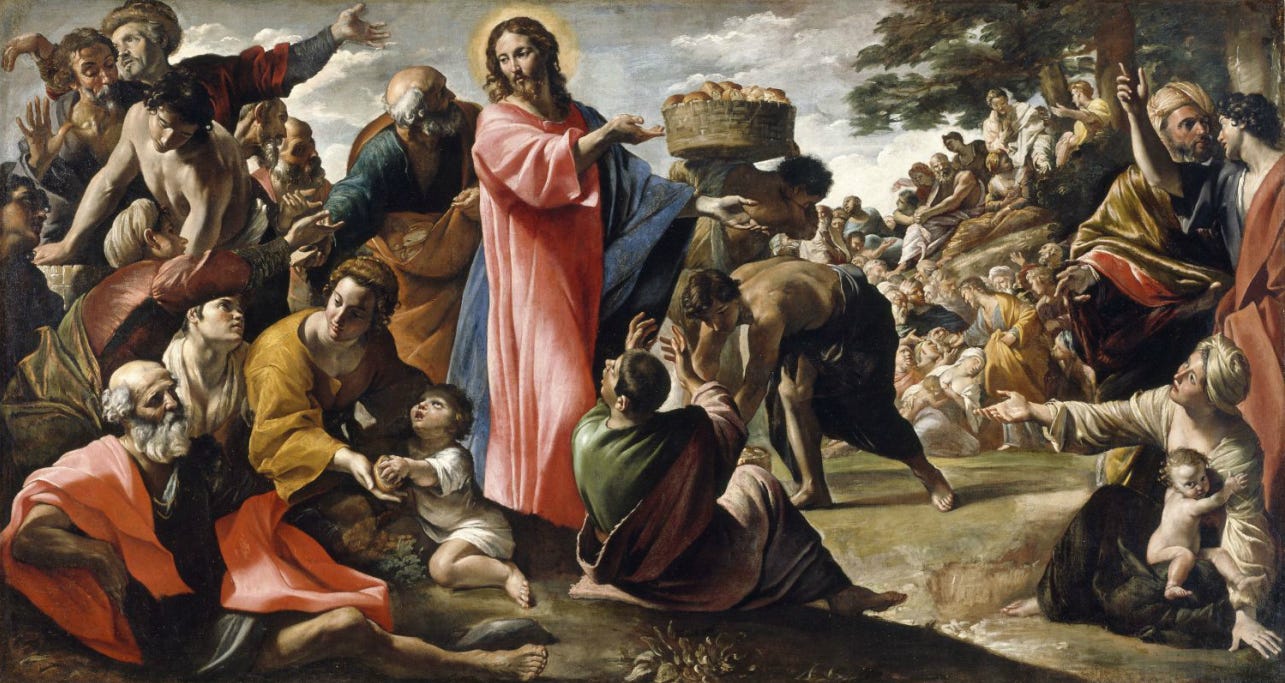
That Nothing May Be Lost (6:1–15)
John tells the feeding of the five thousand with several details that are uinque to his Gospel. One of the more interesting unique details comes comes after everyone has eaten. The other Gospels report twelve baskets of leftovers, but only John records the reason. Jesus tells his disciples, “Gather up the leftover fragments (κλάσματα), that nothing may be lost (ἀπόληται)” (6:12).
On a first reading, the command sounds like good stewardship. Bread was precious, and no one in Galilee threw it away. But the verb Jesus uses, ἀπόλλυμι (apollymi, “to lose” or “to perish”), becomes one of the key words of the chapter, though English translations render it in several ways. A few verses later, Jesus warns the same crowd, “Do not work for the food that perishes” (6:27), and “perishes” translates the same verb. Then he describes his own mission by saying that it was the will of the one who sent him “that I should lose nothing of all that he has given me” (6:39).
John carries the thread to the night of the arrest. Jesus prays that “not one of them has been lost except the son of destruction” (17:12), and in the garden he secures the disciples’ release so that his word might be fulfilled: “Of those whom you gave me I have lost not one” (18:9). The language of gathering runs the same course. Caiaphas unknowingly prophesies that Jesus will die “to gather into one the children of God who are scattered abroad” (11:52).
The earliest Christians heard the connection. The Didache, the earliest non-canonincal Christian writing, which dates to the late first or early second century, gives this prayer over the broken bread of the eucharist: “As this broken bread was scattered over the mountains, and being gathered together became one, so let your church be gathered together from the ends of the earth into your kingdom” (Did. 9:4). The word for “broken bread” in the prayer is κλάσμα (klasma), the same word John uses for the “fragments” in 6:12–13. The church saw itself in the bread the disciples gathered.
The crowd sees something else. They see the multiplication and conclude that Jesus is “the Prophet who is to come into the world” (6:14), and they intend to take him by force and make him king (6:15). Jesus later names their motive: they came looking for him because they “ate [their] fill of the loaves” (6:26). They want a king who keeps the bread coming. Jesus is offering something else.
It’s very easy to look to Jesus and see only what we want to see. The people saw someone who could multiply food and wanted to make him king. It’s not easy to feed an army. But Jesus wasn’t interested in providing the meals for an insurrection. He was gathering the whole world to himself and offering them a spiritual meal of his body and blood. He does this not just for the children of Abraham, but so that nothing and no one may be lost.
The Spirit Who Gives Life (6:60–71)
Many of Jesus’ disciples call his teaching about eating his flesh and drinking his blood “a hard saying” (6:60), and by the end of the chapter, many stop walking with him altogether (6:66). Between those two verses sits Jesus’ explanation for why the teaching is hard for so many people:
“It is the Spirit who gives life; the flesh is no help at all” (6:63).
That line might sound harsher than Jesus intended if we hear it as a rejection of physicality in favor of spirituality. But that’s not what Jesus is getting at. He is locating the actual source of life. Think of creation. Adam doesn’t become a living being until God breathes into him the breath of life (Gen 2:7). Likewise, Ezekiel saw a valley of dry bones and watched the Lord promise to lay flesh on them, but the bones did not live until God’s breath entered them:
“I will put my Spirit within you, and you shall live” (Ezek 37:14).
Flesh in and of itself is not the problem; flesh without spirit is. Eating his flesh and drinking his blood is never a merely physical transaction, whatever the crowd assumed back in verse 26 when they came looking for another meal. Apart from the spirit, even Jesus’ own flesh gives nothing. With the spirit, it gives everything, because the spirit alone raises the dead.
It’s worth noting that this is especially prominent in the eucharist. The epiclesis (from Greek epiklēsis, "invocation") is the portion of the eucharistic prayer in which the celebrant, typically with hands extended or placed over the elements, invokes the Holy Spirit to sanctify the bread and wine so that they may become, for the people, the body and blood of Christ. Physicality without the Spirit won’t give the food that we most truly need.
Some who hear Jesus’ teaching decide the cost is too high and turn back (6:66). John does not soften the moment. Jesus does not chase after them or revise his terms. He turns instead to the twelve and asks whether they intend to leave as well (6:67), and Simon Peter answers with the only logic left available to someone who has actually understood the alternative:
“Lord, to whom shall we go? You have the words of eternal life” (6:68).
Peter’s confession is the correct conclusion once the options are named honestly. If Jesus’ words are what he has just said they are, spirit and life (6:63), then walking away does not lead anywhere better. It leads back to death.
John closes the scene by noting that Jesus already knew who would not believe, and who would betray him (6:64, 71). The twelve include Judas from the start, and Jesus names that fact without alarm. The presence of unbelief inside the community that confesses rightly is not a flaw in the story. It is the story John keeps telling. Some hear the same words and receive life. Some hear the same words and walk away. The difference is never explained by better information.
The Bread That Manna Could Never Be (6:37–51)
For forty years in the wilderness, God provided Israel with manna. Every morning, it appeared on the ground, and each day, the people gathered what they needed (Exod 16:14–18). It was miraculous. It was merciful. Yet, manna was always temporary. The bread itself was never the goal; it was a sign pointing beyond itself.
Jesus makes the provisionality of manna explicit in a discourse found only in John’s Gospel (6:22–59). In 6:49–50, he says:
“Your fathers ate the manna in the wilderness, and they died. This is the bread that comes down from heaven, so that one may eat of it and not die.”
The contrast is stark. Even manna, God’s own supernatural gift, was food that perishes. Those who ate it still died. The living bread is set apart by one thing manna could never provide: life that never ends.
The crowd, however, cannot see this. They γογγύζω, they grumble (6:41), and the word is the same one that trails Israel through the wilderness in the LXX (Exod 16:2; Num 14:2; Ps 78:18–20). A people who cannot receive what God offers will always find reasons to grumble at what he provides.
But Jesus does not respond to their grumbling with another reference to manna. Instead, he references the Prophets: “And they will all be taught by God” (6:45; Isa 54:13). This citation carries new-covenant significance (Jer 31:33–34). The wilderness generation’s failure was not just a failure of nerve; it was a failure of the heart. The New Exodus calls for more than just new provision. It demands a people drawn and taught by the Father himself.
What the Father draws them toward is indicated by a refrain that echoes four times throughout the discourse: “I will raise him up on the last day” (6:39, 40, 44, 54). The new Promised Land of the New Exodus is not Canaan; it is resurrection. Manna sustained Israel on a journey to a land where they would still face death. The living bread sustains toward a destination that death cannot claim.
Manna was always a sign. The living bread is what that sign was always pointing toward, and those who eat it will not merely survive the wilderness. They will be raised.
January 7, 2026
We’re back to reading sequentially through John, so today’s reading is John 6. Remember, as you read the feeding of the five thousand and hear Jesus say, “Whoever feeds on my flesh and drinks my blood has eternal life, and I will raise him up on the last day” (6:54), that the church was already celebrating communion for decades by the time John writes his Gospel. It would have been impossible for John’s Christian readers to hear Jesus’ words in any context other than an explicitly eucharistic one.
68 Simon Peter answered him, “Lord, to whom shall we go? You have the words of eternal life, 69 and we have believed, and have come to know, that you are the Holy One of God.”
This section of John 6 truly saved me on May 14, 2016, when I came home to find my husband had taken his own life. I spend the night at the home of friends, pacing the floor most of the night singing “You’re a Good, Good Father,” reminding myself of the goodness and love of God in spite of what had just happened.
There are those who walks away from God in times like these, but Peter’s confession here reverberated in my mind: to Whom (or what) else could I go? To drugs? Alcohol? Distraction? No, nothing could comfort my soul and keep me moving forward except the life-giving words of Christ. To whom could I go? Only to Him because even without answers to “why?,” He was my only hope
These words could not be more timely. As I’m reading the devotional, my dad is in Hospice Care in New Port Richey. My dad became a believer in 1980 at the age of 45. He’d spent a good 30+ years as an alcoholic (he began drinking at age 12!). He’s been sober ever since and his transformation led me (like Peter with Andrew) to go see this Jesus whom changed my dad so radically overnight!
But death …. And while we know resurrection life is ours (and his), death still robs us of the people we care about and love. Sometimes not in such great ways. My dad’s been battling Alzheimer’s for years and it’s coming calling quite strongly now. It’s robbed him of his ability to communicate clearly, to have a sound mind, to know where he is and why. But today, even amidst the fogginess of his brain, he was able to communicate “I’m glad you’re here”. I know death doesn’t gain the ultimate victory but -man— it really stinks this side of heaven