

Four Testimonies (5:30–47)
Jesus has just healed a man on the Sabbath and told him to carry his mat, and the charge against him has escalated past Sabbath-breaking. He has called God his own Father, “making himself equal with God” (5:18). It is a capital charge, and Jesus answers the charge strangely.
“I can do nothing on my own. As I hear, I judge, and my judgment is just, because I seek not my own will but the will of him who sent me” (5:30).
He then states the rule regarding testimony:
“If I alone bear witness about myself, my testimony is not true” (5:31).
Jewish law did not accept a single, self-interested witness. A charge required two or three witnesses (Deut 19:15). Rather than confessing that his own word is untrustworthy, Jesus refuses to rest on it alone, and he calls witness after witness until the docket is full.
First, John the Baptist, “a burning and shining lamp,” whose light they were once glad to enjoy for a while (5:35). But Jesus sets this testimony aside almost as soon as he raises it. “Not that the testimony I receive is from man” (5:34). There are greater witness still to come.
Second, the works themselves, which the Father gave him to accomplish, the very works he is doing right now in front of them (5:36). The man at the pool, still carrying his mat, is exhibit A.
Third, the Father’s own testimony (5:37–38). They have just accused Jesus of making himself equal with God. Jesus answers that they have never heard the Father’s voice nor seen his form, and that his word does not abide in them. They are zealous for God’s honor, yet they are unable to recognize God’s testimony standing in front of them, healing a paralytic.
Fourth, the Scriptures, and this is where the discourse turns.
“You search the Scriptures because you think that in them you have eternal life; and it is they that bear witness about me, yet you refuse to come to me” (5:39–40).
He adds a few verses later:
“Do not think that I will accuse you to the Father. There is one who accuses you: Moses, on whom you have set your hope” (5:45).
Moses was supposed to be their defense, the credential that secured their standing before God. Jesus tells them their own witness has turned against them.
“If you believed Moses, you would believe me, for he wrote of me. But if you do not believe his writings, how will you believe my words?” (5:46–47).
John the Baptist, Jesus’ own works, the testimony of the Father (the voice from heaven), and the Scriptures themselves all point to who Jesus is. We would do well to listen to them and then follow Jesus, otherwise, the book we cling to so dearly may be the very thing that condemns us in the end.
Two Resurrections (5:19–29)
Daniel’s night vision gave Israel two convictions about the last days. First, one like a son of man would come with the clouds of heaven, be presented before the Ancient of Days, and receive an everlasting dominion that would not pass away (Dan 7:13–14). Second, resurrection would not be just for the righteous, but “many of those who sleep in the dust of the earth shall awake, some to everlasting life, and some to shame and everlasting contempt” (12:2).
In John 5, Jesus draws on these two eschatological claims. Having just healed a man on the Sabbath and been charged with making himself equal with God (5:18), Jesus leans into the accusation. The Father has granted the Son authority to give life and to execute judgment, “because he is the Son of Man” (5:27).
Then Jesus refers to Daniel’s prophecy: “the hour is coming when all who are in the tombs will hear his voice and come out, those who have done good to the resurrection of life, and those who have done evil to the resurrection of judgment” (5:28–29). The duality Daniel foresaw remains, but it is not attached to the voice of the Son of Man.
Readers accustomed to thinking of eternal life as a future reward tend to miss that Jesus has already collapsed the timeline. “Whoever hears my word and believes him who sent me has eternal life. He does not come into judgment, but has passed from death to life” (5:24). The resurrection of the last day has already begun in whoever believes; the verdict is not deferred to a distant tomb but rendered now, in the hearing of his voice.
How Many Years? (5:1–9)
It’s the theology, not the devil, that’s in the details.
Israel’s story is, at many of its crucial turns, a story of waiting. From Egypt to Canaan, from exile to return, the people of God find themselves repeatedly suspended between promise and fulfillment, unable to cross into what God has prepared. John places Jesus in the midst of that long story when he brings him to the Pool of Bethesda, where a man has lain, unable to move, for 38 years (John 5:5).
The number is not incidental. Deuteronomy 2:14 states that Israel spent 38 years in a weakened state between Kadesh-barnea and the brook Zered, the period of divine judgment after the spies’ failure, when the generation that left Egypt died and Israel could not advance. The total wilderness sojourn rounded to forty, a number so familiar it has become shorthand for the whole. However, thirty-eight years was the precise period of stagnation. John’s detail is intentional: the man at Bethesda isn’t just a sick person; he symbolizes Israel, waiting at the waters, unable to cross into God’s rest in the Promised Land.
The Pool of Bethesda, found only in John’s Gospel, was surrounded by five porticoes filled with the blind, the lame, and the paralyzed (John 5:2–3). Into that scene of accumulated suffering comes Jesus. He approaches one man and asks a question that can sound almost cruel: “Do you want to be healed?” (John 5:6). The question probes something deeper than physical desire. The man’s answer reveals his disorientation; he explains only why healing has been impossible, cataloging his lack of help (John 5:7). He does not answer the question. He cannot yet see the one standing before him clearly enough to ask.
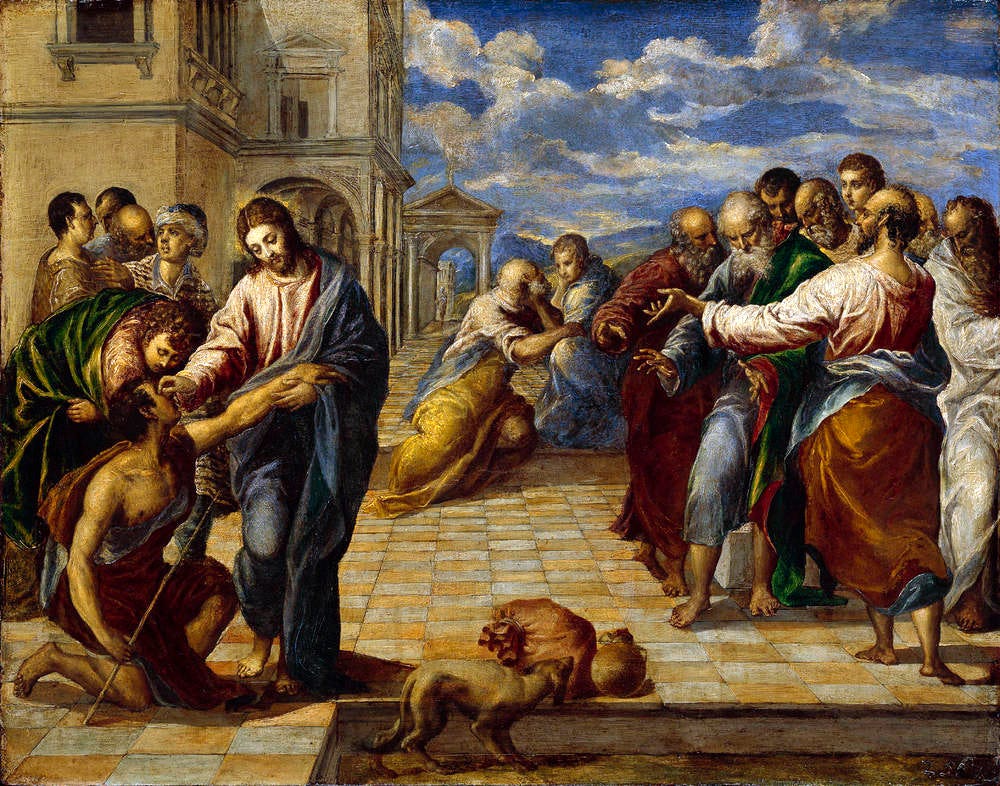
Jesus does not wait for a better answer. He commands, and the man is healed immediately, picks up his mat, and walks (John 5:8–9).
John notes, almost as an aside, that the day was a Sabbath (John 5:9). The detail will ignite the controversy ahead, but it carries its own weight here. The Sabbath was Israel’s sign of covenant rest, the day that pointed toward the completed work of God (Gen 2:2–3). That Jesus heals on the Sabbath is not a violation of it but a fulfillment of what it always signified. The thirty-eight-year wait is over. What the law could not accomplish, Jesus does in a word.
The Sabbath and National Identity (5:10–17)
John 5 begins with Jesus healing a man at the pool on the Sabbath. The Jews tell the man who had been healed that it was not lawful for him to carry his bed on the Sabbath. Likewise, John states that they were persecuting Jesus “because he was doing these things on the Sabbath” (5:16).
It seems unbelievable to us that anyone could be angered by a miraculous healing simply because it happened on the Sabbath, but we need to keep two historical points in mind. First, the people went into exile because they broke God’s commandments, including the Sabbath laws. In fact, the exile punishment is directly linked to the Sabbath in Lev 26:34-35. Second, just a few hundred years earlier, practices that were clearly Jewish—such as food laws, circumcision, and Sabbath observance—had been explicitly banned by the Greeks in an effort to erase Jewish identity. As a result, these practices became a key part of Jewish national and religious identity.
So the Jewish concern with Sabbath keeping isn’t just about “Hey, you’re not supposed to be doing that on this day.” It’s deeper than that. Breaking the Sabbath law not only caused exile but also represented a break from national and religious identity. There’s much more at stake with the Sabbath than just following or breaking a commandment, which is why the Jewish people in Jesus’ day reacted so strongly.
In John 17:3, we find Jesus saying “Now this is eternal life: that they know you, the only true God, and Jesus Christ, whom you have sent.” If eternal life is defined as a knowing of God and Christ, how did the teaching become that eternal life is “in the sweet by and by” rather than it begins once we believe?
Thanks for that explanation! Would have never made that connection between Israel and this man at the pool. He, too, waited to be delivered! Makes me wonder how often we don’t see Jesus act in our lives because we are sitting by a pool waiting for help that can only come from
God.