

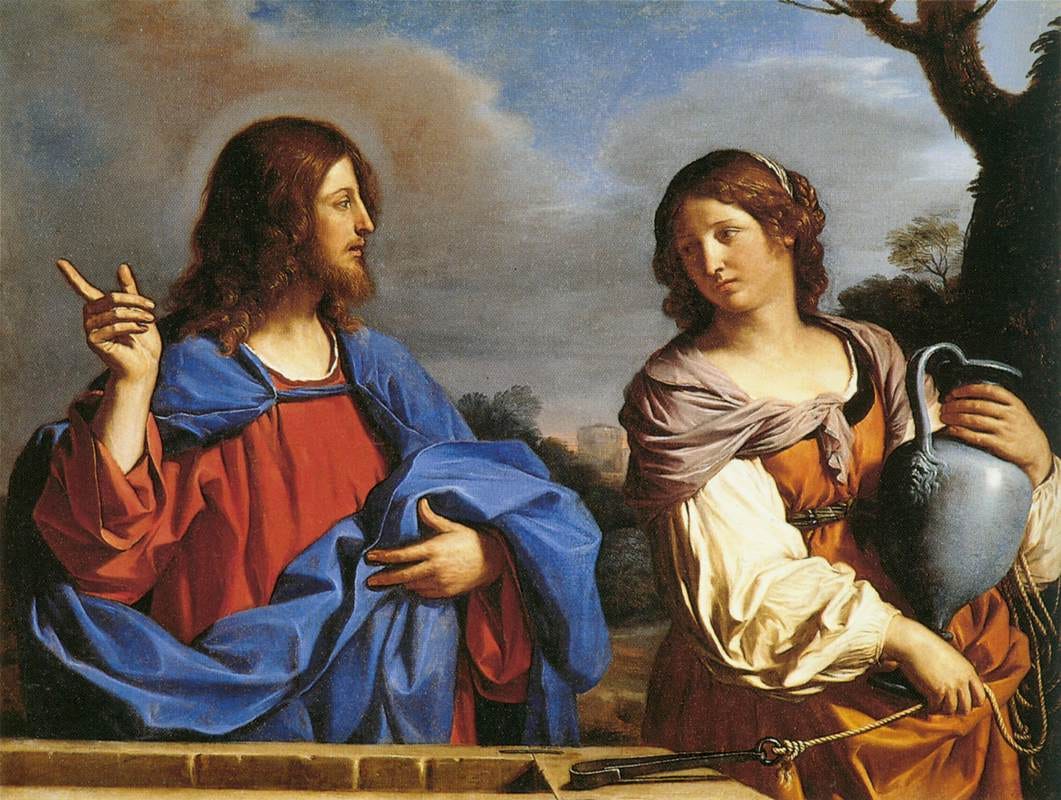
The One who Speaks (4:19–26)
The woman at the well deflects from her own past and turns the conversation to the old argument between the mountains of Gerizim and Jerusalem, and on which mountain worship actually counted. Jesus does not refuse the question so much as outrun it.
“The hour is coming when neither on this mountain nor in Jerusalem will you worship the Father” (4:21).
Both sites have their claim: the Samaritans from the patriarchs who built an altar on Gerizim, the Jews from the temple where the sacrifices are still offered; and Jesus tells her that both claims are about to expire.
“The hour is coming, and is now here” (4:23).
John likes that collision of tenses, a future already arriving. The true worshipers Jesus describes will worship the Father “in spirit and truth” (4:23, 24) because the Father is seeking such worshipers, and what he seeks has nothing to do with favorite mountains, even the temple mount.
The woman changes the topic again.
“I know that Messiah is coming (he who is called Christ). When he comes, he will tell us all things” (4:25).
It’s another deflection, an attempt to put off resolving her earlier question until later. Jesus shuts down her delay tactic.
“I who speak to you am he” (4:26).
In Greek, Jesus says, Ἐγώ εἰμι, ὁ λαλῶν σοι; “I am, the one speaking to you.” Isaiah’s God makes the identical claim in nearly identical words: “my people shall know my name... that I am he who speaks” (Isa 52:6 LXX, ἐγώ εἰμι αὐτὸς ὁ λαλῶν). The God who announces Zion’s coming salvation names himself the one who speaks, and Jesus takes that name as his own.
We can sometimes get so hung up on the formalities of worship, like styles, music preferences, and all sorts of other decisions that go into a Sunday morning. But Jesus wants people who will worship in spirit and in truth. Worshipping in truth begins with listening to what Jesus says. He is I am, and he has spoken. We should listen. Worshipping in spirit begins with recognizing that however we choose to worship, our connection to God doesn’t come through the forms of worship but through the Holy Spirit who now dwells inside us.
Believing Without Seeing (4:43–54)
His son is dying in Capernaum, and the official has come the better part of a day’s journey to find Jesus in Cana. He does not waste words.
“Sir, come down before my child dies” (John 4:49).
Jesus has already met that urgency once, at verse 47, and answered it strangely.
“Unless you see signs and wonders you will not believe” (John 4:48).
The reply sounds harsh for a father racing to prevent his son’s death, but Jesus is not really talking about this one father. σημεῖα καὶ τέρατα (sēmeia kai terata), “signs and wonders,” is the set phrase Israel’s scriptures use for the plagues and the exodus itself (Deut 6:22; Ps 135:9). When the people who had already crossed a sea on dry ground still would not trust him, Yahweh said:
“How long will this people despise me? And how long will they not believe in me, in spite of all the signs that I have done among them?” (Num 14:11).
Signs multiplied in the wilderness, and unbelief kept pace with them. Jesus comes to a Galilee shaped by the same instinct, a crowd that will follow him for what he produces, not for who he is.
Then he gives the official something smaller and harder than a miracle to witness. No blessing over the boy, no trip to Capernaum, no touch.
“Go; your son will live.” The man believed the word that Jesus spoke to him and went on his way (John 4:50).
Nothing has happened yet that he can see. No procedure, no incantation. The word goes out and does exactly what Jesus says.
Confirmation comes a day later, on the road, when his servants meet him with the news that the fever broke at the very hour Jesus spoke. Belief, for this man, runs in the opposite order from what we would choose. He believes, then he sees, and his whole household believes with him (4:53). We prefer it the other way. We want the fever gone, the diagnosis changed, the relationship mended, before we will believe what God has said.
John counts this as the second sign Jesus did after coming from Judea into Galilee (4:54). The deeper miracle was a royal official learning to walk home on nothing but a verb spoken in the future tense because he trusted the one who spoke it.
Living Water (4:7–15)
The prophets had dared to hope that God’s presence would return. When the glory of the Lord departed the Jerusalem temple in Ezekiel 10–11, it was one of the most devastating moments in Israel’s history. But Ezekiel saw a future when a new temple would rise, and from its threshold, living water would flow outward, making everything flourish wherever it reached (Ezek 47:1–12). Zechariah shared this hope: “On that day living waters shall flow out from Jerusalem” (Zech 14:8). God’s return would bring nothing less than living water flowing from the new temple to renew creation.
It is into this stream of expectation that Jesus steps beside a well in Samaria and says something remarkable.
Jesus answered her, “If you knew the gift of God, and who it is that is saying to you, ‘Give me a drink,’ you would have asked him, and he would have given you living water” (John 4:10).
The woman hears a practical claim about water, but Jesus speaks about something much larger. John’s prologue had already set the foundation: “the Word became flesh and ἐσκήνωσεν [tabernacled] among us, and we have seen his glory” (John 1:14). The tabernacling of God’s glory among his people, marked by filling of the tabernacle (Exod 40:34–35) and the dedication of Solomon’s temple (1 Kgs 8:10–11), has been fulfilled again in the person of Jesus. He is the new temple, the place where heaven and earth meet. And from this new temple, living water flows.
“Everyone who drinks of this water will be thirsty again, but whoever drinks of the water that I will give him will never be thirsty again. The water that I will give him will become in him a spring of water welling up to eternal life” (John 4:13–14).
This exchange appears only in John’s Gospel. Its significance grows later in the Gospel, when Jesus proclaims at the Feast of Tabernacles, “If anyone thirsts, let him come to me and drink” (John 7:37), and John clarifies: the living water is the Spirit (7:39). The water Jesus offers the Samaritan woman at this ordinary well is the Holy Spirit, the very presence of God that once filled the tabernacle and the temple, now flowing freely from Jesus and filling his disciples.
The woman went to draw water and met the one from whom the prophets said living water would someday flow. What Ezekiel and Zechariah envisioned as the great renewal of all things, Jesus offers in a quiet conversation beside a well in Samaria.
Forsaken (4:16–18)
It’s common to read John 4 and view the Samaritan woman negatively. She’s drawing water at an unusual time, which some interpret as an indication that she’s an outcast, and she’s had five husbands and is now with a man who isn’t her husband.
However, we must remember that men held all the power in her context. Having a husband was how women stayed out of poverty, and a woman couldn’t divorce her husband under biblical law. So, if she’s had five husbands, she’s either been bereaved or abandoned five times by presumably different men, and quite likely for her own protection, she is now forced to live with a man who is not her husband.
Maybe she’s not the sexually promiscuous woman most readers assume she is, but rather someone who has been abandoned and forsaken multiple times and has been forced to make a difficult choice for her own protection. We don’t have enough information to make a definitive judgment. Still, it’s always valuable to slow down and read familiar texts from different angles to see if any new insights emerge.
Since there are prophecies that water will flow from Jerusalem, is there also a connection here to when water flowed from Jesus’ side as he was crucified?