

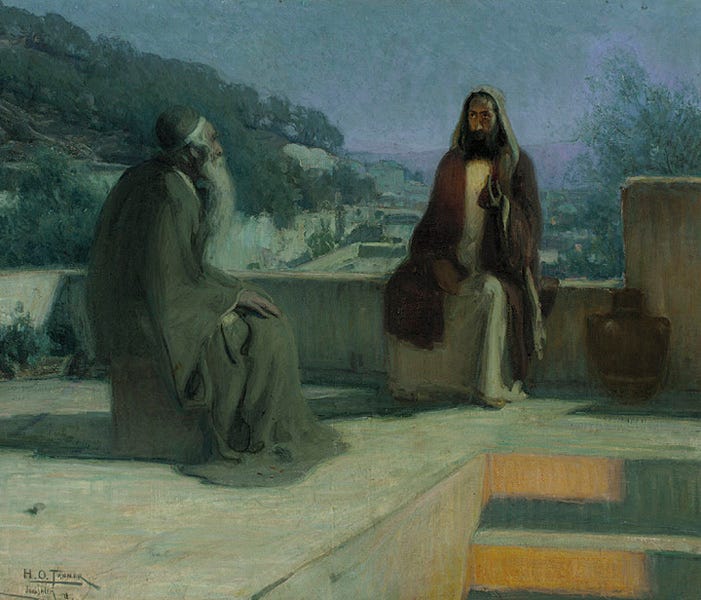
Born Again (3:1–13)
A ruler of the Jews named Nicodemus came to Jesus one night and said:
“Rabbi, we know that you are a teacher come from God, for no one can do these signs that you do unless God is with him” (John 3:2).
He was a Pharisee, a member of the ruling council, and Jesus refers to him as “the teacher of Israel” (3:10). He was a son of Abraham, born into the line God had chosen out of all the families of the earth. Nicodemus had the best possible credentials for approaching God.
And yet Jesus says to him:
“Truly, truly, I say to you, unless one is born again he cannot see the kingdom of God” (3:3).
To tell a son of Abraham he must be born anew was to tell him that his ancestry counted for nothing in the kingdom of God. Interestingly, this is not dissimilar from the initial call of Abrah:
“Go from your country and your kindred and your father’s house to the land that I will show you” (Gen 12:1).
Country, kindred, and his father’s house were the three things that told a person in the ancient world who he was, and Abraham surrendered them all to follow God. Jesus asks the same surrender of Abram’s heir. Descent from Abraham had made Nicodemus secure. It would not make him born again.
Nicodemus thinks Jesus is talking about physical birth (3:4). So Jesus addresses the matter plainly:
“Truly, truly, I say to you, unless one is born of water and the Spirit, he cannot enter the kingdom of God” (3:5).
Through the prophet Ezekiel, the Lord had already promised Israel this mark of her restoration: “I will sprinkle clean water on you, and you shall be clean from all your uncleannesses” and “I will put my Spirit within you” (Ezek 36:25, 27). Yahweh pledges to wash away the defilement that sent Israel into exile and give her his own Spirit so she could finally keep covenant.
Part of being born again is letting go of what defines us. When we are baptized into the Christ through the power of the Spirit, what previously defined us is buried in the baptismal waters. So much of our identity is tied to things like our nationality, ethnicity, language, and social standing, but for those who are born again, what must define us most is our membership is this new people, this new family, that the God of Abraham, Isaac, and Jacob is forming in Jesus Christ.
He Must Increase (3:22–36)
One of the metaphors the prophets used to describe the relationship between Israel and Yahweh was that of a husband and a bride.
“I will betroth you to me forever. I will betroth you to me in righteousness and in justice, in steadfast love and in mercy. I will betroth you to me in faithfulness. And you shall know the LORD” (Hos 2:19–20).
Isaiah likewise spoke of the day when the groom would arrive for his bride: “as a bridegroom rejoices over his bride, so will your God rejoice over you” (62:5). In Israel’s scriptures, the bridegroom who claims Israel as his own was never a human figure. The groom was Yahweh himself.
John the Baptist draws on this language when his own disciples come to him troubled. Jesus is baptizing, and the crowds are leaving John for him (John 3:26). John does not defend his territory. Instead, he locates himself inside a wedding he did not host:
“The one who has the bride is the bridegroom. The friend of the bridegroom, who stands and hears him, rejoices greatly at the bridegroom’s voice. Therefore this joy of mine is now complete. He must increase, but I must decrease” (3:29–30).
Read alongside Hosea and Isaiah, John’s answer carries more weight than mere modesty. He tells his own followers that the role reserved for Yahweh now belongs to Jesus. John is not the bridegroom. Jesus is, and he has come for his bride. John is the bridegroom’s friend. It was time for him to decrease so that Jesus might increase.
The passage closes with the Evangelist editorializing and making the stakes: the one from above speaks the words of God and holds the Spirit without measure (3:34), and “whoever believes in the Son has eternal life; whoever does not obey the Son shall not see life, but the wrath of God remains on him” (3:36). The wedding language is tender, and it carries a summons at the same time. The bridegroom has come. The wedding is about to begin. But those who will not listen to the Son will find themselves outside the party when it begins.
The Lifted Serpent (3:14–21)
Long before Jesus spoke to Nicodemus in the shadows of a Jerusalem night, Israel had already learned what it meant to look to an unlikely source of salvation. In the wilderness, God’s people complained against Moses and against God, and the Lord sent fiery serpents among them (Num 21:5–6). Many died. When the people cried out, God did not remove the serpents. Instead, he provided a remedy that matched the wound: a bronze serpent lifted on a pole, so that anyone who looked at it would live (21:8–9). This strange, counterintuitive act of deliverance is what Jesus references when he explains to Nicodemus what must happen to the Son of Man.
The comparison is startling. One might expect Jesus to compare himself to Moses, the deliverer. Instead, he compares himself to the serpent:
And as Moses lifted up the serpent in the wilderness, so must the Son of Man be lifted up, that whoever believes in him may have eternal life (John 3:14–15).
This image is unique to John’s Gospel and is meant to unsettle us. The serpent was the problem. The serpent in the garden introduced the venom of sin and death into the human story (Gen 3:1–19). Yet Jesus says that when he is lifted up on the cross, he will take the serpent’s place. Paul expresses the same idea: God made the sinless one to become sin for humanity, so that in him we might become the righteousness of God (2 Cor 5:21). The curse does not simply disappear; it goes to the cross.
Only in this light does the meaning of the most familiar verse in all of Scripture become clear.
For God so loved the world, that he gave his only Son, that whoever believes in him should not perish but have eternal life (John 3:16).
The “for” at the beginning of the verse points backward. John 3:16 is not a standalone promise. It explains a substitution: the Son will be lifted up in place of the serpent, taking the venom of sin out of the world and into himself. To crush the serpent’s head, he will take the serpent’s place.
To believe, then, is to look. It is to fix one’s gaze on the one who was lifted up in the serpent’s place and to discover there, not condemnation, but life.
January 3, 2026
John 3:16 is arguably the most famous verse in the Bible, but the entire paragraph is fascinating. These words especially stand out to me: “This is the judgment: the light has come into the world, and people loved the darkness rather than the light because their works were evil” (v. 19).
The light of Christ has come into the world. But light exposes. It reveals. Some people prefer darkness. Some people prefer to keep themselves (or maybe parts of themselves) hidden from the revealing light of Christ. This is judgment: to see the light, but prefer the darkness more. May we who have been born again of the Spirit never prefer darkness to light.
Thank for this in-depth explanation of the comparison of the serpent in the Garden (introducing sin), the bronze serpent on the pole lifted up, and then we know The Serpent who tried to have Jesus forsake His mission to be The One looked upon to remove the curse of sin for us. I’d never made these connections so clearly!