

By What Kind of Death (21:15–19)
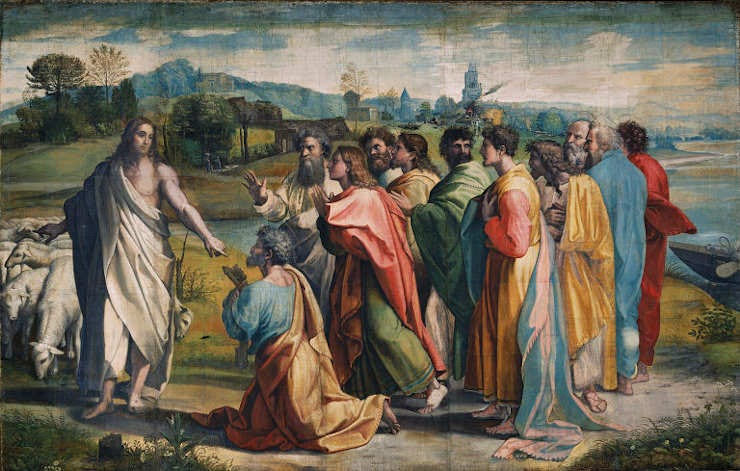
After breakfast, Jesus questions Peter beside the charcoal fire. Three times Jesus hands Peter the flock: “Feed my lambs,” “Tend my sheep,” “Feed my sheep” (21:15–17). Peter is made a shepherd over a flock that belongs to someone else, and John’s readers know what the flock’s owner did for the sheep.
“The good shepherd lays down his life for the sheep” (10:11).
Right after the third commission, Jesus tells Peter what shepherding will cost him.
Truly, truly, I say to you, when you were young, you used to dress yourself and walk wherever you wanted, but when you are old, you will stretch out your hands, and another will dress you and carry you where you do not want to go (21:18).
Young Peter tied his own belt and went where he pleased. Old Peter will have his hands stretched out, someone else will bind him, and he’ll be taken where he doesn’t want to go. The church read the saying as a prophecy of crucifixion very early. Tertullian, writing in the early third century, says Peter “is girt by another, when he is made fast to the cross” (Scorp. 15).
John adds a note:
(This he said to show by what kind of death he was to glorify God.) And after saying this he said to him, “Follow me” (21:19).
John has used that phrase, “by what kind of death,” twice before, but both times he used it in reference to Jesus. When Jesus said, “And I, when I am lifted up from the earth, will draw all people to myself,” John explained, “He said this to show by what kind of death he was going to die” (12:32–33). And later, when the Jewish leaders told Pilate, “It is not lawful for us to put anyone to death,” the case passed to Rome, John comments, “This was to fulfill the word that Jesus had spoken to show by what kind of death he was going to die” (18:31–32). In both places the “kind of death” is crucifixion.
Now John applies the same formula to Peter, with one change. Jesus’ death was something he “was going to die”; Peter’s death will “glorify God.” Throughout John, Jesus uses glorification to describe his own cross: “Father, the hour has come; glorify your Son that the Son may glorify you” (17:1). Peter will glorify God the way his Lord did, through a death like his.
And then Jesus says, “Follow me.” In the upper room, Jesus told Peter, “Where I am going you cannot follow me now, but you will follow afterward.” Peter protested, “I will lay down my life for you” (13:36–37), and before morning he had denied Jesus three times. On the shore, Jesus tells Peter he will keep the promise after all.
Jesus gave Peter the flock and the cross in the same conversation, and he called the sheep “my sheep” every time. Peter’s restoration consisted in receiving the good shepherd’s work and, with it, the good shepherd’s death.
You Follow Me (21:20–25)
Peter turns and sees the disciple Jesus loved following behind them. “Lord, what about this man?” Peter asks (21:21). Jesus has just told Peter how he would die, so this seems like an odd question. Jesus said that Peter would stretch out his hands and that others would dress him and carry him where he did not want to go. And Peter’s immediate response is not to sit and reflect on what Jesus has just told him. Rather, his first response is to ask about someone else’s fate.
Jesus does not answer the question Peter asked, but says instead:
“If it is my will that he remain until I come, what is that to you? You follow me” (21:22).
Peter has just been reaffirmed in his vocation after his monumental failure, but with that reaffirmation comes a cost. Instead of accepting it, Peter glances sideways to compare his fate with that of another disciple. Jesus will not allow this. Whatever is or isn’t in store for the beloved disciple is for Jesus alone to decide. That information is irrelevant to Peter’s task to follow Jesus.
John then clarifies a misunderstanding that had apparently spread.
“So the saying spread abroad among the brothers that this disciple was not to die. But Jesus did not say to him that he was not to die, but, ‘If it is my will that he remain until I come, what is that to you?’” (21:23).
Jesus spoke a conditional statement; someone downwind heard a promise. John does not want to entertain a rumor about the beloved disciple’s immortality.
The Gospel then concludes by reaffirming the authority of the author.
“This is the disciple who is testifying about these things, and who has written these things, and we know that his testimony is true” (21:24).
The phrasing echoes 19:35, where John made the same claim while standing at the foot of the cross. The Gospel of John asks to be believed based on the testimony of a witness who was present during the event described and whose testimony has already been examined and confirmed by others. Then comes the deliberate exaggeration in verse 25 that the world is too small to contain all the books that could have been written about the things that Jesus did. The statement is ironic, given that three of the four canonical Gospels not only recount many of the same events and sayings but also borrow heavily from one another.
The ending of the Gospel of John is pretty straightforward. The task of the disciple is to follow Jesus and to believe the testimony of the apostles. It might be our instinct to compare ourselves to others and wonder why our burden is heavier. We might wish we had the kind of objective information we have about the life of more modern figures. But John says, “I was there. This is true.” And the one of whom it is true says, “Follow me.”
The Shore Is Already Prepared (21:1–14)
Before Jesus says a word to Peter, he has already built a fire.
Just as day was breaking, Jesus stood on the shore; yet the disciples did not know that it was Jesus. Jesus said to them, “Children, do you have any fish?” They answered him, “No.” He said to them, “Cast the net on the right side of the boat, and you will find some.” So they cast it, and now they were not able to haul it in, because of the quantity of fish (John 21:4–6).
The disciples have been fishing all night but have caught nothing. The scene is deliberate. It echoes John 15:5: apart from Jesus, they can do nothing. Before Jesus enters the story, it’s just seven disciples, a boat, a full night of effort, and an empty net.
Then a “stranger” on the shore tells them to cast again.
What follows is an overwhelming catch of fish. John tells us the number: 153. He also tells us that despite the weight and the quantity, the net was not torn. Both details are significant. The Old Testament background illuminates why.
Ezekiel 47 describes a river flowing from the threshold of the temple, east toward the sea. The water grows deeper as it flows, and wherever it goes, life follows.
And wherever the river goes, every living creature that swarms will live, and there will be very many fish. For this water goes there, that the waters of the sea may become fresh; so everything will live where the river goes. Fishermen will stand beside the sea. From En-gedi to En-eglaim it will be a place for the spreading of nets. Its fish will be of very many kinds, like the fish of the Great Sea, very many (Ezek 47:9–10).
Ezekiel’s vision is eschatological. The life-giving river brings an abundance that cannot be measured, and fishermen cast their nets along the shore. John 21 places the disciples’ nets in the water at the dawn of the new creation. The catch that strains the net without tearing is the catch of the age to come.
The unbroken net is also the unbroken community. Peter has denied Jesus. The disciples scattered. The net should be torn. It is not.
And then there is the fire.
When they got out on land, they saw a charcoal fire in place, with fish laid out on it, and bread (John 21:9).
The word for a charcoal fire is ἀνθρακιά. It appears only twice in the New Testament: here, and in John 18:18, where Peter is warming himself while Jesus is being tried inside. The same word, the same kind of fire, the same man standing nearby. John does not explain this, nor does he need to. Peter sees a charcoal fire on the shore, and the reader immediately knows what it signifies.
The restoration has not happened yet. Jesus has not yet asked Peter anything. But the shore is already prepared. The fire is already burning. The meal is already waiting.
The new creation doesn't start after damage is assessed and accounts are settled. It begins with breakfast on a beach, around a fire that should feel like an accusation but ends up being an invitation.
“Simon, Do You Love Me?” (21:15–19)
We started the Gospel of John with “In the beginning” (John 1:1), and now we have reached the end. John 21 is the final chapter of John’s Gospel, and some people call it an epilogue because John 20:30–31 feels like a natural way to conclude the Gospel.
Now Jesus did many other signs in the presence of the disciples, which are not written in this book; but these are written so that you may believe that Jesus is the Christ, the Son of God, and that by believing you may have life in his name (John 20:30–31).
The exchange between Jesus and Peter in this chapter is well-known. Peter denied Jesus three times, and now Jesus asks him three questions. Peter replies three times.
In the exchange, Peter and Jesus switch between different Greek words for the term “love.” Some emphasize this difference heavily. Based on this passage, many Christians have been taught that ἀγαπάω signifies divine, sacrificial, unconditional love, while φιλέω refers to affection or friendship.
On that reading, Jesus asks, “Peter, do you love me with unconditional love (ἀγαπάω)?”
And Peter replies, “Lord, you know that I love you as a friend (φιλέω).”
The whole exchange goes like this:
15When they had finished breakfast, Jesus said to Simon Peter, “Simon, son of John, do you love (ἀγαπᾷς) me more than these?” He said to him, “Yes, Lord; you know that I love (φιλῶ) you.” He said to him, “Feed my lambs.”
16He said to him a second time, “Simon, son of John, do you love (ἀγαπᾷς) me?” He said to him, “Yes, Lord; you know that I love (φιλῶ) you.” He said to him, “Tend my sheep.”
17He said to him the third time, “Simon, son of John, do you love me?” Peter was grieved because he said to him the third time, “Do you love (φιλεῖς) me?” and he said to him, “Lord, you know everything; you know that I love (φιλῶ) you.” Jesus said to him, “Feed my sheep.
Whatever is happening here, it’s a matter of translation. Jesus and Peter almost certainly spoke Aramaic, not Greek, and Aramaic does not have two different words for the verb “love” like Greek does.
I don’t think the difference between ἀγαπάω and φιλέω should be exaggerated because both words are used interchangeably throughout John’s Gospel, and both are used to translate the Hebrew אהב (ahab) in the Septuagint.1 Nevertheless, I do think there is some distinction here; otherwise, the change at the end in Jesus’ last question would be unnecessary. Maybe John is trying to convey in Greek a distinction he perceived in the sound of their voices. After all, capturing the tone of someone’s words is always tricky in written text.
Jesus seems to want more from Peter than Peter is willing to give at this moment. But the beauty of this scene is that, rather than demanding like an imperial Lord that Peter give Jesus the love he deserves, Jesus instead lowers himself to Peter’s level and essentially says, “You φιλέω me? Okay. That is enough, Peter. You are restored. I still have ministry for you to do.”
Jesus’ description of how Peter will die is not a punishment for Peter’s denial or his failure to love as Jesus desires. Instead, it is a gift. Peter’s death will bring glory to God because he will follow Jesus into the same kind of death he experienced.
This scene serves as a good reminder that Jesus will always be there to lift us when we stumble and fall, but it also reminds us that following him always comes with a cost. That cost may be high, but the path Jesus took is the only one that leads to eternal life. What Jesus said to Peter, he says to all of us: “Follow me” (21:19).
The Greek translation of the Hebrew Bible.
I also had never noticed that Jesus restores Peter at a campfire. Warming himself at a campfire is where we see Peter deny Jesus three times. I don’t understand the significance but have NO doubt that Jesus chose the location of the restoration with purpose and intention! It gives me hope that I can be restored in the “place” of my greatest failing — and that Jesus does it with such love and intimacy to draw us in to himself. Rarely do we experience such agape love in life. I’m filled with such longing this morning to experience His self-sacrificing love
I’ve heard it taught that the thrice statement to “feed my sheep” was Jesus’ way of restoring Peter’s three denials. Not sure if that’s the case but it seems to make sense.
I also wonder: when Jesus used the phrase “led where you do not want to go” did Peter understand that meant to the cross? Or was that not reveled to him until it was upon him?