

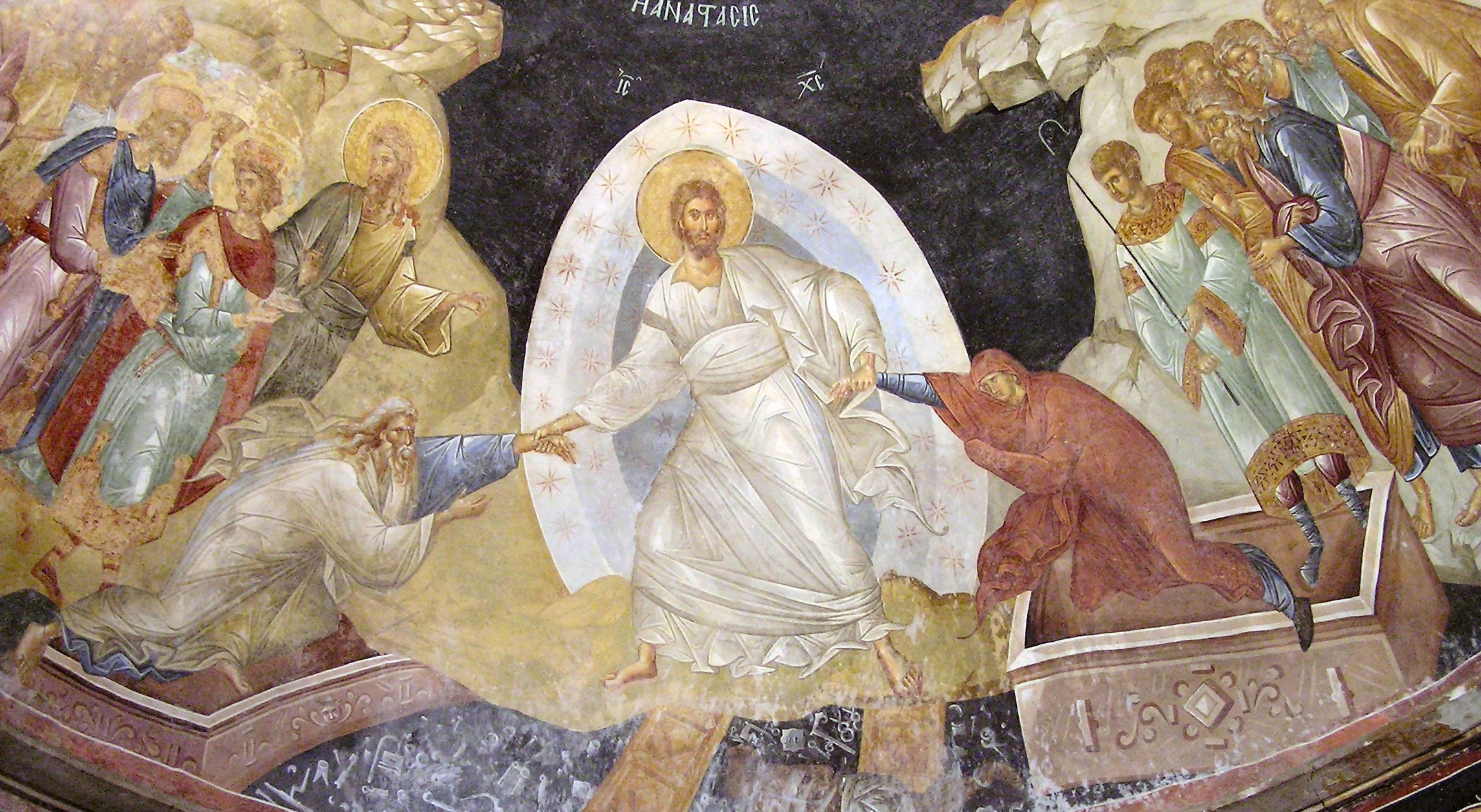
My Lord and My God (20:24–29)
Thomas was not with the other disciples when Jesus first came to them behind locked doors. When he hears their report, he doesn’t believe what he’s heard.
“Unless I see in his hands the mark of the nails, and place my finger into the mark of the nails, and place my hand into his side, I will never believe” (20:25).
Given that Jesus told the disciples he would rise from the dead, it’s unclear why Thomas doesn’t believe the other disciples’ testimony. Thomas appears to want proof, something tangible, something he can see and touch and verify for himself. Thomas sounds a bit like a modern skeptic asking those who promote the Christian faith to meet the demands of modern scientific theory.
Eight days later, Jesus comes again, and this time he comes for Thomas specifically. He does not rebuke him. He repeats Thomas’s own words back to him almost word-for-word.
“Put your finger here, and see my hands; and put out your hand, and place it in my side. Do not disbelieve, but believe” (20:27).
Jesus gives Thomas exactly what he said he needed. He meets Thomas where he’s at, and Thomas responds, “My Lord and my God” (20:28).
Twenty chapters after John declared that the Word was God (1:1), someone inside the story finally says it out loud. And then comes the beatitude.
“Have you believed because you have seen me? Blessed are those who have not seen and yet have believed” (20:29).
Jesus is no longer speaking only to Thomas. He is speaking past him to every generation that will only hear and not see.
We are that generation. We did not stand in the room or place a hand in his hands or side, but we believe. It is a remarkable thing to say with Thomas of someone we’ve never met in person, “My Lord and my God,” but that is our confession.
Thomas knelt before the risen Christ and said what he did not yet fully understand. Belief doesn’t require seeing, nor does it require having all the details worked out. What belief requires is submission to the one the Apostles claim rose from the dead and saying of him that he (and he alone) is our Lord and our God.
Breathed Into Them (20:19–23)
On the evening of the first day of the new week, the disciples are locked behind closed doors. Jesus appears, shows them his hands and side, and then does something the text marks with unusual precision.
And when he had said this, he breathed on them and said to them, “Receive the Holy Spirit” (20:22).
The verb John chooses here is ἐνεφύσησεν. It appears nowhere else in the New Testament. In the Septuagint, the verb appears six times, but two occurrences carry the weight John is reaching for. The first is Gen 2:7, where God forms the man from the dust of the ground and breathes into his nostrils the breath of life, and the man becomes a living creature. The second is Ezek 37:9, where the prophet is commanded to prophesy to the breath, calling it from the four winds to breathe into the slain, that they might live.
Both passages are about the same thing: the animating power of God bringing dead matter to life. The risen Jesus, standing in the first moments of the new creation, performs the act of Genesis 2 and Ezekiel 37 simultaneously. He breathes into his disciples the breath of new life. The Adamic breath that was lost in the garden, the life forfeited through disobedience, the image of God fractured and diminished, is restored here by the last Adam, who himself has passed through death and come out the other side.
Ezekiel 37 adds its own layer. In the vision of the valley, the prophet is commanded to prophesy to the breath, calling it from the four winds to breathe into the slain, that they might live (Ezek 37:9). The vision is a metaphor for Israel in exile, as the text itself makes clear: “these bones are the whole house of Israel” (Ezek 37:11).
But the vehicle of that metaphor is the breath of God animating dead bodies, and the restoration it envisions is explicitly new-covenant: a return from exile, the spirit placed within the people, and God dwelling among them again (Ezek 37:14, 27). John's use of ἐνεφύσησεν reaches for all of that. When Jesus breathes on the disciples, the new covenant promised through the vision is in fact arriving.
This scene is John's Pentecost. The promise of John 7:37–39 — that the one who believes in Jesus would have rivers of living water flowing from within, which John identifies as the Spirit — reaches its fulfillment here. The living water Jesus offered the Samaritan woman (4:10–14), the water he promised to the thirsty on the last day of the feast (7:37–39), now flows to the disciples through the breath of the risen Lord.
The commission follows immediately: “As the Father has sent me, even so I am sending you” (20:21). The newly animated community is sent into the world with the same breath inside them that called creation into being.
The True Gardener (20:11–18)
John is the only Evangelist who tells us that Jesus was arrested in a garden (John 18:1), and he is also the only one who tells us that Jesus was buried in a garden (John 19:41). This repetition is intentional. John is sharing the climax of a story that started in a garden a very long time ago.
In Genesis, Adam was placed in a garden to tend and keep it (Gen 2:15). He was given one command, and he broke it, resulting in the loss of the garden. The ground, once a place of life and fellowship with God, became the land where thorns and thistles grew, where labor was cursed, and where death entered the human story (Gen 3:17–19). What followed was the long, painful story of a world east of Eden, trying and failing to find its way back.
John depicts the arrest and burial of Jesus in gardens to show that the story of Eden is coming to an end. The last Adam enters a garden not to tend it but to be taken from it, handed over to sinful men, tried, and crucified. He is laid in a garden tomb, as the curse of Genesis 3 reaches its darkest and fullest expression. The first Adam lost the garden through disobedience. The last Adam surrenders his life in obedience, taking upon himself the consequences of what the first Adam set in motion. Where the first Adam grasped, the last Adam gave. Where the first Adam hid, the last Adam was handed over. The garden, once the site of humanity’s greatest failure, becomes the place of its only hope.
The Sabbath ended quietly. Then, on the first day of the week, while it was still dark, Mary went to the tomb. She found it empty, wept, and then turned around and saw a man she did not recognize. Thinking he was the gardener, she asked him where the body had been taken (John 20:15). John does not rush to correct her assumption, because at a deeper level, it’s not really a mistake. She stands in the garden where Jesus was buried, on the first day of a new week, looking at the last Adam, and she is more right than she knows.
The risen Christ is the true gardener of God’s new creation, come to restore what the first Adam lost.
The First Day of the Week (20:1–10)
Jesus was crucified on Friday, the sixth day—the day humanity was created (Gen 1:26-31). He rested in a tomb in a garden on the Sabbath, echoing God’s rest on the seventh day of creation (Gen 2:2-3). Then, “on the first day of the week,” he rose from the dead (John 20:1).
These days may seem like just historical details, but they point to a bigger reality.
Twice in John 20, John tells us it was “the first day of the week” (vv. 1, 19). But in Greek, the phrase is striking: τῇ μιᾷ τῶν σαββάτων—literally, “the first of the sabbaths.” Greek has its own perfectly good word for “week” (ἑβδομάς), but John intentionally chooses the Hebrew-rooted word “sabbath” instead.
Why? Because John wants us to see that something monumental has happened. The first week of the old creation has come to its end. God created the world, humanity sinned, God became human, God died, and God rested on the Sabbath in a tomb. The whole arc of the first creation points to this moment.
But when Jesus rises, he rises on the first day. A new week begins—the first week of the new creation. And what did God do on the first day of the first week of creation? He spoke into the darkness and said, “Let there be light” (Gen 1:3).
On the first day of this new week, God spoke into the darkness of death itself and said, “Let there be light.” And the Light of the world rose from the dead (John 8:12).
The Sabbath was always meant to point forward to the day when God’s rest—his completed work of creation and redemption—would fill the earth. The resurrection is that future arriving in our present. Jesus’ rising on the first day doesn’t leave the Sabbath behind; it fulfills it. The true Sabbath rest isn’t about stopping work one day a week. It’s about entering the rest that comes from living in the life of the risen Christ (Heb 4:9-10).
The resurrection isn’t just an event that happened on a specific day in history. It occurred on the first day of the new creation—a creation in which God is remaking everything by the same power that raised Jesus from the dead (2 Cor 5:17; Rom 8:11). We are living in that first week now, moving toward the true Sabbath rest that God always intended and making his Sabbath rest known here and now.