

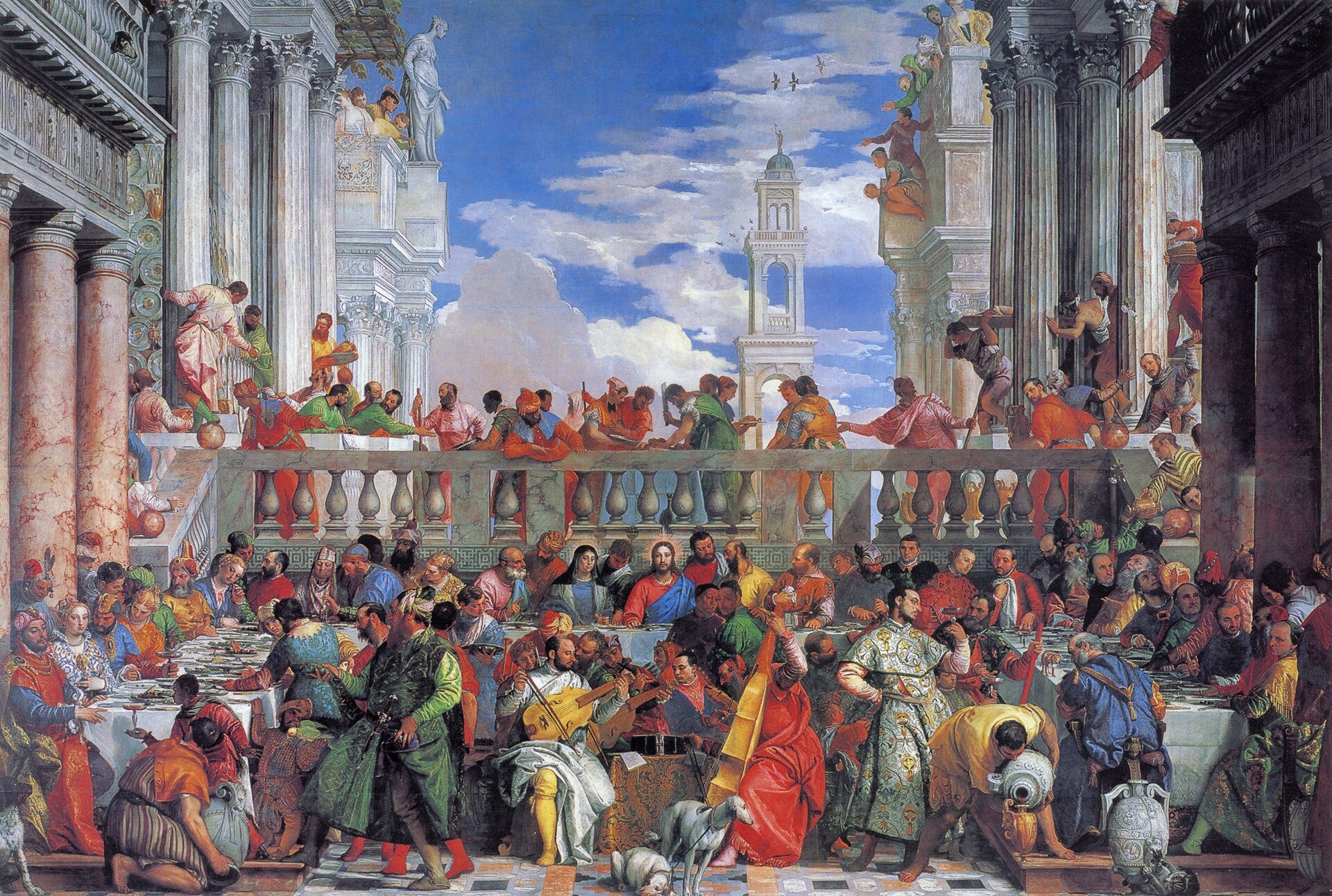
On the Third Day (2:1–11)
“On the third day there was a wedding at Cana in Galilee, and the mother of Jesus was there” (2:1).
The Evangelists often use chronological indicators as signposts. The phrase “the third day” (τῇ ἡμέρᾳ τῇ τρίτῃ) matches, word for word, the Septuagint’s account of Israel’s encounter with God at Sinai. Moses told the people to consecrate themselves, “for on the third day the Lord will come down on Mount Sinai in the sight of all the people” (Exod 19:11), and the narrative delivers on the promise: “on the morning of the third day there were thunders and lightnings and a thick cloud on the mountain” (19:16). John opens the first sign of Jesus’s ministry with the same words the Greek Old Testament uses to open Israel’s defining theophany.
After the miracle at the wedding occurs, John names what has happened plainly:
“this, the first of his signs, Jesus did at Cana in Galilee, and manifested his glory” (2:11).
The word behind “glory” is δόξα, the same word the Septuagint uses for what appeared on Sinai once the covenant had been ratified. “The glory of the Lord dwelt on Mount Sinai,” and its appearance “was like a devouring fire on the top of the mountain” (Exod 24:16–17). At Sinai, that glory stayed behind a fence, with limits set around the base of the mountain: “whoever touches the mountain shall be put to death” (19:12–13). It arrived loud, dangerous, and untouchable. At Cana, on the third day, the same glory arrives at a wedding and is served to all who would like a drink.
John has already told his readers to expect this reversal.
“The law was given through Moses; grace and truth came through Jesus Christ” (1:17).
The jars built for washing hands under the law are filled instead with wine for a celebration, and the water kept for ritual purity becomes the drink of a party no one has to qualify to attend. In Jesus, purity laws are giving way to a party, and glory brings grace and truth, not the risk of death. Something is changing in Christ, and a wedding feast is a great signpost for where those changes are headed.
Saving the Best for Last (2:1–11)
Isaiah pictured the end of the covenant story as a banquet. On his mountain, the LORD of hosts would spread a feast “of rich food... of aged wine well refined,” and he would swallow up death forever (Isa 25:6–8). The prophecy ends with recognition: “Behold, this is our God; we have waited for him” (Isa 25:9). Israel’s hope for the age to come was pictured as people finally sitting down to eat with their God.
John opens Jesus’ public ministry on a similar note. “On the third day there was a wedding at Cana in Galilee” (2:1). The wine runs out, an ordinary failure at an ordinary wedding, until Jesus tells the servants to fill six stone jars with water and draw some out. The wine that comes out is better than what was served before. When the master of the feast tells the bridegroom he has saved the best for last (2:10), the inauguration of Isaiah’s mountain feast has arrived at a wedding in Galilee.
John calls this “the first of his signs,” by which Jesus “manifested his glory” (2:11). The glory that once filled the tabernacle and the temple now shows itself through a wine miracle at a wedding party. But the sign points further than its immediate fulfillment. When Mary tells Jesus the wine has run out, he answers, “My hour has not yet come” (2:4). That phrase returns only once more in this Gospel, on the night before the cross, when Jesus prays, “Father, the hour has come; glorify your Son” (17:1). Mary herself disappears from John’s narrative until she reappears standing at the foot of that same cross (19:25). The wine at Cana and the hour of the cross are bound together from the very first sign Jesus performed.
The hour that had not yet come at Cana did come, and it came at the cross. The best was saved for last, not a wedding party in Galilee, but a body broken and a cup poured out, so that the feast Isaiah saw from a distance might actually be set before us now and in the age to come.
Zeal for Your House (2:13–22)
The prophets of Israel never tired of pronouncing judgment on corrupt worship. Jeremiah stood at the temple gates and declared its destruction (Jer 7:1–15). Malachi foretold a messenger who would prepare the way, but it was the Lord himself who would arrive suddenly at his temple, and Malachi asked who could endure the day of his coming, “for he is like a refiner’s fire and like fullers’ soap” (Mal 3:1–2). Ezekiel watched as the glory of God left a sanctuary polluted by idolatry (Ezek 10:18–19). When Jesus entered Jerusalem and expelled the merchants and money-changers, he was not acting without precedent. He was acting as a prophet.
The Synoptic Gospels place this event during the final week of Jesus’s ministry, where it sets off the plot to arrest him (Matt 21:12–13; Mark 11:15–17; Luke 19:45–46). John, however, places it right at the start of his ministry, immediately after the Cana miracle. This change in position is almost certainly intentional. Such a rearrangement of events would not have surprised ancient readers. Biographers in the Greco-Roman tradition often moved events for thematic reasons, and the Gospel writers followed these same conventions.1 By positioning the cleansing here, John presents Jesus’s entire public ministry as a form of judgment against the corruption of the old way of worship. From the very first public action, the issue of the temple looms over everything that follows.
The interpretive weight of the passage rests on a citation from the Psalter. As Jesus drives out the merchants, a line from the Psalter comes to the disciples’ minds:
“Zeal for your house will consume me.” (Ps 69:9, quoted in John 2:17)
Psalm 69 functions in John mainly as a passion psalm. Its verses appear at the cross: the offer of vinegar to the thirsty Jesus (Ps 69:21; cf. John 19:28–29), the hatred without cause directed at him (Ps 69:4; cf. John 15:25), and the alienation from his own household (Ps 69:8; cf. John 7:5). The psalm is the cry of the suffering righteous one, and John references it here at the beginning of Jesus’ ministry.
What makes the citation in John 2:17 notable is a change in tense. The Septuagint reads κατέφαγέν με, an aorist: “has consumed me.” John’s quotation has καταφάγεταί με, a future: “will consume me.” The consumption is not yet finished. The zeal that drives Jesus to cleanse the temple will not end at the temple gates. It will lead him to the cross. From the moment the first table overturns, the shadow of the passion falls over the story.
The zeal that consumes Jesus, however, is not only zeal for a building. When his opponents demand a sign to justify his actions, Jesus replies:
“Destroy this temple, and in three days I will raise it up” (John 2:19).
The Evangelist clarifies: “he was speaking about the temple of his body” (v. 21). The physical sanctuary is not the ultimate referent. Jesus himself is. The destruction he enacts in the courtyard points forward to the destruction of his own body, and the raising he promises points to resurrection. Ezekiel watched the glory of God depart from a defiled sanctuary. John has already announced that the glory has taken up residence in a new one (John 1:14).
The disciples did not understand this at the time. John is careful to say that they remembered the scripture only after the resurrection (v. 22). The citation is retrospective christology: the disciples see clearly only once they know how the story ends. Zeal for the Father’s house consumed the Son, and the consumption was his death and rising again. Psalm 69’s suffering righteous one, it turns out, was always pointing here.
January 2, 2026
In today’s reading, we explore the wedding at Cana and the cleansing of the temple. At the wedding, Jesus turns water into wine. In the temple, Jesus links his body to the temple and predicts his resurrection.
Two things stand out to me. First, because of Jesus, it’s time to celebrate. When the wine was all gone, Jesus made more. Because of what God has done in Christ, the world (and especially Christians!) should be celebrating!
Second, the link between Jesus and the temple isn’t random. The Spirit of God now dwelt on and in Jesus, not in the temple. The temple was a sign pointing to him, and both would share the same fate — destruction. One would be raised, and the other would be left with not one stone upon another. The true temple is here, so let us rejoice!
See Michael R. Licona, Why Are There Differences in the Gospels? What We Can Learn from Ancient Biography (Oxford: Oxford University Press, 2016); cf. Richard A. Burridge, What Are the Gospels? A Comparison with Graeco-Roman Biography, 2nd ed. (Grand Rapids: Eerdmans, 2004).
6 Now there were six stone water jars there for the Jewish rites of purification, each holding twenty or thirty gallons.”
I am puzzling over the fact that Jesus uses these jars typically used for purification (typically hand-washing before a meal). Why these particular jars? Is there some underlying symbolism that we are missing? He fills the purification vessels with wine, which later in the gospels he will tell the disciples represents his blood shed for us. I think there is something there?