

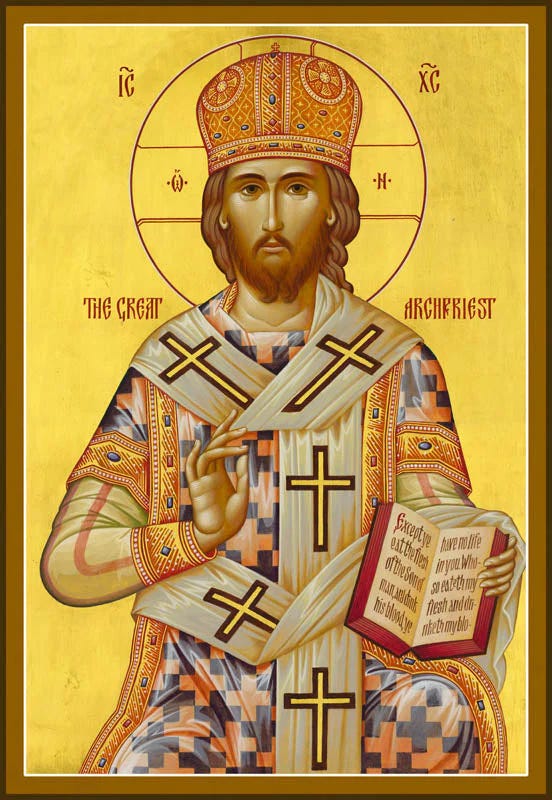
Consecrated for the World (17:6–19)
Before this stretch of the prayer, Jesus has already told the Father for whom he is praying.
“I am praying for them. I am not praying for the world but for those whom you have given me, for they are yours” (John 17:9).
Jesus tells the Father that the world has hated the disciples, “because they are not from the world, just as I am not from the world” (17:14). Yet, he does not ask the Father to remove them from that hostile world.
“I do not ask that you take them out of the world, but that you keep them from the evil one” (17:15).
He asks the Father to keep them in it, guard them, and set them apart within it.
“Sanctify them in the truth; your word is truth” (17:17).
In the Greek Old Testament, the same verb translated as “sanctify” here is used for the ordination of priests. When Moses prepares Aaron and his sons for service at the altar, God commands, “you shall anoint them and ordain them and consecrate them, that they may serve me as priests” (Exod 28:41; cf. 29:1, 33; 40:13). Behind “consecrate” in each of those verses stands the same Greek verb, ἁγιάζω (hagiazō), that Jesus applies to his disciples in verse 17. The word he speaks over his disciples is the word Torah speaks over Aaron.
That verbal match sharpens what Jesus says next: “for their sake I consecrate myself, that they also may be sanctified in truth” (17:19). He applies the priestly verb to himself first. Aaron needed Moses to consecrate him before he could serve at the altar. Jesus consecrates himself because the offering he is about to make is his own life. Because he sets himself apart for that offering, his disciples are set apart by the same word he has given them.
Their vocation, in the verse just before, is one of sending and commissioning, not withdrawal:
“As you sent me into the world, so I have sent them into the world” (17:18).
Aaron’s priesthood involved separation from everyday Israelite life for service at the tabernacle. In contrast, the priesthood that Jesus establishes operates differently. He sets the disciples apart specifically so they can be sent back into the world that he asked the Father never to remove them from.
We tend to view holiness and worldly engagement as opposites, as if the sanctified life involves withdrawing from neighbors, coworkers, and those we find hardest to love. Jesus prays against that instinct. He asks the Father to sanctify us by his word and then to send us. Consecration and mission are connected in a single request because the truth that sets us apart is the same truth the world desperately needs to hear.
The Life of the Age to Come (John 17:1–5)
Jesus defines eternal life exactly once in John’s Gospel, and he does it here.
This is eternal life, that they know you, the only true God, and Jesus Christ whom you have sent. (John 17:3, ESV)
The phrase translated “eternal life” is ζωὴ αἰώνιος — life of the age, the life that belongs to the age to come. The phrase isn’t primarily about duration. “Eternal life” is the life of the new creation, the life of God’s renewed world. Jesus is saying that this life is available now, because he is here.
And the content of that life is knowing God.
Not knowing about God, but knowing him.
In the language of Scripture, to know someone is to be in relationship with them — present, trusting, bound together over time. Jesus is defining the life of the new age as a relationship with the Father through the Son. That relationship is the gift. It is what the Son came to give to the world.
This definition doesn’t appear out of nowhere. Centuries earlier, Jeremiah had announced a new covenant, one whose hallmark would be exactly this kind of knowing:
“And no longer shall each one teach his neighbor and each his brother, saying, ‘Know the LORD,’ for they shall all know me, from the least of them to the greatest, declares the LORD” (Jer 31:34).
The old covenant required mediation — priests, teachers, and prophets. The new covenant Jeremiah envisioned would cut through all of that. Everyone, from the least to the greatest, would know God directly. Jesus stands in the upper room on the eve of his death and announces that the moment Jeremiah described has arrived. The new covenant is here, and its content is knowing the Father through the Son he sent.
The life of the age to come is already breaking in. The life of the new creation doesn’t wait for death. Every act of trust in Jesus, every real encounter with him in Scripture and prayer and sacrament, is new-creation life happening now. Paul writes:
“We were buried therefore with him by baptism into death, in order that, just as Christ was raised from the dead by the glory of the Father, we too might walk in newness of life” (Rom 6:4).
Jesus himself, in his life, death, and resurrection, is the arrival of the age to come, and to know him is to already be living inside that new world.
The rest of the prayer builds on the definition in verse 3. Jesus asks the Father to glorify him so that he can give new-creation life to all those the Father has given him (v. 2). The cross isn’t a detour; it’s the door. What Jesus is about to do — the hour that has finally come — is the act that opens access to knowing, relationship, and life.
It’s worth noting that when Jesus says “Jesus Christ whom you have sent” (17:3), the phrasing sounds unusual coming from Jesus himself. John has shaped this prayer for the ongoing praying community — the prayer was never meant merely to be overheard. The prayer was meant to be prayed. The church has been speaking these words back to God ever since, entering into the same knowing that Jesus describes.
The age to come isn't merely coming. In Jesus, the age to come has already arrived — and to know the Father through the Son in the power of the Holy Spirit is to already be living inside it.
Jesus Prayed for You (17:20–26)
Did you know that Jesus prayed for you? Yes, we all know he is our great high priest interceding for us in heaven at the right hand of God, but even while he was on earth, Jesus prayed for you.
“I do not ask for these only, but also for those who will believe in me through their word, that they may all be one, just as you, Father, are in me, and I in you, that they also may be in us, so that the world may believe that you have sent me” (John 17:20–21, ESV).
This whole chapter is known as the High Priestly Prayer of Jesus. While he is mainly interceding for the disciples who followed him during his earthly ministry, he prays not only for them, but also for those who would believe in him through the testimony, and that’s me and you. As you read John 17 today, remember that Jesus is praying for you, and see if that opens up any new insights into his prayer.
Can you expound more on what eternal life in this passage means? Same Greek words in John 3:16 — but I believe evangelicals would teach this is future (aka “heaven” after we die) but I take it to mean eternal life BEGINS when we first know Jesus !
Jesus makes it clear that believers were never meant to be a part of this world’s system — rather we are to be a light IN the darkness. I wonder how it is, once again, that Christian Nationalism is on the rise! Jesus certainly didn’t champion that mindset and it’s no where else in Scripture. Even here in John 17, Jesus stated “the world has hated them because THEY ARE NOT OF THE WORLD, … I do not ask that you take them out of the world.” It seems the current political movement among some believers is similar to the zealot movement in Jesus’ day. A movement He did not support nor did He call for an uprising against the rulers of that day. Rather, it appears He calls them within the ruling parties to engage with the love of God. Why can’t so many see that as Christ’s reality?