

A New Commandment? (13:31–35)
Judas has just walked out into the night. John marks the moment precisely:
“When he had gone out, Jesus said, ‘Now is the Son of Man glorified, and God is glorified in him’” (13:31).
The betrayal is already in motion, and Jesus speaks of glory. Whatever is coming will not interrupt what he came to do. It will accomplish it.
He turns next to the eleven who remain.
“Little children, yet a little while I am with you. You will seek me, and just as I said to the Jews, so now I also say to you, ‘Where I am going you cannot come’” (13:33).
The hour is close enough that he addresses grown men the way a father addresses children he is about to leave behind. Then comes the commandment.
“A new commandment I give to you, that you love one another: just as I have loved you, you also are to love one another” (John 13:34).
But the love of neighbor was not actually new. The Lord had already commanded it through Moses:
“You shall not take vengeance or bear a grudge against the sons of your own people, but you shall love your neighbor as yourself: I am the LORD” (Lev 19:18).
What then is new? Leviticus sets the standard at self-love: a neighbor is to be loved as you love yourself. That is not a low bar. Most of what passes for self-interest reveals how carefully people already look after their own comfort, reputation, and schedule. But Jesus does not ask the disciples to extend that same careful self-regard to one another. He sets a different standard: καθὼς ἠγάπησα ὑμᾶς (kathōs ēgapēsa hymas), just as I have loved you.
The commandment has not been canceled. It has been given a new reference point, one the disciples have not yet seen in full. Two chapters later, Jesus spells out what that love costs:
“Greater love has no one than this, than to lay down his life for his friends” (15:13).
The new commandment in chapter 13 is given further definition when, in chapter 15, Jesus explains what “as I have loved you” means.
“By this all people will know that you are my disciples, if you have love for one another” (13:35).
The test was never whether we are kind to people who are kind to us. Self-love already produces that much, inside a church as readily as outside one. The test is whether we extend ourselves toward a fellow believer the way Jesus extended himself toward us.
Even My Close Friend (13:21–30)
Long before Judas rose from the table, Israel had already sung about him.
“Even my close friend in whom I trusted, who ate my bread, has lifted his heel against me” (Ps 41:9).
The psalmist knew a wound that no stranger can inflict. An enemy at the gate can be resisted; a friend at the table cannot be suspected until it is too late. Another psalm names the same grief.
“It is not an enemy who taunts me... but it is you, a man, my equal, my companion, my familiar friend. We used to take sweet counsel together; within God’s house we walked in the throng” (Ps 55:12–14).
Betrayal is a companion’s crime.
John already quoted the first of these psalms a few verses earlier (13:18), so he doesn't need to explain what happens next. He only needs to narrate it.
Jesus, troubled in his spirit (the same verb used at Lazarus’s tomb in 11:33 and again in Gethsemane’s shadow in 12:27), announces that one of the Twelve will betray him. The disciples look at one another, uncertain. Peter signals to the disciple reclining at Jesus’s side (13:23), and Jesus responds by dipping a morsel of bread and handing it to Judas.
The gesture was not an accusation. In the customs of the meal, the host’s own hand offering food was a sign of favor, similar to the kindness Boaz shows Ruth at his table (Ruth 2:14). Jesus gives Judas the seat of honor even as he calls him the betrayer. Love does not turn away in the face of impending treachery. It reaches out anyway.
Satan enters Judas, and Jesus simply says, “What you are going to do, do quickly” (13:27). Judas gets up and walks out into the dark.
We assume Judas is the one person in the room we could never become, safely distant from us behind the label “betrayer.” But he wasn't a stranger who wandered in. He was reclining at the table, close enough to receive bread from Jesus’s own fingers, and he still walked into the night.
The Passover lambs were already being examined in Jerusalem’s pens. Israel remembered a night when darkness covered Egypt before deliverance came (Exod 10:21–23). Now, on the eve of its final Passover, the darkness shifts in the other direction, enveloping the one who will hand over the final Lamb. Jesus does not chase Judas into it. He lets him go, and he turns his face toward the cross.
“Will You Lay Down Your Life for Me?” (13:36–38)
The question Jesus asks Peter is not harsh. It is meant to clarify.
Peter has just learned the new commandment: love one another as Jesus has loved you (John 13:34). He watched Jesus kneel with a basin and a towel. Now, when Jesus talks about going somewhere Peter can’t follow, Peter’s instinct is to move forward anyway.
“Lord, why can I not follow you now? I will lay down my life for you” (John 13:37).
The words are genuine, but they are also borrowed.
Throughout this Gospel, laying down one’s life is what Jesus does—and what only Jesus can do first. “I lay down my life for the sheep,” he says in John 10:15, and again, “I lay down my life that I may take it up again” (John 10:17). The verb is τίθημι, the same word that opens the footwashing: Jesus “laid aside” his garments before he knelt (John 13:4). Sacrifice in John always flows from Jesus outward. Peter is reaching for a posture that Jesus has not yet fully modeled for him. He wants to give what he has not yet learned to receive.
Jesus does not scold the impulse. Instead, he guides it with a question: “Will you lay down your life for me?” (John 13:38). The gentle tone is not mocking but rhetorical. Jesus understands what Peter does not about himself. Before the rooster crows, Peter will deny him three times.
The denial predicted here shadows the entire passion narrative. When it occurs, it will not surprise the reader; only Peter will be surprised. But the foretelling also looks ahead to John 21, where the three-fold denial is met with a three-fold restoration.
“Do you love me?” Jesus will ask three times beside another charcoal fire (John 21:15–17).
The question Peter cannot yet answer in the upper room, but he will answer later on the shore.
There is mercy in Jesus’s foreknowledge. He does not abandon Peter for what he is about to do. He asks his question, states the truth plainly, and keeps walking toward the cross. The disciple who will deny him is still the disciple he is shaping.
Peter’s confidence isn’t entirely misplaced. It’s just premature. What he can’t do on the night of the arrest, he will eventually do, even if it leads him somewhere he doesn’t want to go (John 21:18). The cross transforms even those who run from it.
The Lord Who Kneels (13:1–20)
The night before Passover, Isaiah’s Servant and Lord takes a towel.
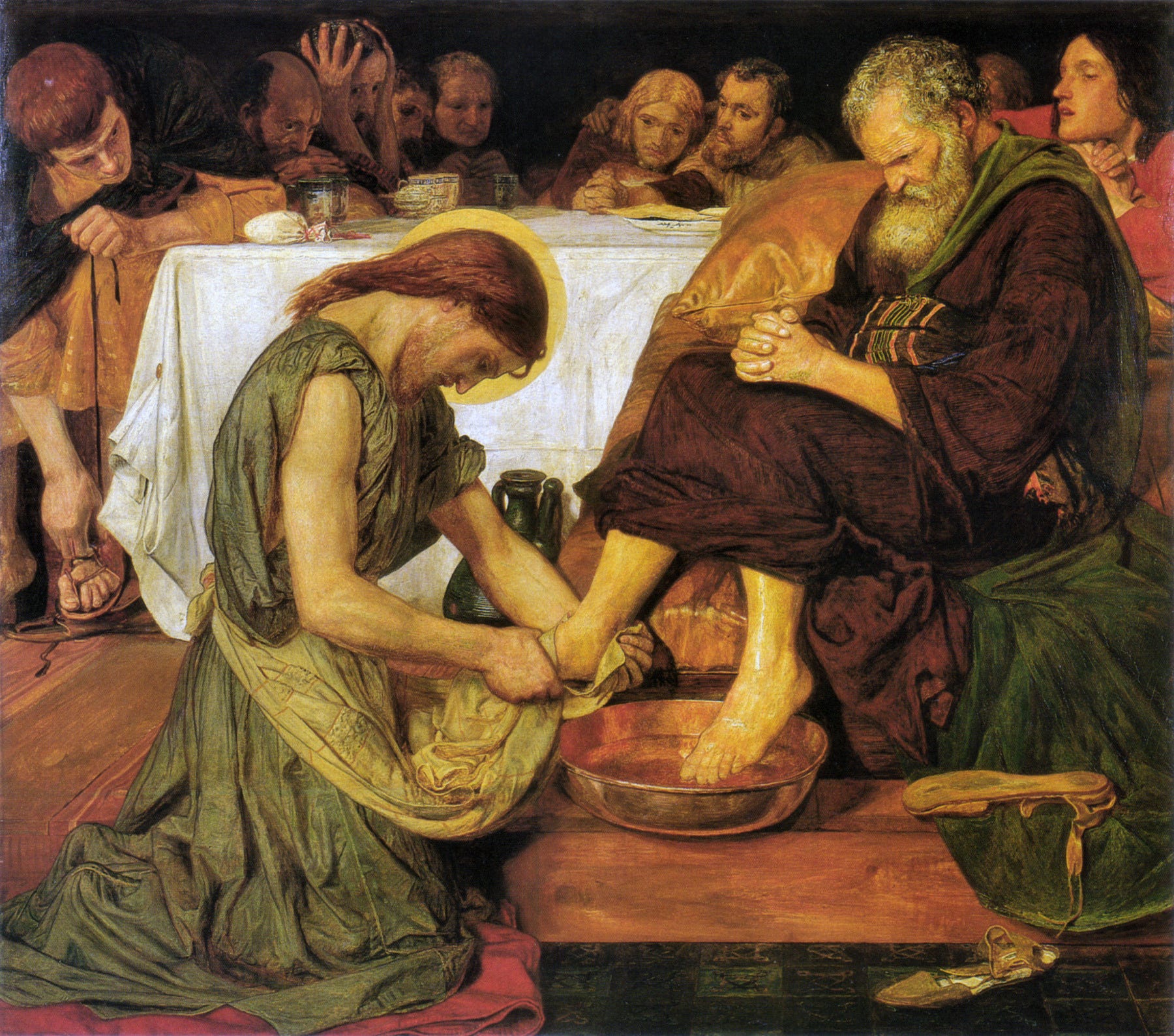
Israel had long anticipated the one who would bear the shame no one else would bear (Isa 52:13–53:12). He would humble himself to a place of disgrace and accomplish what earthly power never could. John begins his account of Jesus’ death not with an arrest but with a basin. Jesus gets up from the table, sets aside his outer garment, and starts to wash his disciples’ feet (John 13:4–5).
That night, Jesus washed feet that he had created.
John’s language is intentional. The verb he uses for “laid aside” (τίθησιν τὰ ἱμάτια) reflects the language Jesus uses elsewhere about laying down his life: “I lay down my life that I may take it up again” (John 10:17). In the same way, when the washing is finished, Jesus picks up his garments again (John 13:12).
The footwashing is more than just a lesson in servanthood. It is the cross, enacted in miniature the night before it happens. Jesus’s life is one continuous downward movement: from the right hand of God, to a manger in Bethlehem, to a basin in the upper room, to a cross outside the city walls (Phil 2:6–8).
It is worth noting that John does not record the words of institution. He mentions no broken bread, no cup, no “This is my body” or “This is my blood.” For John, the footwashing already says it all. The Lord who stoops to wash his disciples’ feet is interpreting his own death before it happens.
Peter understands none of this. His protest, “You shall never wash my feet” (John 13:8), is not rudeness; it is instinct. But Jesus’s answer is firm:
“If I do not wash you, you have no share with me” (John 13:8).
Discipleship does not begin with what you do for Jesus. It begins with receiving what you cannot do for yourself. The one who refuses to be washed cannot belong to the one who washes.
The Passover setting deepens the scene. John places the footwashing explicitly “before the feast of the Passover” (John 13:1), and the “clean/not clean” exchange that follows already has Judas in view (John 13:10–11). Jesus is preparing a people for a New Exodus in which people are cleansed by him through the washing with water.
The ὑπόδειγμα he leaves them (John 13:15), usually rendered “example,” is more than an ethical pattern. It is the shape of the community he is forming: “As I have done to you, you also are to do” (John 13:15). The cross not only saves us. It reshapes us.
On this night, before the bread is broken and the cup is raised, the Lord of heaven and earth gets down on his knees as the servant of all. Go, and do likewise.
A New Commandment (13:31–35)
We want to reach the lost. We aim to evangelize all nations and peoples. We want (to quote our vision statement) “to see the world, especially the places in which we live, work, and worship, filled with disciples of Jesus Christ.”
But how will the world identify us as his disciples?
Surely, it will be through our exegetical skill and theological insight. Surely, it will be our ability to parse Greek verbs and quote the church fathers from memory. Right?
“A new commandment I give to you, that you love one another: just as I have loved you, you also are to love one another. By this all people will know that you are my disciples, if you have love for one another” (13:34–35).
When I typed the words “Christian hate” into Google just now, the top result was a Reddit post titled “Why is there so much hate in Christianity?” When I scrolled down a little further, I found this question on Quora: “If Jesus Christ preached love, why do Christians show so much hate?”
The phrase “so much” really stands out to me in both questions. It’s not just that Christians are so widely known for hatred that people are questioning online how it could be so, but rather that Christians are known for “so much” hatred.
But Jesus commands us to love: love God, love your neighbor, and love one another.
That is how all people will know that we are his disciples. If we want to reach the world and save the lost, it starts with love.
And if you want to see what love looks like, it looks like kneeling to wash the feet of someone who will deny you and someone else who will betray you fatally.
3 “Jesus, knowing that the Father had given all things into his hands, and that he had come from God and was going back to God“
Whenever I read this verse, I think to myself “this is how Jesus was able to lay down his life” and it’s why I can as well! We have to know we’ve come from God, we belong to God, we are secure in Him. Nothing that befalls us can separate us (Romans 8) and nothing we do in service to Him can demean us. If I could think that way, in every moment, what joy I’d have in the privilege of being His and His alone. As someone once said, “we play to an audience of one!”
Insightful understanding of betrayal by a close friend and how the shock and surprise can birth such emotional devastation