

The Fragrance of Perfume (12:1–11)
Six days before the Passover, Jesus comes to Bethany, to the house of the man he had raised from the dead. They make a dinner for him there. Martha serves, as she always does, and Lazarus reclines at the table. A week earlier Martha had stood outside her dead brother’s cave and protested when Jesus ordered for the stone to be rolled away.
Martha, the sister of the dead man, said to him, “Lord, by this time there will be an odor, for he has been dead four days” (11:39).
The Greek verb behind “odor” is ὄζει (ozei), from ὄζω, to give off a smell. Now the man who once gave off the stench of death is sitting at a table, eating and drinking with the one who raised him from the dead.
And this is the moment when Mary takes a pound of pure nard, extravagantly expensive, and anoints Jesus’s feet, wiping them with her hair. When she does so:
The house was filled with the fragrance of the perfume (12:3).
“Fragrance” here is ὀσμή (osmē), the noun built from the same root as ὄζω. John never states the contrast explicitly; the vocabulary does the work on its own. Martha feared the scent of her brother’s death; Mary, with her brother alive and present, fills the house with the fragrance of perfume.
Judas objects. The perfume was worth three hundred denarii, a laborer’s wage for about a year’s worth of work, and Mary poured it on the feet of Jesus. According to Judas, what she should have done was sell it and give the money to the poor. John tells us Judas’s real motive.
He said this, not because he cared about the poor, but because he was a thief, and having charge of the moneybag he used to help himself to what was put into it (12:6).
κλέπτης, thief, is the same word Jesus used three chapters earlier, when he said the thief comes only to steal and kill and destroy (10:10). Judas is not simply dishonest at this dinner; he occupies, in the flesh, the role Jesus had already named as his opposite.
Jesus answers plainly.
“Leave her alone, so that she may keep it for the day of my burial. For the poor you always have with you, but you do not always have me” (12:7–8).
The fragrance filling the house is burial spice, offered early, by a woman whose own brother had already died and been raised. Again, John doesn’t tell us, but the reader is left to wonder whether Mary bought this perfume to use on her brother’s decaying body. Since it was no longer needed for that purpose, she pours it out on the feet of the one who made such a purpose moot.
Crowds come not only for Jesus but to see Lazarus, and the chief priests respond with a plan of their own.
So the chief priests made plans to put Lazarus to death also, because on account of him many of the Jews were going away and believing in Jesus (12:10–11).
News of resurrection will not stay contained to the location where it happened; it spreads, the way a smell fills a house. The authorities could argue about sabbath-keeping and law-breaking and a host of other issues, but they could not argue with a man who used to be dead. So they not only oppose Jesus, but seek to undo the very work that he had done.
Where there was death, Jesus brings life, and he does so through his own death. Where there was supposed to be the stench of death, there was instead the sweet fragrance of perfume, for the one who had died was alive again. Indeed, the one whose feet were anointed to prepare for his own impending death would one day live again, too. His death brings life to the dead. Where there was once the stench of death, there is now the sweet fragrance of life.
The Hour Has Come (12:20–33)
Daniel saw one like a son of man approach the Ancient of Days and receive dominion, glory, and a kingdom, “that all peoples, nations, and languages should serve him” (Dan 7:14). It is Jesus’ favorite way of naming himself, and every time he uses it, he is claiming that vision as his own.
Centuries earlier, God had already promised Abraham that “in your offspring shall all the nations of the earth be blessed” (Gen 22:18). Israel’s God was never going to keep his blessing to himself. He was always going to bring the nations in through Abraham’s own offspring, and Jesus is that offspring (Gal 3:16).
Now the nations are starting to come to Jesus.
“Now among those who went up to worship at the feast were some Greeks. So these came to Philip, who was from Bethsaida in Galilee, and asked him, ‘Sir, we wish to see Jesus’” (John 12:20–21).
Twice already in this Gospel, Jesus has said his hour has not yet come (John 2:4; 7:30). When Gentiles come asking for him, he says the opposite.
“The hour has come for the Son of Man to be glorified” (John 12:23).
Daniel’s Son of Man was promised the worship of every nation and tongue. That promise is arriving now, not as Gentiles bowing before a throne, but as a handful of Greeks looking for a Galilean rabbi at a festival. Jesus recognizes the moment because he already knows how his kingdom will actually be won.
“Truly, truly, I say to you, unless a grain of wheat falls into the earth and dies, it remains alone; but if it dies, it bears much fruit” (John 12:24).
A few verses later, he explains how that death draws the nations in.
“And I, when I am lifted up from the earth, will draw all people to myself” (John 12:32).
“Lifted up” is not new language. Moses lifted a bronze serpent on a pole in the wilderness so that anyone who looked at it would live (Num 21:9). Jesus becomes that serpent. He is lifted up as sin and curse (2 Cor 5:21), so that whoever looks to him, Jew or Greek, might live. This is why he calls it ‘glory’ rather than ‘tragedy’. The Son of Man reigns from the one place no one expected, a cross planted like a grain of wheat, drawing the nations to himself as he dies.
Then he turns the pattern on his disciples.
“Whoever loves his life loses it, and whoever hates his life in this world will keep it for eternal life” (John 12:25).
You do not get to admire this pattern from a safe distance. On the cross, the grain has already fallen, and the harvest is already secured; nothing you do adds to that. But if the Son of Man reigns by dying, following him will look the same way for his disciples. “If anyone serves me, he must follow me; and where I am, there will my servant be also” (John 12:26). We follow him not to earn what he finished, but to belong to the one who is drawing all people to himself.
The Glory that Undoes You (12:37–43)
Isaiah was a man who had seen glory. In the year King Uzziah died, he saw a vision of the Lord sitting on a throne, high and lifted up, with his train filling the temple, while seraphim cried out, “Holy, holy, holy is the Lord of hosts; the whole earth is full of his glory” (Isa 6:3). The vision overwhelmed him. “Woe is me! For I am lost; for I am a man of unclean lips” (Isa 6:5). A burning coal was pressed to his mouth, and then came the call: go and preach to a people who would not listen.
John makes a startling claim about that vision. Having recorded that Jesus performed signs, and still the crowd would not believe, he cites two passages from Isaiah to explain their unbelief. The first is from the Servant Songs:
“Lord, who has believed what he heard from us, and to whom has the arm of the Lord been revealed?” (John 12:38, quoting Isaiah 53:1).
The second is the hardening oracle from Isaiah’s own call:
“He has blinded their eyes and hardened their heart, lest they see with their eyes, and understand with their heart, and turn, and I would heal them” (John 12:40, quoting Isaiah 6:10).
Then John writes:
“Isaiah said these things because he saw his glory and spoke of him” (John 12:41).
The pronoun refers to Jesus. The vision Isaiah had in the temple— the one that overwhelmed him and motivated him to preach— was a vision of the preincarnate Son. What Isaiah saw enthroned was the glory of the one who would one day stand in the very city where that temple had been built, performing signs the crowd refused to accept.
The irony deepens in vv. 42–43. Many of the authorities believed, but they would not admit it, fearing expulsion from the synagogue. John’s verdict is brief and precise:
“They loved the glory that comes from man (τὴν δόξαν τῶν ἀνθρώπων) more than the glory that comes from God (τὴν δόξαν τοῦ θεοῦ)” (John 12:43).
Isaiah saw the glory of God and was overwhelmed by it. The authorities caught a glimpse of God’s glory but chose a different kind of glory instead. The word δόξα carries multiple senses: radiance, honor, and reputation. The approval of the Pharisees, the standing they had spent years building, was more important to them than what God was offering.
This issue isn’t restricted to the first century. The glory that comes from men is visible, immediate, and measurable. The glory of God undoes you before it commissions you. That cost is more than most are willing to pay.
John is asking us today whether we prefer the glory of man or the glory of God. From my limited perspective, most Christians today prefer τὴν δόξαν τῶν ἀνθρώπων.
The Wrong Festival (12:12–19)
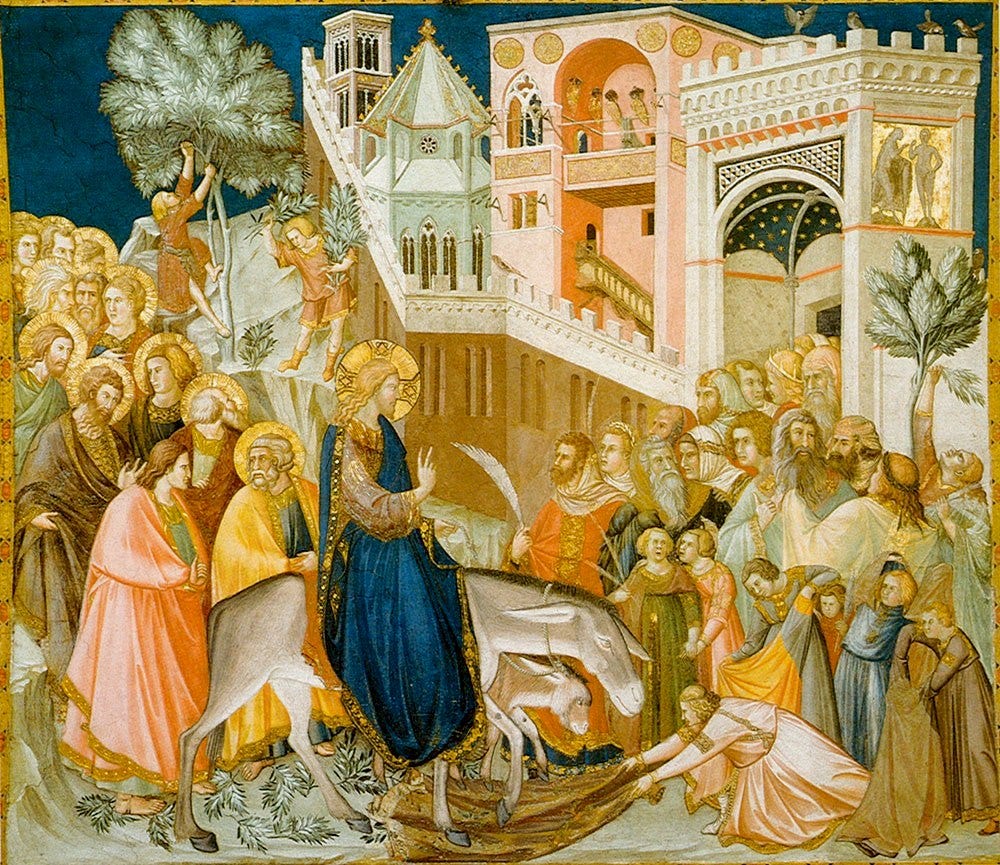
The triumphal entry is one of those events in the life of Jesus recorded in all four Gospels, an occurrence that is rarer than one might think. Along with John 12:12-19, there are parallel passages in Matthew 21:1-17; Mark 11:1-11; and Luke 19:29-40. While John makes clear that the time of year is around the Passover (John 12:1), the scene of the triumphal entry is reminiscent of another Jewish festival.
John already mentions the Feast of Dedication, as he calls it, in 10:21. Today, that festival is more commonly known as Hanukkah. This festival commemorates the Maccabean revolt against the Seleucid Empire in the 2nd century BC. As part of this revolt, Judas Maccabeus and his brothers reclaimed Jerusalem and the Second Temple. Notice the similarities in the scene as Judas Maccabeus enters Jerusalem.
On the twenty-third day of the second month, in the one hundred seventy-first year, the Jews entered it with praise and palm branches, and with harps and cymbals and stringed instruments, and with hymns and songs, because a great enemy had been crushed and removed from Israel (1 Macc 13:51, NRSV).
6 They celebrated it for eight days with rejoicing, in the manner of the festival of booths, remembering how not long before, during the festival of booths, they had been wandering in the mountains and caves like wild animals. 7 Therefore, carrying ivy-wreathed wands and beautiful branches and also fronds of palm, they offered hymns of thanksgiving to him who had given success to the purifying of his own holy place. 8 They decreed by public edict, ratified by vote, that the whole nation of the Jews should observe these days every year. 9 Such then was the end of Antiochus, who was called Epiphanes (2 Macc 10:6–9).
Now here’s John’s account of the triumphal entry:
12 The next day the large crowd that had come to the feast heard that Jesus was coming to Jerusalem. 13 So they took branches of palm trees and went out to meet him, crying out, “Hosanna! Blessed is he who comes in the name of the Lord, even the King of Israel!” (John 12:12–13).
At the triumphal entry, the people aren’t welcoming the Passover sacrifice. They are welcoming (they think) the second coming of Judas Maccabeus. They don’t want a Passover lamb. They want a king, and so they welcome him as one, expecting him to do what Judas and his brothers had done before when they brought an end to the reign of Antiochus Epiphanes in Judah.
Jesus is a king, but not like they expect. He comes low and riding on a donkey. The Jews are, in effect, celebrating the wrong festival at the wrong time. It wasn’t Hanukkah. It was Passover, and, for the most part, they failed to see the lamb of God right in front of their eyes.
As I read the story of the anointing, I was reminded of this passage in 2 Corinthians 2:14-15:
“14 But thanks be to God, who always leads us as captives in Christ’s triumphal procession and uses us to spread the aroma of the knowledge of him everywhere.
15 For we are to God the pleasing aroma of Christ among those who are being saved and those who are perishing.”
I think a great question we should pose to ourselves is “am I a fragrant aroma? Or do I just stink?”
I have a question about Isaiah 6:10 quoted here in John. Why would God blind eyes and harden hearts? It’s also something we read He did with Pharoah. Both these instances seem to give credence to pre- destination or Calvinism — yet we read in the NT that God says he wants all people to be saved? Can you elaborate?