

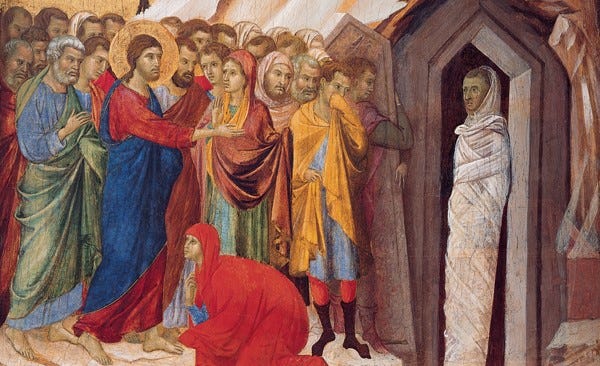
That We May Die With Him (11:1–16)
When Jesus learns that his friend Lazarus is ill, he doesn’t go to him immediately. Instead, he says:
“This illness does not lead to death. It is for the glory of God, so that the Son of God may be glorified through it” (11:4).
Jesus stays where he is for two more days, and only then does he head to Bethany. The way John describes this moment is worth considering.
Now Jesus loved Martha and her sister and Lazarus. So, when he heard that Lazarus was ill, he stayed two days longer in the place where he was (11:5–6).
Jesus loved Mary, Martha, and Lazarus, so he didn’t come right away. His love for them was to be manifested in resurrection, not in healing.
Now, when Jesus’ disciples hear that he will be heading back to Bethany, into a territory where the Jews have been seeking to stone him, they protest. Jesus comments that Lazarus is sleeping rather than dead, and they reply that if he’s really just sleeping, he’ll wake up, and they should take the safe course of action. But Jesus expresses his resolve to go, and so one disciple, the one we know mostly for his doubt, says:
“Let us also go, that we may die with him” (11:16).
I’m always struck by this moment, not only because so-called Doubting Thomas seems to express the very opposite of doubt, but also because of how it fits in the subtext of this scene.
Everything in this scene before this statement is about God's glory being manifest through resurrection. Jesus waits two days to make certain that Lazarus is really dead, but he does this because he loved Mary, Martha, and Lazarus, and because he understood that what happened to Lazarus (bodily death) wasn’t actually the end of his friend’s story. God intended to raise him up, and this is a signpost for what God will do on the last great day for all who believe in Christ.
And in that context, in which even our bodily death is for the glory of the God who will raise us from the dead, what more could a disciple say than, “Where Jesus goes, I’ll go, and if it costs me my life, so be it.” Jesus calls us to take up our cross and follow him because he knows that death is not the end of our story. We can follow, go with him, and walk the path that he walked because we know that at the end of that path, he will raise us up.
[[Bonus: This saying also stands out to me because it’s featured prominently in the finale of Lost. Spoiler warning for those who want to watch the clip.]]
Scattered Abroad (11:45–57)
Israel’s prophets never saw the exile as the end. Moses had already promised that after the scattering, the LORD “will gather you again from all the peoples where the LORD your God has scattered you” (Deut 30:3–4). A return from exile was always part of the plan.
Isaiah had pictured a signal raised for the nations, so that God would “assemble the banished of Israel, and gather the dispersed of Judah from the four corners of the earth” (Isa 11:12). Jeremiah put it more tenderly still: “He who scattered Israel will gather him, and will keep him as a shepherd keeps his flock” (Jer 31:10). And Ezekiel, in the very chapter that features dry bones coming back to life, ends with the scattered nation gathered under one king and one shepherd (Ezek 37:21–22, 24). For Israel, the promise of gathering carried the weight of hope itself.
By the time Lazarus walks out of his tomb, the chief priests and Pharisees have stopped debating whether Jesus performs signs and had started calculating what to do about it. Caiaphas, the high priest that year, cuts through their indecision:
“You know nothing at all. Nor do you understand that it is better for you that one man should die for the people, not that the whole nation should perish” (John 11:49–50).
John does not let the remark pass as mere political calculation:
He did not say this of his own accord, but being high priest that year he prophesied that Jesus would die for the nation, and not for the nation only, but also to gather into one the children of God who are scattered abroad (11:51–52).
A high priest speaks truly while believing falsely, the way Balaam once blessed Israel with a mouth bent on cursing it (Num 23–24). Caiaphas is speaking about Rome and self-preservation. God intends his words to refer to Christ’s salvific cross. The office built for atonement, one man standing in for the many, becomes for one afternoon the mouthpiece of the very promise it was meant to serve.
That promise of one shepherd is why Jesus had already said, of sheep not yet gathered into his fold, “I must bring them also, and they will listen to my voice. So there will be one flock, one shepherd” (10:16). Ezekiel’s one shepherd has arrived, and the exile is coming to an end. All those scattered and separated from God are being called home by the death of the Good Shepherd.
Unbind Him (11:38–44)
When Ezekiel stood in the valley of dry bones, God commanded him to prophesy breath into the slain (Ezek 37:9). Bones rattled, flesh appeared, and a large multitude rose to their feet. It was a vision of national restoration, with the entire house of Israel raised from exile and despair (37:11). But it remained just a vision. By the time Jesus arrives at a sealed tomb outside Bethany, the vision is about to turn into a voice.
The Lazarus story is found only in John; it’s missing from all three Synoptic Gospels. When Jesus gets to the tomb, he tells the people to remove the stone. Martha protests:
“Lord, by this time there will be an odor, for he has been dead four days” (John 11:39).
Four days were significant in the Jewish understanding of death. Hope had not just dimmed; it had vanished. Jesus responds by highlighting the glory of God (11:40) and prays aloud, not for himself but for the crowd watching (11:42). They need to grasp that what follows comes from the Father.
Then he calls out with a loud voice (φωνῇ μεγάλῃ):
“Lazarus, come out.” (11:43)
And Lazarus comes. But he emerges still bound, his hands, feet, and face wrapped in grave linens (11:44). (Notably, this is not the case when Jesus is raised.) Lazarus is alive but not yet free. The miracle requires one more command. Jesus speaks it:
“Unbind him, and let him go.” (11:44)
Death had bound him, and Jesus releases him. The one who declared himself the resurrection and the life (11:25) doesn’t merely restore a pulse; he undoes the grip of death entirely and sends Lazarus back into the world free from his death clothes.
John doesn’t allow the reader to linger. The sign immediately triggers the Sanhedrin’s decision to put Jesus to death (11:53). The one who opens tombs will soon enter one. But he enters it as the one who commands graves, not as one ruled by them. What Ezekiel saw as a vision of scattered bones slowly gathering, Jesus performs as a living voice at a sealed stone. And the command he speaks over Lazarus, he intends to speak over all who are his.
On the last great Easter Day, the Lord will say to death about all of us, “Unbind them, and let them go.”
Even Now (11:17–27)
In the Book of Common Prayer 2019, the burial liturgy offers several options for the Gospel reading. They are all good, but my top choice is by far John 11:21-27. I am always struck by how Martha speaks to Jesus.
Martha said to Jesus, “Lord, if you had been here, my brother would not have died. But even now I know that whatever you ask from God, God will give you” (11:21–22).
I love her belief that Jesus’s presence would bring healing, but even more, I cherish those two words: “even now.” Even now, despite this loss, despite this tragedy, despite death, she knows the story isn’t over. She understands death doesn’t get to have the final say in her brother’s life because Jesus has finally arrived. His presence changes everything.
Jesus then says that Lazarus will rise again, which Martha takes as a reference to the typical first-century Jewish belief in a general resurrection, showing how widespread this belief was. Jesus clearly has something else in mind.
It’s important to note that the Jewish belief in resurrection was primarily a collective belief rather than an individual one. It was something God would do for everyone (or at least the children of Abraham) on the last great day. The concept of an individual resurrection outside of that collective event doesn’t seem to have come into anyone’s mind.
Jesus responds to Martha:
“I am the resurrection and the life. Whoever believes in me, though he die, yet shall he live, and everyone who lives and believes in me shall never die. Do you believe this?” (11:25–26).
This is a notable statement for several reasons. First, it references the divine name as Jesus begins with the words ἐγώ εἰμι, “I am.” Second, Jesus claims to be the resurrection and the life, and as I have said elsewhere, the order is unexpected. As ἐγώ εἰμι, he was part of the creative process. All things were made “through him,” so he is the life of the world, and he embodies this life so completely, thoroughly, and strongly that when faced with death, he is also “the resurrection.” Resurrection is the ultimate affirmation of life—and also of the goodness of creation.
Third, there is the remarkable claim that anyone who believes in him shall never die, even as Lazarus lies dead in the tomb. Earlier, Jesus said that Lazarus had “fallen asleep” (11:11), a phrase Paul also uses to describe death. I interpret Jesus to mean that those who believe in him will never truly experience death, meaning they will have no conscious awareness of it.
Fourth, and maybe most importantly, there’s the question: “Do you believe this?” Knowing what Jesus said and did matters, but the key question is still “Do you believe this?”
How timely is this devotional as well as the previous one on this chapter! Today I go to make memorial plans for my 91-year old dad, who “fell asleep” Tuesday April 14 at 12:23 am. I have NO doubt he will be raised to life because he accepted Jesus’ message at the age of 45! It brings me comfort during this time to know we will be reunited some day because Jesus IS the resurrection and the life and he (my dad) who believed in him never truly dies!!