

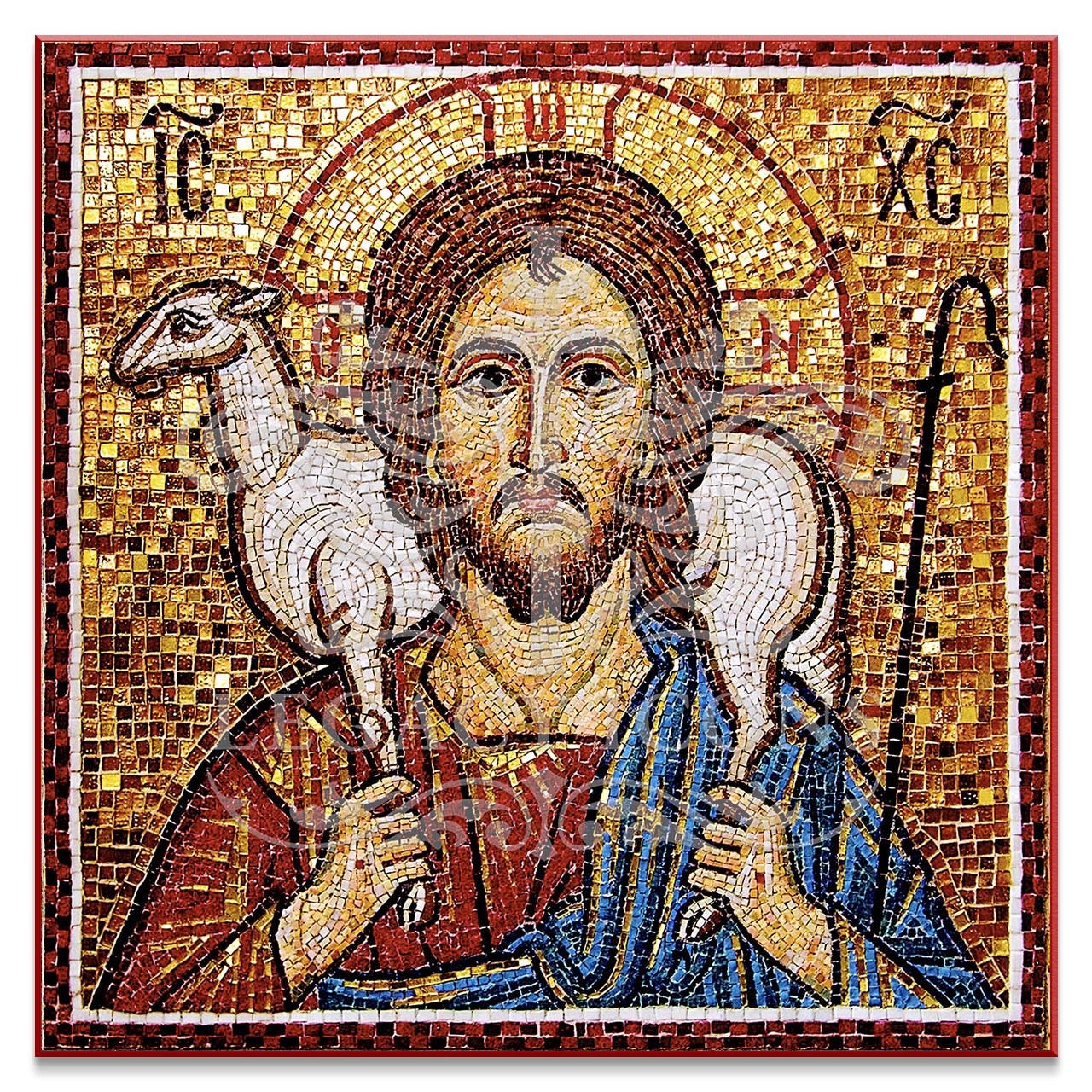
The Shepherd’s Voice (10:1–10)
Jesus opens with an image drawn from the ordinary mechanics of Judean shepherding, then turns it immediately into an accusation.
Truly, truly, I say to you, he who does not enter the sheepfold by the door but climbs in by another way, that man is a thief and a robber (10:1).
A sheepfold was typically an enclosed courtyard with a single opening, sometimes watched overnight by a hired gatekeeper. A shepherd uses the door because he has nothing to hide from the paid gatekeeper. Someone who scales the wall almost certainly has something to hide.
But Jesus is the Good Shepherd, and so he says of the shepherd:
To him the gatekeeper opens. The sheep hear his voice, and he calls his own sheep by name and leads them out (10:3).
“Leads them out” translates the Greek verb, ἐξάγω (exagō). The Pentateuch uses this exact verb, repeatedly, for the exodus itself: “the LORD your God, who brought you out [ἐξαγαγών] of the land of Egypt” is the Torah’s own shorthand for who God is to Israel (Deut 5:6; cf. Exod 20:2; Deut 6:12). The Good Shepherd is one again leading his sheep out of their slavery.
When he has brought out all his own, he goes before them, and the sheep follow him, for they know his voice. A stranger they will not follow, but they will flee from him, for they do not know the voice of strangers (10:4–5).
The Shepherd goes before the sheep, and the sheep follow. They don’t follow because he makes the most convincing argument. They follow because they hear his voice when he calls to them. This says something profound about what it means to follow Jesus, and also what it should mean to call out to other sheep.
Too often modern shepherds, i.e., pastors, want the sheep to hear their voice and follow them. But what if ecclesial shepherds aren’t meant to amplify their own voice, but the voice of the Good Shepherd? The sheep aren’t supposed to be following us or our voice. They’re supposed to hear his voice and follow him, so pastoring and evangelism are at their very best when we echo and repeat the voice of the Good Shepherd rather than amplifying our own voice and brand.
Jesus then shifts the metaphor.
So Jesus again said to them, “Truly, truly, I say to you, I am the door of the sheep. All who came before me are thieves and robbers, but the sheep did not listen to them” (10:7–8).
He moves from describing the shepherd to naming himself the entrance, the one fixed point any legitimate claim on the flock must pass through.
I am the door. If anyone enters by me, he will be saved and will go in and out and find pasture (10:9).
Going in and out to find pasture is a life that moves, grazing and returning, not a life spent huddled behind a wall for safekeeping.
The thief comes only to steal and kill and destroy. I came that they may have life and have it abundantly (10:10).
The metaphors are mixed, but the point is clear. Jesus is the Good Shepherd of the sheep, and he is leading his people out again in a new Exodus so they may have life, and have it abundantly. But he is the only way into this new community of sheep. He is the door that the sheep who hear his voice must pass through. He is calling them. They must follow, for the path he leads them on is the only path to eternal life.
“I Said, You Are Gods” (10:31–39)
Psalm 82 is a courtroom scene. God stands in the divine assembly and pronounces judgment on Israel’s own judges, the men entrusted to act in his name and defend the weak. They have failed. They have shown partiality to the wicked while the fatherless and the afflicted go undefended, and the psalm says the result is cosmic: “all the foundations of the earth are shaken” (Ps 82:5). It is in the middle of this indictment that God addresses the judges directly.
I said, you are gods, sons of the Most High, all of you. Nevertheless, you shall die like men, and fall like any prince (Ps 82:6–7).
These men bear the title “gods” because the word of God came to them for the office of judgment, not because they possess a divine nature. The psalm ends by asking God himself to do what the human judges would not:
“Arise, O God, judge the earth” (Ps 82:8).
Psalm 82 is the text Jesus quotes after the Jews pick up stones against him for saying, “I and the Father are one” (10:30–31). They charge him with blasphemy: “You, being a man, make yourself God” (10:33). Jesus answers from their own law.
Is it not written in your Law, “I said, you are gods”? If he called them gods to whom the word of God came, and Scripture cannot be broken, do you say of him whom the Father consecrated and sent into the world, “You are blaspheming,” because I said, “I am the Son of God”? (10:34–36).
The argument moves from lesser to greater. Jesus is not lowering his divine claim to the level of Israel’s judges. They only received the word of God for a temporary office. He has not merely received the word. The Father consecrated him and sent him into the world. If an inherited office was enough to earn Israel’s judges a divine title without blasphemy, the one the Father set apart before he ever came into the world has far greater warrant to be called Son of God.
The judges of Psalm 82 were indicted for failing to defend the weak. The men holding stones in the temple make the same failure, refusing the very scripture they claim to uphold, rather than submit to the judgment standing in front of them. Jesus does not answer their second attempt to seize him (10:39) by retreating from the claim. He will go to the cross still consecrated, still sent, still doing his Father’s works, and there he will do what Psalm 82’s judges never could: give account for the weak, in his own body.
The Shepherd-King (10:22–30)
For centuries, Israel had been waiting for a shepherd. The prophet Ezekiel announced that God’s appointed shepherds had failed, scattering the flock across the nations (Ezek 34:1–6). In their place, God made a promise:
I will set up over them one shepherd, my servant David, and he shall feed them: he shall feed them and be their shepherd (Ezek 34:23).
The coming shepherd would be a king from the line of David, someone who would gather the scattered sheep and lead them on behalf of God himself.
The scene in John 10:22–30 is unique to the Fourth Gospel. It is winter, and Jesus is walking in Solomon’s Portico. John takes care to tell us that it was “the Feast of Dedication” (10:22). Protestant and Jewish readers will search their Old Testaments in vain for this feast. The Feast of Dedication, known today as Hanukkah, commemorated the Maccabean rededication of the Jerusalem Temple in 164 BC, after Antiochus IV Epiphanes had desecrated it. Judas Maccabeus, “the Hammer,” led a military revolt, recaptured the temple mount, and restored Israel’s worship (1 Macc 4:36–59). He was, by any measure, the kind of shepherd-king Israel celebrated: a warrior who fought for his sheep.
It is in this theologically charged atmosphere that the crowd presses Jesus:
How long will you keep us in suspense? If you are the Christ, tell us plainly (John 10:24).
They have heard him speak of the Good Shepherd. They understand what he is hinting at. If he is the shepherd, he is claiming to be the Christ, and they want him to say so clearly. What better time could there be than the Feast of Dedication for another Judas Maccabeus to reveal himself?
Jesus’s reply cuts to the heart of the misunderstanding:
I told you, and you do not believe. The works that I do in my Father’s name bear witness about me, but you do not believe because you are not among my sheep (John 10:25–26).
He is the Messiah, and he has shown them plainly. But his works tell a very different story from the one celebrated by the Feast of Dedication. In John’s Gospel, Jesus has already done what Judas did. He has already made his way to the temple and cleansed it. But where Judas went to drive out the pagans, Jesus drove out his fellow Judeans. Jesus will go again to Jerusalem, but this time he goes to lay down his life. Where the Maccabean shepherd took up the sword to bring political freedom, the Good Shepherd will stretch out his hands on a Roman cross to bring ultimate redemption. The feast celebrating military liberation has become the backdrop for a redefinition of what true liberation really looks like.
Ezekiel’s promised shepherd had come, but he was not the kind of shepherd Israel had expected. He was far better.
Other Sheep (10:11–18)
Since we are in the season of Epiphany, I want to consider what Jesus says in verse 16.
And I have other sheep that are not of this fold. I must bring them also, and they will listen to my voice. So there will be one flock, one shepherd (John 10:16).
Jesus, among other roles, was a prophet to Israel. He is calling to them, and those who respond positively are his sheep, who hear the voice of the Good Shepherd and follow him. But the prophets had always hinted — actually, more than hinted — that God’s plan was not limited to the descendants of Abraham, Isaac, and Jacob. Part of God’s original promise to Abraham included the words, “and in you all the families of the earth shall be blessed” (Gen 12:3).
What God was doing in and through Jesus was not just for Israel but for the whole world, so he has “other sheep that are not of this fold.” These sheep are those who respond positively to Jesus from every tongue, tribe, race, and people around the globe. I won’t delve into theories about the doctrine of election, but there’s something significant about the words “I have other sheep” and “I must bring them also.” Either way, the goal, as we see elsewhere in the New Testament, is to create one new humanity from these many sheep, so that there will be one flock and one shepherd. I can’t help but think of the powerful scene from Revelation 5.
After this I looked, and behold, a great multitude that no one could number, from every nation, from all tribes and peoples and languages, standing before the throne and before the Lamb, clothed in white robes, with palm branches in their hands, and crying out with a loud voice, “Salvation belongs to our God who sits on the throne, and to the Lamb!” And all the angels were standing around the throne and around the elders and the four living creatures, and they fell on their faces before the throne and worshiped God, saying, “Amen! Blessing and glory and wisdom and thanksgiving and honor and power and might be to our God forever and ever! Amen” (Rev 5:9–12).
We see here not just one nation, but representatives from all of humanity, united as one flock praising the one shepherd (who is the Lamb!) and our creator God, and to that I say, “Amen!”