

Come and See (1:35–51)
John has already named Jesus the Lamb of God once (1:29). When he says it again the next day, it costs him two of his own disciples (1:36–37). They leave John and follow Jesus, and Jesus turns and asks the first question he puts to anyone in this Gospel:
“What are you seeking?” (1:38).
The disciples do not answer him directly. It makes me wonder if the question is really for the reader. Instead, the disciples ask where Jesus is staying. Jesus does not explain himself. He simply says, “Come and you will see” (1:39), and they do, staying with him until evening.
That reference to seeing repeats throughout the remainder of the chapter. Andrew finds his brother Simon and tells him they have found the Messiah (1:41), and brings him to Jesus (1:42). The next day Jesus finds Philip and tells him to follow (1:43), and Philip finds Nathanael and makes the same basic claim that Andrew had made, that they have found the one about whom Moses and the prophets wrote (1:45). Nathanael is not impressed. Nazareth has no reputation worth mentioning (1:46). Philip does not argue the point. He repeats the invitation that Jesus extended to him: “Come and see” (1:46).
Jesus already knows Nathanael before Philip brings him. He saw him under the fig tree (1:48), and whatever that detail means to Nathanael, it is enough. Nathanael confesses Jesus as Son of God and King of Israel in a single breath (1:49). Jesus’s answer is not quite a compliment.
“Because I said to you, ‘I saw you under the fig tree,’ do you believe? You will see greater things than these” (1:50).
Then he says what those greater things are:
“You will see heaven opened, and the angels of God ascending and descending on the Son of Man” (1:51).
Centuries earlier Jacob dreamed of a ladder reaching from earth to heaven, and “the angels of God were ascending and descending on it” (Gen 28:12). He woke up and named the place Bethel, the house of God, the spot where heaven and earth meet. Jesus takes that image and moves it. The angels no longer ascend and descend on a ladder. They ascend and descend on Jesus. He is the place where heaven and earth now meet, and Nathanael, along with Andrew, Simon, and Philip, are invited to see it happen.
The whole pericope follows this shape. Nobody in it is argued into faith. Andrew does not debate his brother; he tells him what he found and brings him along. Philip does not out-argue Nathanael’s objection about Nazareth; he repeats the invitation he was given himself. We tend to assume the people around us need better reasons before they will consider Jesus, so we rehearse arguments instead of making the simpler offer that was made to these four men: “come and see.”
I Am Not (1:19–34)
When priests and Levites from Jerusalem asked John who he was, he answered plainly: “I am not the Christ.” Pressed further, he denies being Elijah, denies being the Prophet, and only then identifies himself, applying a citation rather than claiming a title:
“I am the voice of one crying out in the wilderness, ‘Make straight the way of the Lord,’ as the prophet Isaiah said” (1:19–23).
The priests and Levites arrive with a script already written. Israel had been told that Elijah would return before the day of the Lord (Mal 4:5), and Moses had promised a prophet like himself, whom the people were to heed (Deut 18:15, 18). Asking whether John is Elijah or the Prophet hands him a role Israel had waited centuries to see filled, and John refuses.
There is some tension here with the other Gospels. Mark describes John as wearing the same clothing that Elijah wore (Mark 1:6; 2 Kgs 1:8), and Matthew has Jesus name him outright as the Elijah who was to come (Matt 11:14; 17:12–13). This Gospel makes no such move. John appears to deny being the Elijah-figure prophecied by Malachi, although he could also be denying that he is Elijah redivivus, which softens the tension somewhat.
What John does claim for himself is important. Isaiah prophesied the end of the exile and the return of Yahweh to Zion. John claims this role and names his entire ministry as preparatory. He is the voice, not the one whose way is being prepared.
The next day, John sees Jesus and says, “Behold, the Lamb of God, who takes away the sin of the world” (1:29). John’s own Gospel supplies the fullest gloss on this title. At the crucifixion, Jesus dies as the Passover lambs are being slaughtered (19:14), and his legs are left unbroken in fulfillment of the law that no bone of the Passover lamb may be broken (Exod 12:46; 19:36). Chapter one announces what chapter nineteen completes.
But the Passover lamb protected Israel from the destroyer; it did not, on its own, take away sin. For that, the image reaches toward Isaiah's servant, “led like a lamb to the slaughter,” who would “bear the sin of many” (Isa 53:7, 12).
John adds one more piece of testimony: “I saw the Spirit descend from heaven like a dove, and it remained on him” (1:32). Israel’s judges had been filled with the Spirit for a task, then left to themselves. What John describes does not depart; a Spirit that rests and stays marks someone whose identity was for far more than a single task.
John says, “I have seen and have borne witness that this is the Son of God” (1:34). John’s task was to point not to himself but to Jesus. In this way, he is a model of all disciples of Christ. Our task is always to bear witness about him and not ourselves. We prepare his way. He is the one for whom the world is longing and waiting.
From Creation to Tabernacle (1:1–18)
Quick! Answer this question without looking up the answer: How does the book of Exodus end? Recent experience tells me that most people aren’t sure about the answer to this question, but the answer is actually pretty important for understanding the narrative arc from Genesis through Exodus.
Genesis starts with creation. God creates the world and his image bearers, then dwells with his people in the temple known as the Garden of Eden. Then Adam sins, and humankind is exiled from the garden and the presence of God. Tragically, God no longer dwells among his people.
Throughout the story that follows, God does appear at certain moments to be with his people, but these instances are just that: instances. God appears, and then he leaves.
But then, with an outstretched arm, God frees his people from Egypt and calls them to Mount Sinai, where he meets them on the mountain. And this time, God shows up, and he intends to stay. He gives Moses not just the Law, but also instructions for building the Tabernacle, the movable dwelling where God would live with his people as they traveled through the wilderness and into the Promised Land.
The book of Exodus concludes with God’s glory filling the Tabernacle.
34 Then the cloud covered the tent of meeting, and the glory of the Lord filled the tabernacle. 35 And Moses was not able to enter the tent of meeting because the cloud settled on it, and the glory of the Lord filled the tabernacle (40:34–35).
In that moment, the narrative arc of Genesis–Exodus was complete. The God who had at first dwelt with his people was now dwelling with them once again. But what does this have to do with the Gospel of John?
John draws on this very narrative arc in the introduction to his Gospel:
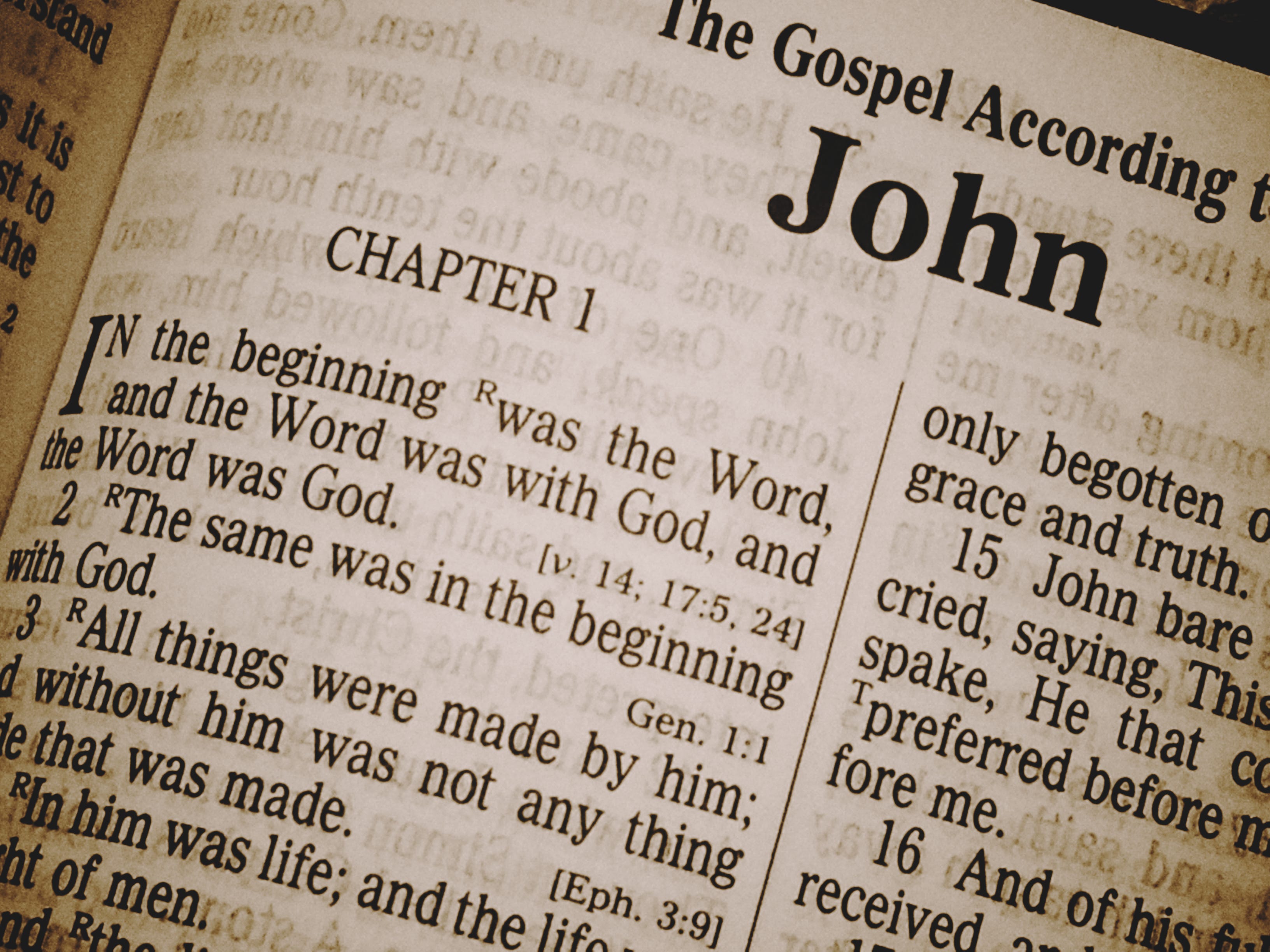
1 In the beginning was the Word, and the Word was with God, and the Word was God. 2 He was in the beginning with God. 3 All things were made through him, and without him was not any thing made that was made (John 1:1–3).
The introduction begins with creation and then moves to presence and glory:
14 And the Word became flesh and dwelt among us, and we have seen his glory, glory as of the only Son from the Father, full of grace and truth (John 1:14).
The Greek word translated as “dwelt” is σκηνόω, from σκηνή, which means “tent.” This word is the one used for the Tabernacle in the LXX (the Greek translation of the Old Testament).1 John’s point is fairly obvious. The God who created the world and then dwelt with his people has come to dwell with his people once again in the person of Jesus. John wants his readers to see that Jesus is the tabernacling presence of the creator God back on earth once again, and that seeing him is to have seen the glory of God.
First Post (Jan 1, 2026)
Happy New Year! Thank you for signing up to Walk with Jesus in 2026! Each year, many people make resolutions for their health, finances, and habits—all good things. But what about our spiritual life? The Word became flesh. God has united himself to humanity forever, and that changes everything. As followers of Jesus, shouldn’t our resolutions be about following him more closely? About loving people more genuinely? We’re starting with John because there’s no better place to begin walking with Jesus than “In the beginning.” Happy reading!
In the LXX, “the glory of the Lord filled the tabernacle” (Exod 40:35) is translated as δόξης κυρίου ἐπλήσθη ἡ σκηνή.
It gave me pause to hear Jesus say “what are you seeking?” That’s a question we should ask ourselves occasionally — what AM I seeking? Political power? To be ‘right?’ An intellectual assent to the Bible and the teachings of Jesus? To have an easy and trouble-free life? Or am I pursuing Him?! I thought of John 17:3 where we are told “ And this is eternal life, that they know you, the only true God, and Jesus Christ whom you have sent.” The men in this account all acknowledge who Jesus is and was: Rabbi, Messiah, the fulfillment of Moses (the Law) and the Prophets, the Son of God, and the King of Israel! Yet we know that as Jesus is taken to the cross, most of them seemed perplexed that He wasn’t the fulfillment of what those titles meant to them.
This passage is a great reminder for me to make sure I’m following The Christ, The Son of God, and that knowing Him is eternal life. Not knowing about Him but truly knowing Him, His character, and following in His steps which leads to a cruciform life not anything else! Oh
I’ve got a question that I’ve never seen addressed. John is asked if he is the Christ, Elijah, or the Prophet. Who is this mysterious Prophet to whom they refer?