

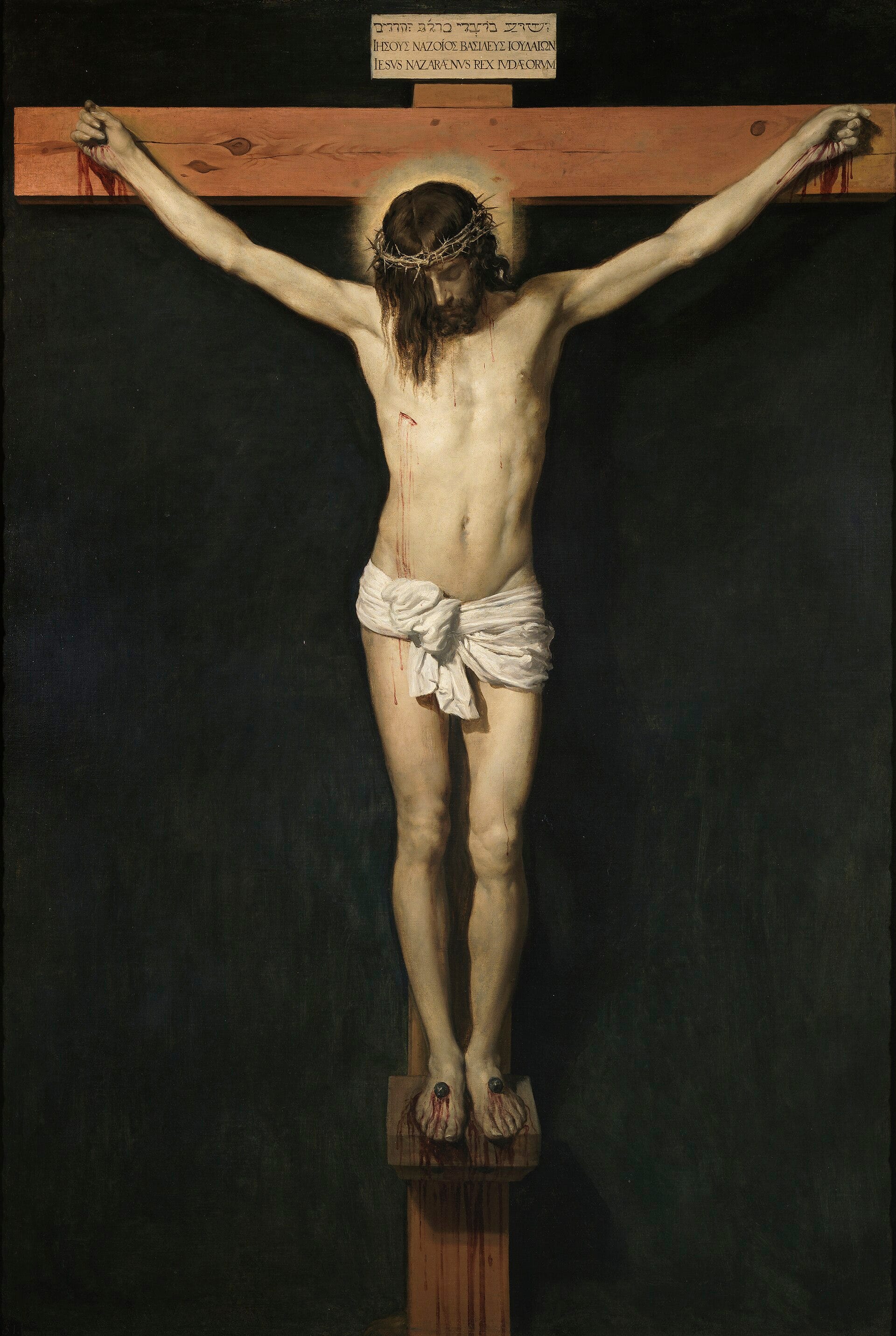
Into Your Hands (Luke 23:44–49)
The psalms of lament provided ancient Israel with a language for moments of crisis — words to express when the body weakens, enemies close in, and God feels far away. Israel’s faithful sufferers kept turning to these prayers, confident that God listened even to the darkest cries. Jesus dies within this tradition, using its language at his final breath.
Which Psalm he draws on, however, depends on which Gospel you read. Mark and Matthew both record a cry of dereliction as Jesus’ last spoken words: “My God, my God, why have you forsaken me?” (Ps 22:1 quoted in Mark 15:34 and Matt 27:46). The weight of abandonment falls hard in those accounts.1 Luke’s account is strikingly different. Luke omits the cry of dereliction entirely. In its place, Jesus speaks three times from the cross (23:34, 43, 46), and every word is either a prayer or an act of grace. His final word is a quotation of Ps 31:5:
“Father, into your hands I commit my spirit” (Luke 23:46).
Not a cry of dereliction; a prayer of trust. The wider context of Ps 31 shows a righteous sufferer surrounded by enemies, mocked and forgotten, yet holding onto God as his refuge. The psalmist does not doubt God’s listening; he trusts in it. Luke’s Jesus dies exactly this way: not in apparent abandonment but in deliberate, filial trust.
The word “spirit” (πνεῦμα) points to the full scope of biblical anthropology. When God formed man in Gen 2:7, he breathed life into dust, and the creature became alive as a combined body and spirit. Neither alone constitutes a complete human being. When Qohelet describes death, he states that the dust returns to the earth and “the spirit returns to God who gave it” (Eccl 12:7). In biblical terms, death signifies the unmaking of that union. Jesus on the cross intentionally and willingly fulfills Eccl 12:7: he entrusts the animating spirit, God’s own breath, given at creation, back into the Father’s hands.
The picture Luke paints is not the Greek view of an immortal soul escaping a disposable body. The spirit Jesus commits to the Father is not destined for eternal disembodied existence. God holds it until the resurrection, when it returns to the body, and Jesus becomes fully alive again in the biblical sense: body and spirit united. The resurrection is not a separate miracle added to the cross. It is the completion of what Jesus began with his final prayer.
Luke’s dying Jesus is the righteous sufferer of Ps 31, trusting, praying, entrusting himself to the Father’s care. And the Father, who holds the spirit of his Son, proves trustworthy when the tomb opens on the third day.
Although if you read the whole Psalm, your perspective shifts.