

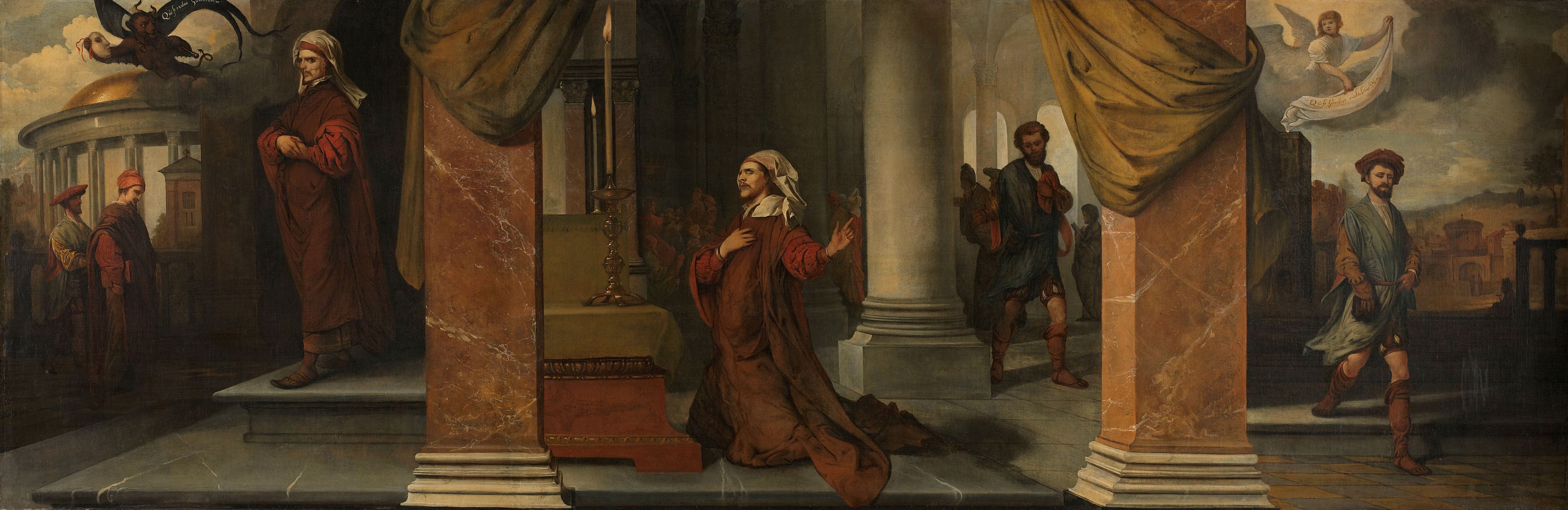
He Went Home Justified (18:9–14)
Throughout Israel’s history, the way sinners approach a holy God has remained consistent. God provides the way; the worshiper only brings their need. The extensive sacrificial system, from the tabernacle to Solomon’s Temple to the Second Temple, was based on this principle. On the Day of Atonement, the high priest entered the inner sanctuary not because of his own worth but bearing the blood of the sacrifice. No one approached the mercy seat on their own terms.
Jesus shares a parable that assumes this entire structure. He addresses it, Luke says, “to some who trusted in themselves that they were righteous, and treated others with contempt” (Luke 18:9). Two men go to the temple to pray. One brings his record with him; the other comes empty-handed.
The Pharisee’s prayer warrants careful consideration:
“God, I thank you that I am not like other men, extortioners, unjust, adulterers, or even like this tax collector. I fast twice a week; I give tithes of all that I get” (Luke 18:11–12).
His words are not shallow pretense. The Pharisee is almost certainly being honest. He fasts more than what Torah requires and tithes part of everything he gets. By every outward standard, he is exactly what Israel should be. But his prayer is directed just as much at himself as at God.
The tax collector adopts a different posture. He stands far away, refuses to lift his eyes to heaven, and beats his chest. His prayer is only six words in Greek: ὁ θεός, ἱλάσθητί μοι τῷ ἁμαρτωλῷ, “God, be merciful to me, a sinner” (Luke 18:13). The word ἱλάσθητί relates to the concepts of propitiation and atonement, the same group of words connected to the mercy seat and the entire Levitical system (cf. Lev 16:2, 13–15). Standing in the temple courts, this man offers the only prayer the temple was ever meant to receive.
The verdict comes in a single sentence:
“I tell you, this man went home justified rather than the other” (Luke 18:14).
The word is δεδικαιωμένος — declared righteous before the judge of heaven and earth. The tax collector received the verdict that the Pharisee assumed was already his.
The sacrificial system existed to say one thing: God provides the mercy; we bring only our need. The tax collector understood what every altar and offering had communicated for centuries. The Pharisee, despite his precision, completely missed it. He approached God with a full résumé and left empty-handed. The tax collector came with nothing and returned home justified.