

Come, For Everything is Now Ready (March 23, 2026)
Luke 14 never departs from the dinner table. From the moment Jesus reclines in a Pharisee’s home on the Sabbath (Luke 14:1) to the parable of the king’s messenger summoning strangers from country roads to fill his hall (14:23), the chapter presents a continuous reflection on one question: who is welcome at the feast?
The question is more than just social. It reflects Isaiah’s vision of the eschatological feast on Zion:
“On this mountain the LORD of hosts will make for all peoples a feast of rich food, a feast of well-aged wine” (Isa 25:6).
Every dinner in Luke 14 points to that eschatological feast.
Jesus arrives at the Pharisee’s table already under observation (14:1). When a man with dropsy appears, the scrutiny increases. The word Luke uses for his condition, ὑδρωπικός, appears nowhere else in the New Testament (14:2). The healing that follows isn’t so much an interruption of the meal as a preview of it: the man symbolizes every broken body that the Isaianic feast promises to restore (Isa 35:5–6; 61:1). Jesus then notices the guests vying for places of honor and shares a parable about seating that reflects the spirit of the kingdom:
“Everyone who exalts himself will be humbled, and he who humbles himself will be exalted” (Luke 14:11).
The instruction to the host sharpens the point. Do not invite those who can repay you. Invite “the poor, the crippled, the lame, the blind” (14:13), the very people Isaiah’s banquet is for. Jesus says the repayment will come at “the resurrection of the just” (14:14). The logic is entirely eschatological: Set your table now in light of the future God has promised.
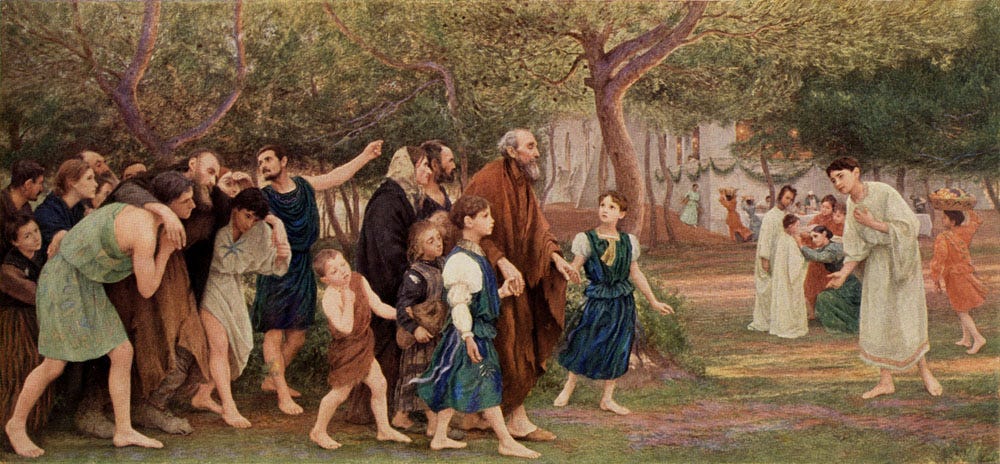
The parable of the great banquet illustrates what happens when the invitation is refused (14:15–24). The excuses given, such as a field, oxen, or a new wife, reflect the exemptions in Deut 20:5–7, provisions for men with something too important to abandon. Those who claim worldly exemptions give up the kingdom’s feast. Instead, people experiencing poverty and people with disabilities from the city streets, along with strangers from the open roads, come in.
Then, suddenly, Jesus turns to the crowds following him and raises the bar. To sit at this table, you must be willing to carry a cross (Luke 14:27). The tower builder who cannot finish is a fool. The king who cannot win is vulnerable. Half-hearted salt is useless (14:34–35). The feast is real, the invitation is open, but the banquet demands everything.
The question Luke 14 asks the reader is not whether you know that the last shall be first. The question is whether you are living as if you believe it.
My comment has nothing to do with Luke 14 but rather just an encouragement to Father Michael: Thank you for taking the time to create these daily reflections. I am learning something new daily. Having been in evangelical spaces most of my Christian life, it’s refreshing to hear from someone who has taken the time to educate himself that you might pass that along to us. I’ve begun listening to NT Wright, as well, and am relishing the wisdom and insight he brings to many cultural issues of our day. Thank you for being willing to call out our societal woes and point us back to the teachings of Christ. I believe I’m a recovering evangelical on the Canterbury Way!
Sometimes I squirm under Holy Spirit’s scrutiny of my heart and life, but I still appreciate the questions you ask us from your reading of the text.