

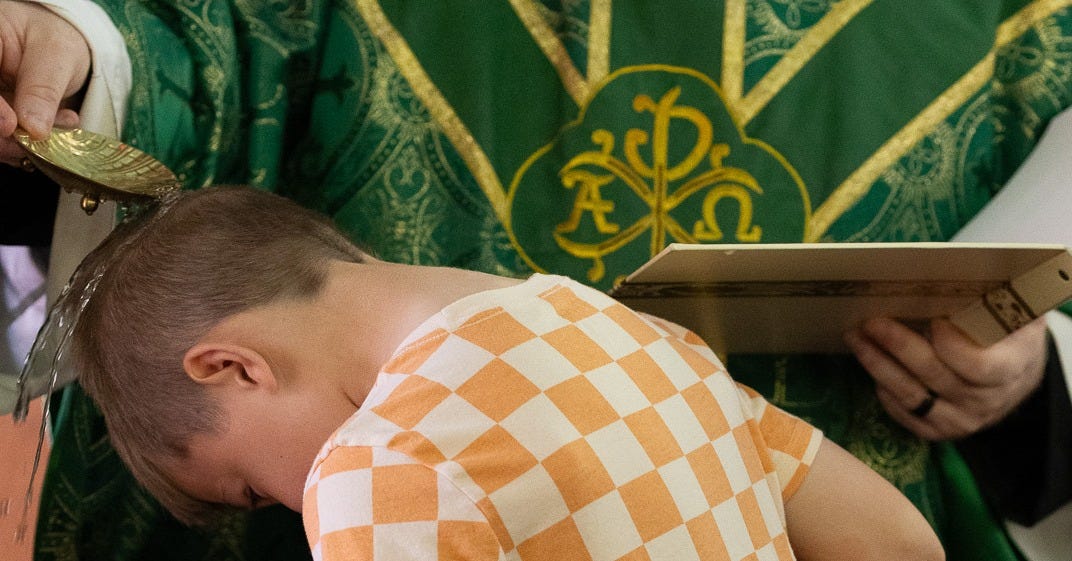
This post is a recap of the first session of our confirmation class at St. Dunstan’s Anglican Church. Whether you were there or not, whether you are a confirmand or simply someone who wants to think more carefully about what Christian faith entails, I hope this is useful. I have tried to organize the material so it flows better on the page than it did in a room with teenagers who kept pulling their legs into their shirts.
Why the 1662 Catechism?
For this confirmation course, we are studying (among other things) the 1662 Catechism of the Anglican Church — a beautifully concise expression of the Christian faith that has served the Church in its 1662 form for over three and a half centuries — and in earlier forms going back to the 1549 Prayer Book, giving it a history of nearly five hundred years. You can find a version updated by Alan Jacobs in modern English here.
I want to explain why I prefer the 1662 catechism because that choice communicates an important understanding of what Anglicanism is (at least as I see it) and our goals in confirmation.
The 1662 Catechism is surprisingly brief. Compared to Luther’s catechisms or the Westminster Confession, its restraint becomes instantly clear. The Anglican tradition has historically emphasized what truly matters—the core of Christian faith and life—and has let those essentials speak for themselves without unnecessary elaboration.
The catechism covers five main topics. First, what happened at your baptism — your entry into the life of Christ and the Church. Second, what Christians believe — summarized in the Apostles’ Creed. (The Apostles’ Creed has always been the traditional creed of baptismal instruction in the Western church; the Nicene Creed, which Anglicanism also affirms, belongs to the Eucharistic liturgy rather than the catechism.) Third, how Christians are called to live — the Ten Commandments and our Lord’s summary of the Law. Fourth, how and why Christians should pray, and this is where the catechism often surprises people. Here, the catechist pauses and shares something (rather than just asking questions) before moving on to prayer.
My young friend, please understand this: that you are not able to do these things with your own strength, or to walk in the Commandments of God, and to serve him, without his special grace. So you must learn at all times to call for that grace through prayer.
Only then does the catechist ask for the Lord’s Prayer. The sequence is deliberately theologically structured: here is what you must believe, here is how you should live — and now, before we proceed further, you need to understand that none of this is possible without God’s grace, so demonstrate that you know how to ask for it. The last section, added after the original version, discusses the dominical (i.e., Christ-originated) sacraments.
These five elements — Baptism, the Creed, the Commandments, the Lord’s Prayer, and the Sacraments — are not random. They encompass the entire Christian life: who you are, what you believe, how you are called to live, how you are called to pray, and how God encounters you in the sacramental life of the Church. Everything else flows from these.
The Anglican tradition has always viewed brevity and beauty not as compromises but as core principles. When the Book of Common Prayer was initially developed, its creators drew heavily on Scripture for its wording, weaving together the different accounts and apostolic writings so that God’s people could pray the very words of Jesus and his apostles. The prayer book has even been affectionately called “Scripture rearranged.”
The idea was that when we pray the words of Scripture, we are standing on the most solid ground possible. It has been noted that a person who faithfully prays the BCP throughout a year will have prayed or heard the vast majority of Scripture — not as a study tool but as the core language of worship. Brevity and beauty are not accidents but intentional choices — a conscious effort to let Scripture’s words work without too much human interference.
That is the spirit with which we are approaching the catechism and confirmation.
What Happened at Your Baptism
The catechism starts with baptism, and so do we.
After observing that (traditionally) you received your name at your baptism — a practice still followed in some traditions today, and significant because your name identifies who you are — the catechism asks what occurs at that moment. The answer is threefold.
I was made a member of Christ, a child of God, and an inheritor of the kingdom.
These are not three unrelated facts that just happen to be listed together. There is a reasoning behind them, and the order is important.
The most important thing is that you are made a member of Christ—that is, you are united to him. You are incorporated into the one who is the Son of God, the heir of all promises. This is the foundation on which everything else is built. The New Testament emphasizes this repeatedly: all of God’s promises find their “yes” in Jesus Christ. He is the one descendant of Abraham, Isaac, and Jacob in whom all covenant promises are fulfilled. When you are united with Christ, you become— as Paul says—a fellow heir. Not because of your own lineage or merit, but because you are in him.
Because you are in him, you become a child of God. This is adoption language. It is worth distinguishing two different senses in which the Bible speaks of divine sonship. In one sense — the creational sense — all human beings are God’s offspring, made in his image (cf. Acts 17:28; Luke 3:38). But the New Testament uses “child of God” in a deeper, redemptive sense to describe those who are united to Christ through faith and baptism. It is this adoptive sonship that the catechism has in view. Sonship in this sense is a status given through union with the Son. You are made a sibling of Christ; you are brought into his relationship with the Father.
And because you are a child of God, you inherit the kingdom. All that God promised — to Abraham, to David, to Israel, and to creation itself — is yours in Christ.
Everything begins with being “in Christ,” even something like sanctification. Sanctification is not about achieving something you don’t yet have. It is about becoming who you already are in Christ. Your true identity is not based on your flesh and blood, your failures, or your weaknesses. Instead, it is determined by what Jesus Christ says about you. The Christian life involves the ongoing process of becoming that person in reality, day by day. This process starts at your baptism and is reinforced through your confirmation.
Vocation, Not Checklist
Baptismal and Confirmation Promises according to the BCP 2019:
Question: Do you renounce the devil and all the spiritual forces of wickedness that rebel against God?
Answer: I renounce them
Question: Do you renounce the empty promises and deadly deceits of this world that corrupt and destroy the creatures of God?
Answer: I renounce them.
Question: Do you renounce the sinful desires of the flesh that draw you from the love of God?
Answer I renounce them.
Question: Do you turn to Jesus Christ and confess him as your Lord and Savior?
Answer: I do.
Question: Do you joyfully receive the Christian Faith, as revealed in the Holy Scriptures of the Old and New Testaments?
Answer: I do.
Question: Will you obediently keep God’s holy will and commandments, and walk in them all the days of your life?
Answer: I will, the Lord being my helper.
The baptismal promises are not just a list of religious rules. They outline a calling.
The baptismal liturgy states three promises made on behalf of the baptized: to renounce the devil and all his works, to believe all the articles of the Christian faith, and to follow God’s holy will and commandments. Together, these outline a way of life, a complete way of being in the world.
The point I want to emphasize is the difference between a list of moral rules (what to do and what not to do) and a vocation that stems from identity. Someone might tell you what a good Christian should and shouldn’t do, give you a checklist, and send you on your way. But that is not what happens in baptism or confirmation. In both, God is saying: “I have created you, I have redeemed you, I have united you to my Son, and I am sending you into the world for a purpose. Your main calling in life comes from what I have done for you.”
You have secular vocations—jobs, callings, roles in families and communities—all of which matter, and all of them can be expressions of your God-given humanity. But your primary vocation flows from your baptism because your primary identity comes from who you are in Christ.
Confirmation, then, is more than just a graduation ceremony. It is the moment when you stand up and say: I understand what was entrusted to me at my baptism, and I accept it. I make these promises on my own, and I recognize that my vocation as a child of God begins here.
The Big Story: God’s Homecoming
All of this only makes complete sense when you understand the larger story of Scripture — the story into which baptism places you.
So, what is the Bible about? It is not, at its core, about how people can go to heaven when they die. That is a Platonic idea, not a biblical one. The story of the Bible is about God’s desire to dwell with his people. And the movement of that story is not humanity ascending to God — it is God descending to humanity.
Creation (Genesis 1–2). The opening verses of Scripture establish the foundation:
In the beginning, God created the heavens and the earth. The earth was without form and void, and darkness was over the face of the deep. And the Spirit of God was hovering over the face of the waters (Gen 1:1–2).
Genesis 1 and 2 are best understood as a temple narrative. When you see the separation of waters, land emerging from chaos, and an image placed within the space, you are in the realm of ancient Near Eastern temple language. The Temple is where a god’s spirit resides. Creation, therefore, is the process of building the space where God plans to dwell with humans. And indeed, God walks in the garden with Adam and Eve (Gen. 3:8). That is the story’s opening condition: God dwelling with humanity.
The Fall (Genesis 3). They sin and are exiled from the garden. The connection between God and humanity is broken. The rest of the story shows how God restores this connection by coming to humanity, not humanity going to God.
The Tower of Babel (Genesis 11). Humanity, having been cut off from God, tries to reconnect on its own terms — building a tower to heaven (Gen. 11:4), with humans ascending instead of God descending. God refuses. He confuses the languages, scatters the nations, and then does something different: he calls one man.
Abraham (Genesis 12). God chooses one family to be the way he will restore the world:
I will bless you and make your name great, so that you will be a blessing...and in you all the families of the earth shall be blessed (Gen 12:2–3).
The covenant isn’t an end in itself — it’s the means of restoration. However, God still does not dwell with his people. The patriarchs have encounters with God — Jacob’s Ladder (Gen 28:10–17), the wrestling at the ford (Gen 32:22–32) — but these are moments of contact, not the fully restored dwelling.
The Exodus and the Tabernacle (Exodus). The people are slaves in Egypt. God frees them — not just to escape slavery, but so they can worship. As he explicitly tells Pharaoh: Let my people go, that they may serve me (Exod. 8:1). They gather at Sinai, receive the Law, and are given detailed instructions to build the Tabernacle — the portable sanctuary where God will dwell among them on their journey.
Let them make me a sanctuary, that I may dwell in their midst (Exod 25:8).
Why is the Tabernacle important? Because God is once again going to dwell with his people. And when it is finished, the book of Exodus concludes with one of the most dramatic moments in all of Scripture.
The cloud covered the tent of meeting, and the glory of the Lord filled the tabernacle. And Moses was not able to enter the tent of meeting because the cloud settled on it, and the glory of the Lord filled the tabernacle (Exod 40:34–35).
There is so much glory that it leaves no room for a human being. But notice what this moment truly is: it is the conclusion of the narrative arc that began in Genesis 1. The Spirit of God was hovering over the formless void. God brought order and life from chaos. He placed his image in the garden and walked with his people. Then sin shattered that communion, and the story has been pushing forward ever since toward one question: Will God dwell with his people again?
The ending of Exodus answers that question. He does. The glory fills the Tabernacle, and God is once again dwelling among his people. The story is not over, but an important chapter has been written: the God of creation has not abandoned his world. He is on the move, and he is coming home.
The Temple (2 Samuel 7; 1 Kings 8). The people wander. They enter the land. They ask for a king. David — the man after God’s own heart (as Samuel declares in 1 Sam. 13:14, a word fulfilled when David is anointed in ch. 16) — says he wants to build God a permanent house. The prophet Nathan initially agrees, then comes back and says: God told me something. You are not going to build me a house. I am going to build you a house.
I will raise up your offspring after you...and I will establish his kingdom. He shall build a house for my name, and I will establish the throne of his kingdom forever (2 Sam 7:12–13).
God’s response to David’s wish to build a temple is to promise a son through whom God himself will dwell.
Solomon constructs the Temple. The Ark of the Covenant is brought inside. And in 1 Kings 8 — once again — the cloud fills the house of the Lord, and the glory of the Lord fills the house of the Lord, so much so that the priests cannot stand to serve because of the cloud (1 Kgs 8:10–11). That much glory. Solomon prays over the Temple and asks the question that lies at the core of the entire story:
But will God indeed dwell on earth? Behold, heaven and the highest heaven cannot contain you; how much less this house that I have built (1 Kgs. 8:27).
And yet — God’s desire is exactly this: to dwell with his people here. Also, notice how Solomon, in the same prayer, immediately links the filling of the Temple to the promise God made to David (1 Kgs 8:22–26): the place where God dwells and the promised Son of David are connected from the beginning.
The Departure of the Glory (Ezekiel 10–11). The people sin. The prophets warn them. And then, in Ezekiel 10 and 11, one of the most devastating passages in all of Scripture: the glory of God rises up from the Temple—
The glory of the Lord went out from the threshold of the house (Ezek. 10:18).
—and departs to the east. God departs. The people go into exile. Throughout all of Second-Temple Jewish literature—whether it’s the rebuilding of the Temple by the returning exiles under Ezra and Nehemiah, the Maccabees, or Herod’s grand renovation—the one thing that never happens is the return of the glory. The story remains unfinished. God created the world to dwell with his people; that connection was broken, and it has not yet been restored.
Jesus, the True Temple (John 1:1–14; 2:19–21). John starts his gospel: “In the beginning” (John 1:1). Deliberately, unmistakably, he echoes the opening words of Genesis. He is indicating that a new creation story is beginning. And he tells us in verse 14 that the Word — through whom all things were made — became flesh. The Greek word translated as “dwelt” is σκηνόω (skēnoō) — the word for pitching a tent, related to the Tabernacle. And how does verse 14 end?
And we have seen his glory, glory as of the only Son from the Father, full of grace and truth (John 1:14).
The glory that left the Temple has returned. Jesus himself makes the identification explicit:
Destroy this temple, and in three days I will raise it up (John 2:19).
John notes: “he was speaking about the temple of his body” (John 2:21). Jesus is the true Temple. He is the place where God’s Spirit now dwells. He is the place where God’s glory fills the world.
And then Jesus goes to the cross. What keeps God from dwelling with humanity? Sin. Jesus deals with sin on the cross—bearing the full weight of human rebellion and its consequences. He rises from the dead, ascends to heaven as Lord of the world (Acts 1:9–11), and then pours out his Holy Spirit on his people.
Pentecost (Acts 2). Now, carefully observe how Luke describes what occurs, because the echoes are intentional.
When the day of Pentecost arrived, they were all together in one place. And suddenly there came from heaven a sound like a mighty rushing wind, and it filled the entire house where they were sitting. And divided tongues as of fire appeared to them and rested on each one of them. And they were all filled with the Holy Spirit (Acts 2:1–4).
Notice the sequence: first, the sound fills the house — the building, the room, the space — and then the Spirit rests on each person and fills them individually. This is not accidental. Luke is writing in the tradition of Exodus 40 and 1 Kings 8. In both of those earlier moments, the glory of God fills the structure first — the Tabernacle, then the Temple. Now, at Pentecost, the Spirit fills the room, and then fills the people. The people are the new Temple. God is not upgrading the building; he is changing what the building is. The dwelling place of God is no longer made of cedar and stone. It is made of flesh and blood, gathered in the name of Jesus.
What is meant to fill the Temple? The Spirit and God’s glory. What has God done now? He has made his people into temples.
Do you not know that your body is a temple of the Holy Spirit who is in you, whom you have from God? (1 Cor 6:19).
This isn’t merely a metaphor. It is a real statement about where God now resides — the indwelling of the Spirit is not illustrative but actual. The analogy to the Temple is the vehicle; the reality it points to is genuine.
Paul reiterates this in 2 Corinthians, and it’s worth pausing to observe what he’s doing here.
We are the temple of the living God; as God said, “I will make my dwelling among them and walk among them” (2 Cor 6:16).
The words Paul quotes mainly come from Leviticus 26:11–12 — God’s promise to Israel that he would dwell among them and walk with them — and from Ezekiel 37:27, where God reaffirms this promise in the context of Israel’s restoration after exile. Paul is not creating a new idea. He is saying that what the Law promised and what the prophets looked forward to is now fulfilled in the Church, the community of people indwelt by God’s Spirit. The entire story of the covenant — God’s long-standing desire to live with his people — finds its fulfillment here. The Church is the community of Spirit-indwelt temples, the place where God’s glory is present in the world and intended to shine outward.
The Final Homecoming (Revelation 21–22). And where does the story end?
Then I saw a new heaven and a new earth...And I saw the holy city, new Jerusalem, coming down out of heaven from God (Rev 21:1–2).
Not humanity ascending. Heaven descending. And the voice from the throne:
Behold, the dwelling place of God is with humanity. He will dwell with them, and they will be his people, and God himself will be with them as their God. He will wipe away every tear from their eyes, and death shall be no more (Rev. 21:3–4).
Notice, too, that in the new creation, there is no Temple building:
I saw no temple in the city, for its temple is the Lord God the Almighty and the Lamb (Rev 21:22).
And notice what John tells us about the city’s shape. The New Jerusalem measures equally in length, width, and height — twelve thousand stadia in each direction (Rev. 21:16). It is a perfect cube. This connection is not a coincidence. The Holy of Holies in Solomon’s Temple — the innermost sanctuary, the very place where the glory of God dwelt, the place no one could enter except the high priest once a year — was also a perfect cube: twenty cubits long, twenty cubits wide, twenty cubits high (1 Kgs. 6:20).
John is telling his reader that in the new creation, the entire city is the Holy of Holies. The whole of the new creation is the Most Holy Place. There is nowhere you can go that is not the immediate presence of God. The Temple and the city are one and the same. God himself is the Temple. The whole of the new creation is the place where God dwells with his people — filled with his glory, as the waters cover the sea (cf. Hab. 2:14).
What This Means for You
The story of the Bible is not about souls escaping earth to live with God forever somewhere else. It is about God coming to fill his world with his glory and to dwell with his people forever.
As a baptized Christian, you are the firstfruits of that reality. You are the place where God’s Spirit now resides in the world. You are a small, mobile temple — not in any mere metaphorical way, but in the most literal theological sense. God’s love, God’s mercy, God’s presence, and God’s kingdom ethics: these are to be expressed into the world through you.
This truth is what confirmation is about. The bishop will lay hands on you and pray for the strengthening of the Holy Spirit — another blessing from the one who already lives in you, for a life of service in God’s story. When you say I do to those promises, you are not just checking a box. You are enlisting in the project.
Everything about the Christian life — vocation, obedience, prayer, sacraments, service, suffering — originates from this story. The story isn’t about fire insurance. It’s about God’s desire to be with his people and his resolve, at any cost, to make that happen.
We are not there yet. But before that day comes, he has made little temples — little moveable places where his Spirit dwells — and sent them into the world he loves. That is who you are.